
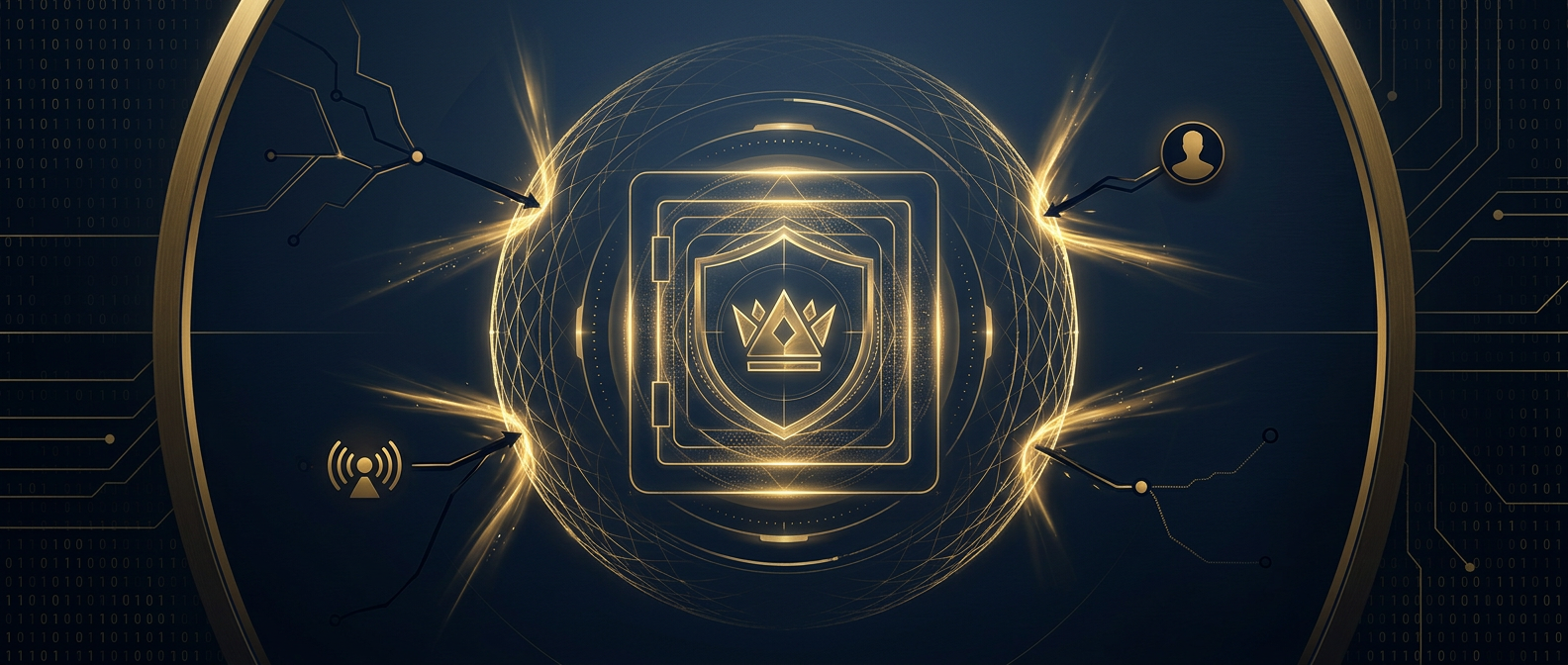
A corporate counterintelligence program is the disciplined, standing capability that detects and defeats hostile efforts to collect your firm’s secrets — from competitors, foreign intelligence services, insiders, and criminal actors. It combines information protection, technical surveillance countermeasures (TSCM), insider-risk management, and travel operational security into one governed function. Unlike ordinary security, which guards doors and networks, counterintelligence assumes you are already a target and works to identify, deceive, and neutralize the collector.
Most mid-market and even large private firms have no chief security officer, no counterintelligence function, and no idea who is collecting against them. Yet they hold exactly what a rival, a foreign state-linked entity, or a departing insider wants: pricing models, M&A pipelines, source code, clinical data, deal terms, litigation strategy, and the personal patterns of principals. The threat is not hypothetical — the FBI has publicly warned that economic espionage and trade-secret theft cost U.S. companies staggering sums annually. This guide is written for the general counsel, founder, family-office principal, or board director who owns risk but has no dedicated security organization. It explains what corporate counterintelligence genuinely is, who is collecting against you, and how to stand up a credible program — TSCM, insider risk, information protection, and travel OPSEC — without first building a department.
What is corporate counterintelligence, and how is it different from security?
Security is defensive and static: it raises walls — locks, guards, firewalls, badge readers — and waits. Counterintelligence (CI) is adversary-focused and active: it starts from the assumption that a capable collector is already interested in you, and it works to answer three questions security never asks — who wants our information, how would they get it, and how do we detect and defeat that collection before it succeeds? Security protects assets; counterintelligence protects secrets against a thinking, adaptive human adversary who studies your defenses and looks for the seam.
The distinction matters because the two require different mindsets, and buying more of the first will never deliver the second. A firm can pass every penetration test and still hemorrhage its crown jewels through an elicited conversation at a conference, a compromised executive laptop seized at a border, a listening device in a boardroom, or a trusted engineer walking out with the source repository. The table below maps the difference that sophisticated buyers must internalize.
| Dimension | Conventional security | Counterintelligence |
|---|---|---|
| Posture | Defensive, reactive | Adversary-focused, proactive |
| Core question | Are we protected? | Who is collecting against us, and how? |
| Focus | Assets, facilities, networks | Secrets, people, methods of collection |
| Threat model | Opportunistic intruder | Trained, patient, adaptive collector |
| Human dimension | Access control | Elicitation, recruitment, insider risk |
| Technical dimension | Firewalls, cameras, alarms | TSCM sweeps, device hygiene, signals discipline |
| Success measure | No breach detected | Collection attempts detected and defeated |
Who is actually trying to collect against your firm?
You cannot defend against a threat you refuse to name. Credible counterintelligence begins with a sober threat assessment of who has the motive and means to target your specific business. For most firms, the collector falls into one of five profiles — and the right program is calibrated to which ones actually apply to you.
Competitors and competitive-intelligence hired guns
The most common and most underestimated collector. Rivals rarely break the law themselves; they retain “competitive intelligence” firms whose tradecraft ranges from legitimate open-source research to aggressive pretexting, elicitation of your staff at trade shows, and cultivation of disgruntled insiders. The target is pricing, roadmap, capacity, and deal pipeline.
Foreign intelligence and economic espionage
If your firm holds advanced technology, controlled research, critical-infrastructure knowledge, or sensitive government-adjacent work, you are a plausible target for state-linked collection. The U.S. National Counterintelligence and Security Center (NCSC) has repeatedly documented systematic foreign efforts to acquire American intellectual property through cyber intrusion, insider recruitment, joint ventures, and academic and travel-based collection.
Insiders — the trusted, the departing, and the recruited
The insider is the collector’s preferred vector because they already hold legitimate access. This includes the departing employee who copies the client list, the engineer who is quietly on a rival’s payroll, and the ordinary staffer who is elicited or coerced without ever realizing they are a source. Insider risk is where counterintelligence and workforce trust intersect.
Criminal and financially motivated actors
Ransomware crews, business-email-compromise rings, and data brokers collect to monetize. Their interest in your secrets is transactional, but the exposure — leaked credentials, exfiltrated files, extortion — is identical to espionage in its consequences.
Activists, litigants, and hostile investigators
Adversaries in litigation, activist campaigns, or contested transactions run their own collection — surveillance of principals, dumpster-level document recovery, and social engineering — to gain leverage. The method is intelligence collection even when the motive is not espionage.
What does a counterintelligence program actually protect?
A program that tries to protect everything protects nothing. The first act of real counterintelligence is to identify the “crown jewels” — the handful of information assets whose loss would materially damage the enterprise — and concentrate protection there. For most firms this is a short, uncomfortable list: the pricing and margin model, the M&A or fundraising pipeline, unfiled intellectual property and source code, customer and supplier terms, litigation and regulatory strategy, and the personal and travel patterns of the principals. Everything downstream — who may access it, where it lives, how it moves, and how you would know it left — flows from that inventory.
Information protection is therefore not a document-classification exercise for its own sake; it is the disciplined mapping of your genuine secrets to the specific people, systems, rooms, conversations, and journeys through which a collector could reach them. Frameworks such as the controlled-information safeguards published by the National Institute of Standards and Technology (NIST) give a defensible structure for this, but the judgment about what is truly a crown jewel is a business decision that cannot be outsourced to a checklist.
How do you build a counterintelligence program without a CSO?
You do not need a security department to have a serious counterintelligence posture. You need a defined owner, a threat-driven scope, and a small number of disciplined practices executed consistently — augmented by outside specialists for the technical work. The following framework is how an elite firm stands up a program for an organization that has no CSO.
- Assign ownership and legal cover. Name a single accountable executive — often the general counsel — and run the program under legal privilege where appropriate. Counterintelligence touches employees and privacy; it must sit on a documented, lawful foundation from day one.
- Run a threat and crown-jewel assessment. Identify who realistically collects against you (the five profiles above) and the short list of assets worth protecting. This scoping is what keeps the program proportionate and affordable.
- Map collection pathways. For each crown jewel, trace every route a collector could take — a person, a device, a vendor, a conversation, a facility, a trip — and rank them by likelihood and impact.
- Harden information protection. Apply access minimization, need-to-know compartmentation, device and data-egress controls, and clean-desk and disposal discipline to the crown jewels specifically, not the whole estate.
- Stand up insider-risk management. Fuse behavioral indicators with technical monitoring (DLP/UEBA) under strict HR, legal, and privacy guardrails, with a documented investigation and escalation workflow.
- Institute a TSCM cadence. Schedule technical surveillance countermeasure sweeps of sensitive spaces on a risk-based rhythm and before high-stakes events — board meetings, negotiations, earnings preparation.
- Build travel and event OPSEC. Give traveling principals a repeatable protocol for high-risk destinations, conferences, and hostile jurisdictions (covered below).
- Establish detection and response. Define what a collection attempt looks like, who receives the report, and how the firm responds — including preservation of evidence for potential civil or criminal action.
- Exercise, measure, and adapt. Test the program with realistic scenarios, track attempted-collection indicators, and revise as the threat and the business change.
Notice that only two of these steps are equipment-driven. The rest are governance, judgment, and discipline — which is exactly why a program can be commanded by a small internal owner working with an outside partner, rather than requiring a standing department.
What is TSCM, and when do you actually need a sweep?
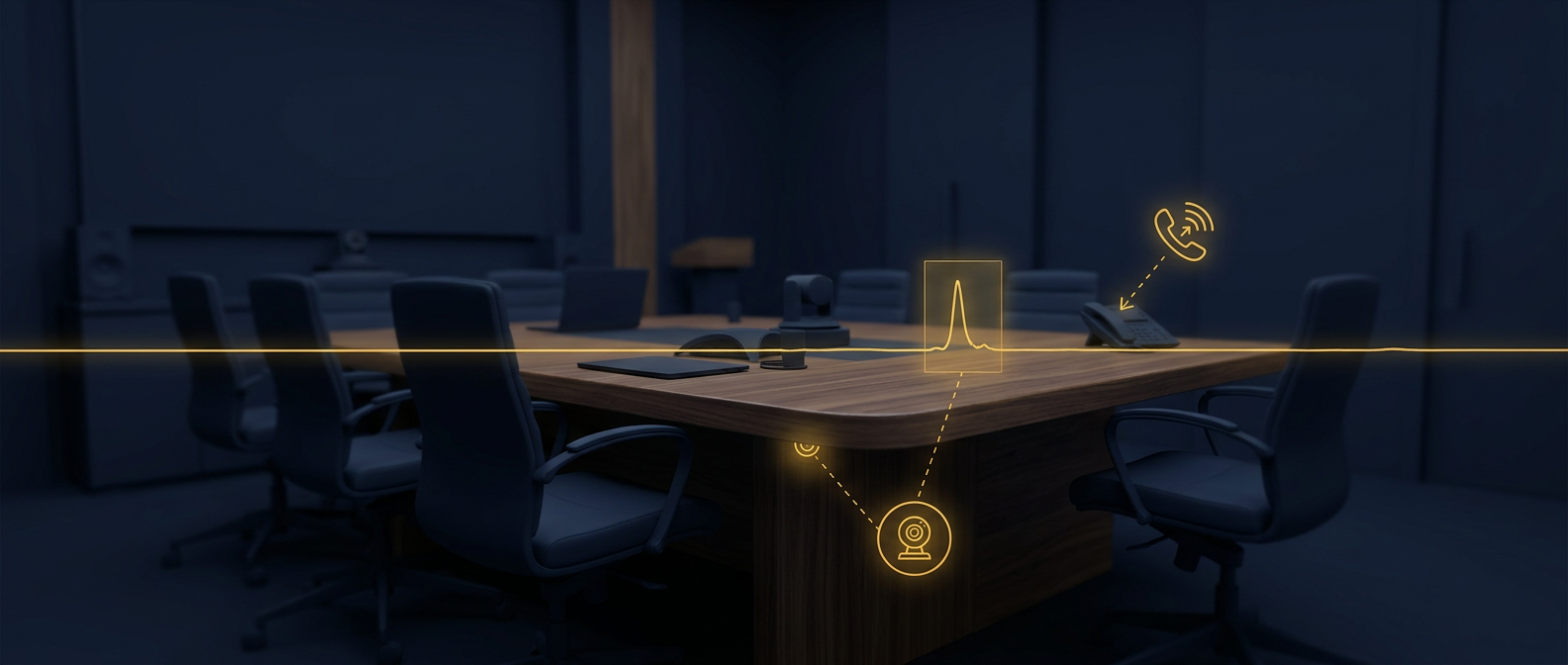
Technical surveillance countermeasures (TSCM) — commonly called a “bug sweep” — is the physical and electronic inspection of a space to detect eavesdropping devices, covert cameras, compromised telecommunications, and technical vulnerabilities that allow audio or data to be intercepted. Real TSCM is not a consumer “detector” waved around a room; it is a methodical inspection by trained technicians using spectrum analysis, non-linear junction detection, thermal and physical search, and telephone and network-line inspection, followed by a written vulnerability report.
You do not sweep continuously; you sweep on risk. The triggers that justify a professional TSCM inspection are specific and recognizable:
- Before high-stakes events — board meetings, M&A negotiations, litigation strategy sessions, earnings preparation, and executive off-sites.
- After a suspected compromise — a competitor or adversary demonstrably knows something they should not, or confidential terms surface externally.
- After facility access by outsiders — contractors, vendors, cleaners, or unknown visitors have had unsupervised access to sensitive spaces.
- On a periodic cadence — for permanently sensitive rooms (executive suites, boardrooms, secure conference space) on a scheduled rhythm.
- Before and during travel — hotel rooms, temporary offices, and vehicles used for sensitive discussions in higher-risk jurisdictions.
The mark of a professional sweep is not the gear on display but the report that follows: what was inspected, what was found, what remains a residual vulnerability, and what to do about it. A sweep that produces only “all clear” with no methodology and no vulnerability findings is theater.
How do you protect executives who travel?
Travel is where a principal’s information protection collapses, because it strips away the controlled environment. In transit and abroad — especially in jurisdictions with aggressive state-linked collection — devices can be imaged at borders, hotel rooms and vehicles are not private, public networks are hostile, and the executive is elicited by people who arranged to be in the room. Travel OPSEC is the discipline that restores a defensible posture on the move.
A mature travel counterintelligence protocol addresses the whole journey: a pre-trip threat brief for the destination; “clean” loaner devices carrying only trip-necessary data rather than the executive’s full digital life; disciplined use of encrypted communications and avoidance of untrusted networks and gifted electronics; awareness of elicitation and honeypot approaches; secure handling of documents and disposal; and a return protocol in which devices are treated as potentially compromised until inspected. For principals at genuine risk, this integrates with protective planning on the ground. The FBI’s counterintelligence guidance and the NCSC both stress that business travelers are a primary collection opportunity — and that preparation, not paranoia, is the countermeasure.
What separates a real CI program from security theater?
The market is full of providers who sell equipment and reassurance rather than intelligence. The difference between a credible counterintelligence capability and expensive theater is visible in how the work is scoped, executed, and reported. A serious program is threat-driven, not fear-driven; it names specific adversaries and protects specific secrets, rather than sweeping everything and reporting comfort. It integrates the human, technical, and cyber dimensions instead of selling a single service in isolation — because a collector who is blocked at the network will simply try the boardroom, the conference, or the border. It operates lawfully, with documented privilege and privacy discipline, so that findings survive legal scrutiny. And it delivers written, evidenced assessments with residual-risk findings, not verbal “all clear.” Guidance from bodies such as the U.S. Cybersecurity and Infrastructure Security Agency (CISA) reinforces that insider risk and information protection are program disciplines, not one-time purchases.
How does Honeybadger deliver counterintelligence?
Honeybadger Solutions builds and commands counterintelligence programs for firms that have no CSO — owning the threat assessment, crown-jewel mapping, and governance, then integrating the technical and human disciplines under one accountable engagement. Our digital forensics, cybersecurity, financial-investigation, and background-intelligence capabilities are handled in-house and delivered globally, which lets us connect signals that single-service vendors miss: a suspicious data-egress event to a departing insider, an elicited conversation to a competitor’s collection campaign, a compromised travel device to an exfiltration attempt. This work is delivered through our investigations, intelligence, and security consulting practices as a single coordinated program.
Based in Arizona with offices in Casa Grande, Phoenix, and Oro Valley, we serve principals and organizations across all of Arizona, nationwide, and internationally. TSCM inspections, executive protection, and on-the-ground travel security are executed through our commanded, vetted-partner network — with established theaters in California, Texas, and Florida and other regions served on a mandate basis — directed from Arizona home command and integrated with our in-house intelligence and cyber work. For firms standing up an insider-risk and counterintelligence capability for the first time, the result is a defensible, threat-driven program rather than a pile of disconnected services.
Frequently asked questions
Does a mid-sized company really need counterintelligence?
If your firm holds secrets a competitor, foreign entity, insider, or litigant would value — pricing models, IP, deal pipelines, source code, client terms — then yes. Counterintelligence is not about size; it is about whether you hold information worth collecting. Most breaches of trade secrets happen at firms that assumed they were too small or too obscure to be a target, which is precisely what makes them attractive.
What is the difference between a bug sweep and TSCM?
“Bug sweep” is the informal term; TSCM (technical surveillance countermeasures) is the professional discipline. Real TSCM uses spectrum analysis, non-linear junction detection, physical and thermal search, and line inspection performed by trained technicians, and it ends in a written vulnerability report. A consumer “detector” or a verbal all-clear with no methodology is not TSCM — it is theater that provides false confidence.
Can you build a program if we have no security team?
Yes — that is the common case. A counterintelligence program is commanded by a single accountable owner (often the general counsel) supported by outside specialists for the technical work. We provide the threat assessment, crown-jewel mapping, governance, insider-risk workflow, TSCM cadence, and travel protocols, so you get a disciplined capability without first hiring and building a department.
Is counterintelligence work legal, and how do you keep it defensible?
Done correctly, yes. Counterintelligence touches employees, devices, and privacy, so it must be scoped under legal counsel, run with documented privacy and HR guardrails, and, where appropriate, conducted under legal privilege. We build every program on that lawful foundation and preserve evidence to defensible standards, so that any finding can survive scrutiny in a boardroom, a courtroom, or a regulatory review.
About Honeybadger Solutions
Honeybadger Solutions is an Arizona-licensed security and investigations firm delivering intelligence-led counterintelligence, investigations, protection, and cyber services to executives, families, and organizations nationwide and internationally. Digital forensics, cybersecurity, financial investigations, and background intelligence are handled in-house and delivered globally. TSCM, physical, and executive protection are delivered through a commanded vetted-partner network with established theaters in California, Texas, and Florida, directed from Arizona home command.
Offices: Casa Grande (HQ), Phoenix, and Oro Valley, Arizona.
Phone: 602-725-2818
Confidential consultation: discuss a private counterintelligence or investigations engagement with our team.