

A corporate internal investigation follows a fixed sequence: intake and triage, the privilege decision, written scoping, evidence preservation and litigation hold, document and data review, interviews conducted outward-in, credibility analysis and findings, then remediation and closure. The order is not cosmetic. Preserving evidence before anyone is alerted, and settling privilege before the first email is sent, are what make the final record defensible in litigation, arbitration, or a regulatory audit.
Most published guidance explains whether to investigate and who should do it. This is the operational counterpart: the actual workflow, step by step, in the order an elite investigations team executes it. Each phase has an owner, a deliverable, and a set of decisions that cannot be deferred. Getting the sequence wrong—interviewing the subject before imaging the laptop, or writing a report before deciding who it is for—is how organizations convert a manageable problem into their opponent’s best exhibit.
What Does the Investigation Workflow Look Like End to End?
Before the individual steps, it helps to see the whole arc. A well-run internal investigation is a relay, not a scramble: each phase produces a deliverable that the next phase depends on. The table below maps the standard workflow—who owns each stage, roughly how long it takes for a mid-complexity matter, and what it must produce before the process advances.
| Phase | Primary owner | Typical duration | Required deliverable |
|---|---|---|---|
| 1. Intake & triage | Counsel / HR lead | First 24–48 hours | Verbatim complaint record, severity assessment, interim-measures decision |
| 2. Privilege decision | General counsel / outside counsel | Day 1, before any collection | Written engagement framing legal purpose; investigators named as counsel’s agents |
| 3. Scoping & plan | Lead investigator + counsel | Days 1–3 | Written scope: allegations, standards, custodians, witnesses, timeline |
| 4. Preservation & hold | Digital forensics + IT/legal | Days 1–5 (starts immediately) | Litigation hold issued; forensic images captured; evidence log opened |
| 5. Document & data review | Investigators / forensic analysts | Days 3–14 | Reconstructed factual timeline from records, not memory |
| 6. Interviews (outward-in) | Lead investigator + notetaker | Days 10–20 | Documented interviews: reporter, witnesses, subject last |
| 7. Analysis & findings | Lead investigator | Days 18–25 | Credibility analysis; findings on preponderance standard |
| 8. Report & remediation | Counsel + HR / leadership | Days 20–30 | Report in counsel-specified format; corrective action; closure + retaliation watch |
Durations are illustrative for a single-complaint matter; enterprise fraud, cross-border conduct, or multi-witness harassment inquiries run longer. The non-negotiable is the order—particularly that preservation begins on day one and interviews come only after the documentary record is built.
Step 1: Complaint Intake and the First 24–48 Hours
The clock starts the moment a credible report reaches someone with authority to act—a manager, HR, an ethics hotline, or the board. What happens in the first two days disproportionately shapes whether the eventual record is credible. The intake phase is not about solving the case; it is about capturing the allegation cleanly and stopping harm without prejudging.
- Capture the complaint verbatim. Record exactly what was alleged, by whom, against whom, when, and how it surfaced—in the reporter’s own words. Do not paraphrase into conclusions. This contemporaneous record becomes a fixed reference point that later testimony is measured against.
- Assess severity and urgency. Screen for safety risk, threats or workplace violence, ongoing financial loss, regulatory reportability, and the seniority of the subject. Severity determines whether this is an HR conversation or a formal, privileged investigation.
- Screen for immediate risk. Identify any flight risk, evidence-destruction risk, or witness-intimidation risk. If the subject controls the systems that hold the evidence, that risk is acute and drives preservation timing.
- Decide on interim measures. Consider paid administrative leave, suspension of system and building access, or separating the parties. Frame these as neutral protective steps, never as findings of guilt, and document the rationale.
- Notify the right people—and only them. Route the matter to counsel and a small, need-to-know circle. Over-notification spreads rumor, taints witnesses, and destroys the discretion the process depends on.
- Log the intake decision. Whether the matter is opened as a formal investigation or handled informally, record the decision and its basis. An undocumented “we looked into it” is indistinguishable from doing nothing.
A practical intake test for counsel: if the allegation, assumed true, would justify termination, would be reportable to a regulator such as the U.S. Equal Employment Opportunity Commission, or would embarrass the company in a headline, treat it as a formal investigation from the first hour.
Step 2: Making the Privilege Decision Before You Touch Anything
The single most consequential decision in the entire workflow is made before any evidence is collected: will this investigation be privileged, and how will that be structured? Get it wrong and every note, email, and draft finding becomes discoverable by the opposing party.
Attorney-client privilege does not attach automatically because a lawyer is in the room. It attaches when the investigation is conducted at the direction of counsel for the primary purpose of providing legal advice. The reliable structure is a written engagement from the general counsel or outside counsel that states the legal purpose, directs the inquiry, and names the investigators—internal or external—as counsel’s agents. Communications and work product created in that frame are far more defensible.
The controlling authority is the U.S. Supreme Court’s decision in Upjohn Co. v. United States, which extended privilege to communications between counsel and employees below the control group when made to secure legal advice for the company. Two operational consequences flow from it. First, every interview conducted by counsel or counsel’s agents should open with an Upjohn warning: counsel represents the company, not the individual; the conversation is privileged; and the company—not the employee—decides whether to waive that privilege. Second, if the investigation’s findings will also serve an ordinary business purpose—supporting an insurance claim, a public statement, or a routine operational fix—privilege can be waived, so the intended use must be decided at intake, not after the report is drafted. A dual-purpose investigation that fails to keep the legal purpose primary is the classic way privilege is lost.
Step 3: Scoping the Investigation and Writing the Plan
Scope is where discipline separates a targeted inquiry from a fishing expedition. Before anyone is interviewed, the lead investigator and counsel produce a written investigation plan. A defensible plan answers, in writing, the following:
- The specific allegations to be tested—stated as discrete, provable propositions, not vague concerns.
- The standards implicated—which policies, contractual terms, and legal duties the conduct would breach if substantiated.
- The custodians and data sources—whose devices, mailboxes, accounts, badge records, and financial systems hold relevant evidence.
- The witness list and provisional sequence—who is interviewed, in what order, and why.
- The timeline and checkpoints—a realistic schedule with points at which counsel reassesses scope.
- Confidentiality and communication rules—who knows, what they are told, and how updates are recorded.
A written scope keeps the inquiry proportionate and rebuts two opposite criticisms that surface later: that the investigation was a limitless fishing expedition, or that it was a deliberately narrow whitewash designed to miss the real problem. The plan is a living document—scope legitimately expands when evidence points somewhere new—but each expansion is a documented decision, not a drift.
Step 4: Evidence Preservation and the Litigation Hold
Preservation is the step most often botched and the one with the harshest consequences when it is. It begins in parallel with intake—often before the subject knows anything is happening—because the moment a person under suspicion is alerted is the moment evidence starts disappearing.
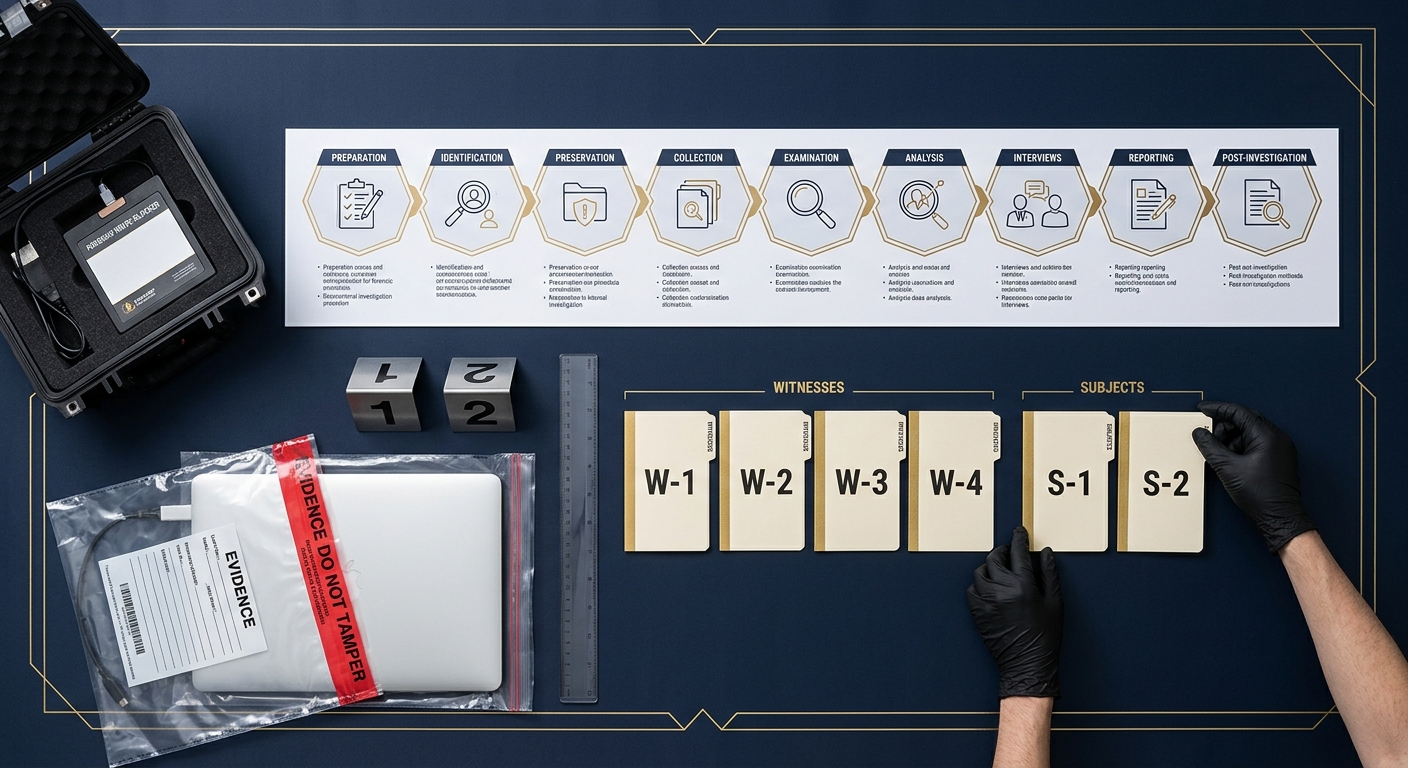
Two things happen here, and their order matters. First, issue the litigation hold. A written hold suspends routine deletion and instructs relevant custodians and IT to preserve documents, emails, messages, and data tied to the matter. Failure to do so exposes the organization to spoliation sanctions and an adverse-inference instruction—a judge telling the jury to assume the missing evidence was unfavorable. Second, capture the evidence forensically. Relevant devices and accounts are imaged before anyone browses them, because opening a file, logging into a live mailbox, or letting an active account keep running can alter or overwrite the very metadata—timestamps, deleted-file remnants, access logs—that proves the case.
This is where forensic discipline is decisive and where chain of custody begins. Every item—an imaged laptop, a badge-access export, a mailbox collection, a cash-drawer reconciliation—is acquired in a defensible manner, logged, hashed, stored securely, and made traceable from acquisition to eventual production. The methodology follows established forensic practice such as the guidance published by the National Institute of Standards and Technology. Evidence collected this way survives a Daubert challenge; a manager’s screenshots do not. This is precisely why sophisticated organizations route acquisition to a certified examiner rather than internal IT improvising under pressure—the subject of our digital forensics practice.
Step 5: Document and Data Review Before Interviews
With evidence preserved, the team reconstructs what the records show before relying on anyone’s memory. This is the phase that most distinguishes elite investigations from amateur ones. Memory is malleable, self-serving, and easily contaminated; documents, metadata, and financial flows are not.
Digital forensics traces the conduct—who accessed what, when, from where, and what was moved, deleted, or exfiltrated. Financial forensics traces the money—invoices, approvals, vendor relationships, reimbursement patterns, and ledger anomalies, work that anchors our financial investigation capability. Together they build the factual spine the interviews will test. The investigator walks into every interview already knowing the timeline, so the interview becomes a test of the subject’s account against the record rather than an open-ended fishing session that generates speculation. When a witness’s story contradicts the metadata, that contradiction—not the story—is the evidence.
Step 6: Sequencing the Interviews (Outward-In)
Interviews are conducted in a deliberate order—reporting party first, then witnesses from most to least central, then the subject last. Interviewing outward-in means that by the time the investigator sits down with the subject, the documentary picture and the corroborating accounts are already established, and the subject is responding to specific, evidenced allegations rather than a fishing expedition. Interviewing the subject too early tips them off, invites destruction of evidence and coordination of stories, and wastes the leverage that preparation provides.
- Prepare from the documents. Never interview blind. Enter each interview with the timeline, the records, and the precise questions that witness can answer.
- Use a two-person team. A dedicated notetaker lets the lead focus on the witness and creates a corroborating record of what was said—valuable when testimony is later disputed.
- Deliver the Upjohn warning. When counsel or counsel’s agents interview, state that counsel represents the company, not the individual, and that the company controls privilege. Skipping it has unwound privilege claims.
- Word confidentiality carefully. Request confidentiality to protect evidence integrity, but avoid blanket gag orders. The National Labor Relations Board scrutinizes overbroad confidentiality rules that can chill protected concerted activity; tie the request to case-specific need.
- Open questions first, then lock facts. Let the witness narrate freely, then confirm specifics. Avoid leading questions, avoid promises of confidentiality you cannot keep, and never signal the conclusion you expect.
- Give the subject a genuine hearing. Present the allegations with enough specificity to allow a meaningful response, and record it fully. A rushed or one-sided subject interview is the most common foundation for a later “the investigation was a sham” argument.
Step 7: Analysis, Credibility, and Findings
Once the record and the interviews are complete, the investigator weighs the evidence and reaches findings. Two principles govern this phase. First, the standard of proof is preponderance of the evidence—more likely than not—not the criminal “beyond a reasonable doubt.” Second, findings are stated as substantiated, not substantiated, or inconclusive, never as pronouncements of criminal guilt.
Where accounts conflict, credibility is assessed against recognized factors—corroboration by independent evidence, inherent plausibility, motive to fabricate, consistency across accounts, the presence or absence of contemporaneous records, and demeanor. Crucially, the analysis addresses exculpatory evidence and alternative explanations rather than ignoring them. An investigation that only marshals evidence in one direction reads as advocacy, and advocacy is what plaintiffs’ counsel dismantle in deposition. The mark of a professional finding is that it explains not just the conclusion but the reasoning—why one account was believed over another.
How Should the Findings Report Be Structured?
The report is written in the format counsel specifies—sometimes a full written report, sometimes an oral report to preserve privilege, depending on the matter’s litigation posture. Whatever the form, a defensible findings report contains, in order:
- Scope and mandate—the allegations investigated, who directed the inquiry, and the standard of proof applied.
- Methodology—evidence collected, custodians, interviews conducted, and the period covered, demonstrating thoroughness.
- Factual findings—the reconstructed timeline, stated as facts supported by cited evidence.
- Credibility determinations—where accounts conflicted, which was credited and the reasoning.
- Findings on each allegation—substantiated, not substantiated, or inconclusive, tied to the evidence.
- Recommendations—where the mandate calls for them, proportionate corrective options (findings and discipline decisions are usually kept separate so the fact-finder stays neutral).
The report is written as though a judge will read it, because one might. Precise language, cited evidence, addressed alternatives, and a named standard of proof turn the report from a liability into the organization’s strongest defense.
Step 8: Remediation, Closure, and the Retaliation Watch
Findings are not the finish line. The workflow closes with action and follow-through, which is often where legal exposure is either extinguished or created anew.
- Proportionate corrective action. Discipline is calibrated to the finding and applied consistently with how comparable conduct has been treated. Inconsistent discipline is itself evidence of pretext.
- Systemic remediation. Beyond the individual, fix the control gap the matter exposed—policy revisions, access controls, training, or vendor oversight—so the same failure does not recur.
- Documented closure. Record the resolution, the action taken, and the date, completing the auditable file.
- Close the loop—carefully. Inform the reporting party that the matter was taken seriously and action was taken, without over-disclosing confidential outcomes.
- Monitor for retaliation. Retaliation is now the most frequently alleged basis of charge in EEOC filings, and a mishandled aftermath is a common trigger. Actively watch the reporting party’s treatment—schedule changes, exclusion, performance criticism—for a defined period after closure.
Which Process Failures Get Cases Thrown Out?
The recurring failures are procedural, not factual, and every one traces back to breaking the sequence above:
- Alerting the subject before preserving evidence—the fastest route to spoliation and destroyed metadata.
- Interviewing before building the record—letting memory, not data, drive the case.
- No privilege decision at intake—turning the entire file into discoverable material.
- Skipping the Upjohn warning—unwinding privilege one interview at a time.
- Overbroad confidentiality directives—creating a separate labor-law violation.
- A one-sided or rushed subject interview—the foundation of the “sham investigation” defense.
- No retaliation monitoring—winning the investigation and losing the retaliation claim.
National Reach, Discreet Command
Honeybadger Solutions runs this workflow for corporate clients across Arizona, nationwide, and internationally. Our digital forensics, cybersecurity, financial investigations, and background intelligence functions are in-house and remote-by-design, so preservation and analysis can begin within hours of intake regardless of where the conduct occurred. Field and protective operations are commanded through a vetted-partner network, with Arizona as home command and established theaters in California, Texas, and Florida. From a single executive complaint to an enterprise-wide fraud scheme, the process and the standard do not change—explore our full corporate investigations and security capabilities, or reach our teams through the Phoenix office.
Frequently Asked Questions
What is the correct order of steps in an internal investigation? Intake and triage, the privilege decision, written scoping, evidence preservation and litigation hold, document and data review, interviews conducted outward-in (reporter, witnesses, then subject last), credibility analysis and findings, and finally remediation and closure. The order is deliberate: preserving evidence and settling privilege before anything else is what keeps the record defensible.
Why are interviews conducted after evidence is collected, not before? Because documents, metadata, and financial records are objective and memory is not. Building the factual timeline first lets the investigator test each account against the record and prevents the subject from being tipped off, destroying evidence, or coordinating stories before the evidence is secured.
When should the privilege decision be made? At intake, before any evidence is collected or emails sent. Privilege attaches only when the investigation is conducted at the direction of counsel for the purpose of legal advice, with investigators acting as counsel’s agents. If the findings will also serve an ordinary business purpose, privilege can be waived, so the intended use must be fixed up front.
What is an Upjohn warning and when is it given? It is the statement, given at the start of every interview conducted by counsel or counsel’s agents, that counsel represents the company—not the individual—and that the company controls whether the privileged conversation is ever disclosed. It comes from the Supreme Court’s Upjohn decision, and omitting it has caused courts to unwind privilege claims.
About Honeybadger Solutions
Honeybadger Solutions is an Arizona-licensed security and investigations firm serving all of Arizona, the nation, and international clients. We combine in-house digital forensics, cybersecurity, financial investigations, and background intelligence with a vetted network for field and protective operations. Our teams execute discreet, defensible internal investigations built to withstand litigation, arbitration, and regulatory scrutiny at every step of the process.
Three offices: Casa Grande (HQ), Phoenix, and Oro Valley. To discuss a confidential matter, book a consultation online. Learn more about our corporate and internal investigations capabilities and request a discreet consultation.
Browse by topic
Security guard services · Private investigations · Cybersecurity · Digital forensics · Financial fraud investigation · Executive protection · All articles