

Investigating a whistleblower complaint means running a defensible internal inquiry while protecting the reporter’s identity and shielding them from retaliation. Employers should preserve the source’s anonymity to the extent possible, appoint an independent investigator insulated from the accused, preserve evidence immediately under a litigation hold, apply Sarbanes-Oxley and Dodd-Frank protections, and report substantive matters to the audit committee or board. A whistleblower matter is not an ordinary HR complaint. It carries federal anti-retaliation exposure, potential regulatory reporting obligations, and a reporter who can lawfully take the same allegations to the SEC or OSHA at any moment. How the first 72 hours are handled usually determines whether the company controls the narrative or inherits an external investigation.
This guide is written for general counsel, audit committee chairs, chief compliance officers, and the boards of public and private companies alike. It covers what separates a whistleblower investigation from a routine internal one, how to handle anonymous and confidential reports without exposing the source, why independence is decisive, and how the statutory landscape—Sarbanes-Oxley Section 806, Dodd-Frank, and OSHA-administered protections—shapes every decision from intake to board reporting.
What Makes a Whistleblower Investigation Different?
Every credible complaint deserves a disciplined investigation, but whistleblower matters carry three features that ordinary workplace inquiries do not, and each one changes how the investigation must be run.
- A legally protected reporter. Federal and state statutes give whistleblowers affirmative protection against retaliation. The instant a report is made, an adverse employment action against that person—termination, demotion, schedule change, exclusion, or a sudden negative review—can become the basis of a separate, often more dangerous, retaliation claim.
- A parallel external channel. A whistleblower is never required to use the internal process. They can report directly to the U.S. Securities and Exchange Commission, the U.S. Occupational Safety and Health Administration, the Department of Justice, or a sector regulator—and under Dodd-Frank may be eligible for a monetary award for doing so. If the company mishandles the internal report, the reporter’s next call is external.
- Subject-matter that reaches the board. Whistleblower complaints frequently allege accounting fraud, securities violations, bribery, safety cover-ups, or misconduct by senior management—matters that implicate the audit committee’s direct statutory responsibility and cannot be delegated back to the people the complaint may concern.
The practical consequence: a whistleblower investigation must be simultaneously more discreet (to protect the source), more independent (to survive scrutiny), and more thoroughly documented (because a regulator may one day review it) than a standard internal matter.
Which Laws Govern Whistleblower Complaints?
Employers do not get to choose which framework applies—the nature of the allegation and the company’s structure decide it. The table below compares the three regimes that most often govern corporate whistleblower complaints in the United States. Treat it as an orientation, not legal advice; the controlling analysis for any specific matter belongs to counsel.
| Dimension | Sarbanes-Oxley §806 | Dodd-Frank / SEC Program | State & common-law |
|---|---|---|---|
| Who is covered | Employees of public companies and their contractors/subsidiaries | Individuals who report possible securities-law violations to the SEC | Employees generally, per state statute or public-policy doctrine |
| Protected conduct | Reporting fraud against shareholders, securities or mail/wire fraud—internally or externally | Reporting securities violations to the SEC (internal-only reporting may not qualify for anti-retaliation coverage) | Reporting illegal activity, safety issues, or refusing unlawful acts |
| Where a claim is filed | OSHA, within 180 days of the retaliatory act | Directly with the SEC; retaliation suits in federal court | State agency or court, varying deadlines |
| Signature remedy | Reinstatement, back pay, special damages, fees | Award of 10–30% of sanctions over $1M; anti-retaliation damages | Reinstatement, damages, sometimes punitive |
| Employer takeaway | Audit committee must maintain complaint procedures | Strong incentive for the reporter to go external; move fast internally | Retaliation exposure exists even for private, non-SEC employers |
Two structural points matter across all three. First, Sarbanes-Oxley Section 301 requires the audit committee of a public company to establish procedures for the receipt, retention, and treatment of complaints about accounting, internal controls, and auditing—including a confidential, anonymous channel for employees. Second, the Supreme Court’s decision in Digital Realty Trust v. Somers held that Dodd-Frank’s anti-retaliation protections attach to those who report to the SEC, which sharpens the reporter’s incentive to file externally. A company that responds slowly or defensively to an internal report is, in effect, pushing its own whistleblower toward the regulator. Details on the federal programs are published by the SEC Office of the Whistleblower and the OSHA Whistleblower Protection Program.
How Do You Handle an Anonymous or Confidential Report Without Burning the Source?
Protecting the reporter is not a courtesy—it is a core investigative control. A source who is exposed, or who watches a colleague get exposed, stops cooperating, and every future whistleblower in the organization learns that the hotline is a trap. Two categories require different discipline.
Anonymous reports arrive with no identified reporter—typically through a hotline or an ethics portal. They are still fully actionable and must be investigated on their merits; an allegation does not become less credible because the author withheld their name. The challenge is that the investigator cannot go back to the source for clarification, so the documentary and forensic record has to carry more of the weight. Resist the reflex to hunt for the reporter’s identity. Attempting to unmask an anonymous whistleblower is itself frequently treated as a form of retaliation and can convert a manageable inquiry into a statutory violation.
Confidential reports come from an identified person who has been promised their identity will be protected. Here the working rule is strict need-to-know: the reporter’s name is disclosed only to the smallest possible circle and only where genuinely necessary to the investigation. Practical safeguards include:
- Compartmentalize identity. Assign the matter a case number and reference the source by role or code, not by name, in working documents and interview notes.
- Interview to obscure sourcing. Structure the inquiry so the subject cannot deduce who reported by the sequence or specificity of questions. Where possible, gather corroborating evidence before any interview so the case does not visibly hinge on one person’s account.
- Control the paper trail. Store identifying information separately from the general case file, with restricted access, and route sensitive communications through counsel.
- Set expectations honestly. Tell the reporter that the company will protect confidentiality to the fullest extent possible, but that absolute anonymity cannot be guaranteed if litigation or a regulator later compels disclosure. Over-promising is its own liability.
Why Does Investigator Independence Matter So Much?
Independence is the difference between an investigation that ends a problem and one that becomes the problem. A whistleblower complaint often names—or implicates—the very people who would ordinarily oversee the response: a manager, a controller, a general counsel, sometimes the CEO. If the accused chain of command controls the investigation, the findings are worthless the moment they are challenged, and the appearance of a cover-up can be more damaging than the underlying allegation.
Independence is assessed on a ladder that rises with the seniority of the accused and the gravity of the allegation:
- Routine, lower-level misconduct may be handled by internal compliance or HR, provided they sit outside the accused’s reporting line.
- Allegations against senior management should move to outside counsel or an independent external investigator, because no internal function can credibly investigate the people who control its budget and career.
- Accounting, financial-reporting, or securities allegations belong under the audit committee, which retains its own independent counsel and forensic investigators reporting directly to the committee—not to management.
- Allegations touching the board itself require a special committee of disinterested directors with fully independent advisors.
Engaging independent digital forensics and financial investigators is not merely optics. External specialists preserve and analyze evidence to a courtroom standard, carry no institutional stake in the outcome, and can testify to a methodology that a regulator or plaintiff’s counsel cannot easily attack. This is a central reason sophisticated boards route sensitive whistleblower matters to a dedicated corporate investigations team rather than absorbing them internally.
The Whistleblower Complaint Response Framework
An elite response follows a fixed sequence. The order protects both the reporter and the record; breaking it—interviewing before preserving, or alerting management before assessing independence—is how companies forfeit control of the matter.
- Acknowledge and log within 72 hours. Record the complaint verbatim under a case number, timestamp its receipt, and—where the reporter is identified—confirm receipt without commenting on outcome. Silence reads as indifference and drives reporters external.
- Triage for severity and reportability. Screen for accounting/securities implications, safety risk, senior-management involvement, and any external reporting deadline. This screen sets the independence level and the escalation path.
- Fix privilege and independence up front. Decide whether the investigation is conducted at the direction of counsel for legal advice, and appoint an investigator insulated from everyone named. These two decisions cannot be made after the fact.
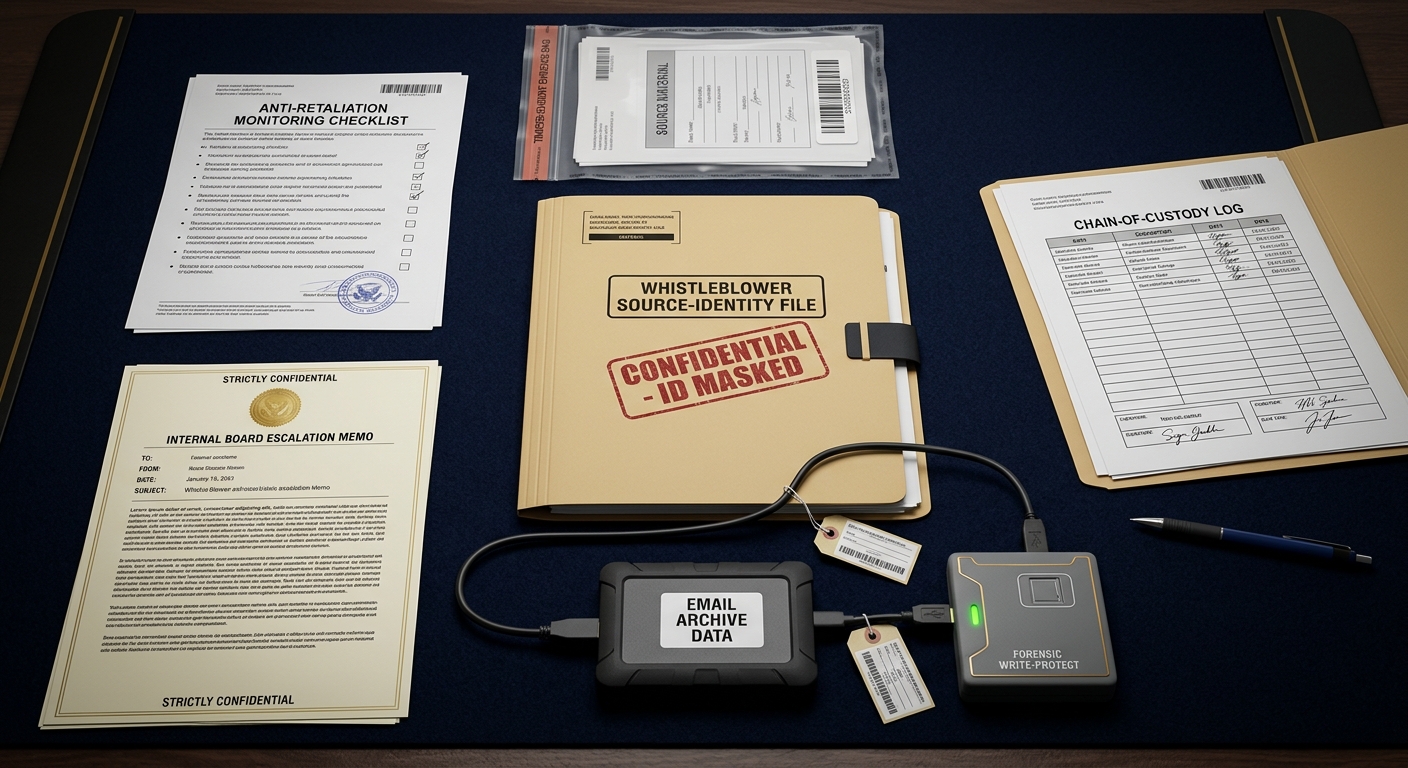
- Preserve evidence and issue a litigation hold immediately. Suspend routine deletion, forensically image relevant devices and accounts, and open a chain-of-custody log—before the subject is aware anything is happening.
- Assess and lock in reporter protection. Baseline the reporter’s employment status and put an anti-retaliation watch in place so any adverse action is caught and questioned before it is taken.
- Build the documentary record. Reconstruct the facts from data, communications, and financial records before relying on memory, and structure sourcing to shield the reporter.
- Interview outward-in. Corroborating witnesses first, the subject last, each interview prepared from the evidence and—where counsel directs—opened with an Upjohn warning.
- Reach findings on a preponderance standard. State each allegation as substantiated, not substantiated, or inconclusive, with reasoning that addresses exculpatory evidence.
- Report to the audit committee or board. Deliver findings in the format counsel specifies to the governance body that owns the matter, independent of implicated management.
- Remediate and monitor for retaliation. Apply proportionate corrective action, fix the control gap, close the loop with the reporter, and actively monitor their treatment for a defined period.
How Do You Preserve and Build the Evidence Record?
Whistleblower allegations—financial fraud, falsified records, kickbacks, data destruction—live in documents and systems, and those systems are often controlled by the people under scrutiny. Preservation therefore begins in parallel with intake and before any subject is alerted. A written litigation hold suspends automatic deletion; relevant mailboxes, devices, financial systems, and cloud accounts are then imaged forensically so that timestamps, deleted-file remnants, and access logs are captured intact rather than overwritten by casual review.
Every item is acquired defensibly, hashed, logged, and traceable from collection to eventual production. Digital forensics reconstructs who accessed and moved what, and when; financial forensics traces the money through invoices, approvals, vendor relationships, and ledger anomalies. Together they build a factual spine that does not depend on—and therefore does not expose—the whistleblower’s testimony. Evidence gathered to this standard withstands a Daubert challenge and regulatory scrutiny; a manager’s ad hoc screenshots do not. This work anchors our digital forensics and financial investigation capabilities and follows established methodology such as the guidance published by the National Institute of Standards and Technology.
How Do You Protect the Reporter From Retaliation?
Retaliation is the most common way employers lose whistleblower matters—often after the underlying allegation itself proves unsubstantiated. The company wins the investigation and loses the retaliation claim. Because retaliation can be subtle and even unintentional, it must be managed as an affirmative program, not left to good intentions.
- Baseline before anything changes. Document the reporter’s role, compensation, reviews, and standing at the moment of the report, so any later change can be measured against a fixed record.
- Gate adverse actions. For a defined period, route any proposed discipline, reassignment, negative review, or termination involving the reporter through counsel for a legitimacy check before it is executed.
- Insulate the decision-makers. Where feasible, ensure that managers making routine employment decisions about the reporter are unaware of the complaint, breaking the causal chain a retaliation claim depends on.
- Guard against unmasking. Treat any attempt to identify an anonymous reporter, or to pressure a confidential one, as a serious violation of the process.
- Watch the informal channel. Retaliation frequently arrives as exclusion, cold-shouldering, or reassignment of desirable work—not a formal action. Monitor the reporter’s day-to-day treatment, not just their pay stub.
Retaliation is now the most frequently alleged basis of charge filed with the U.S. Equal Employment Opportunity Commission, and whistleblower-specific statutes add federal remedies on top of that exposure. A structured anti-retaliation watch is the single highest-return control in the entire process.
What Does the Board or Audit Committee Need to See?
For public companies, the audit committee owns accounting and auditing complaints by statute; for private companies and nonprofits, sound governance points the same direction whenever the allegation implicates senior leadership or material risk. Board-level reporting should be timely, candid, and structured so directors can exercise informed oversight without contaminating the investigation. A defensible board report addresses, in order:
- Nature and source posture of the complaint—what was alleged, through which channel, and whether the reporter is anonymous or confidential (never the identity itself unless strictly necessary).
- Independence structure—who is investigating, to whom they report, and why that arrangement is insulated from the people implicated.
- Scope, status, and preservation—what is being examined, what evidence has been secured, and the litigation-hold posture.
- Preliminary and final findings—stated against the preponderance standard, with alternatives addressed, in the format counsel specifies to preserve privilege.
- Retaliation and reporting-obligation status—the anti-retaliation watch and any external reporting or disclosure duties triggered.
- Remediation and control-gap closure—corrective action and the systemic fix that prevents recurrence.
The report is drafted as though a regulator will one day read it, because in a serious matter one might. Precise language, cited evidence, a named standard of proof, and demonstrated independence convert the file from a liability into the organization’s strongest defense.
National Reach, Discreet Command
Honeybadger Solutions conducts whistleblower and internal investigations for corporate boards and general counsel across Arizona, nationwide, and internationally. Our digital forensics, cybersecurity, financial investigations, and background intelligence functions are in-house and remote-by-design, so evidence preservation and source-protective analysis can begin within hours of intake regardless of where the conduct occurred—and independent of the management the complaint may concern. Field operations are commanded through a vetted-partner network, with Arizona as home command and established theaters in California, Texas, and Florida. Whether the matter is a single anonymous hotline tip or an audit-committee-directed fraud inquiry, the standard does not change—explore our full corporate investigations and security capabilities, or reach our teams through the Phoenix office.
Frequently Asked Questions
Do we have to investigate an anonymous whistleblower complaint? Yes. An anonymous complaint is fully actionable and must be assessed on its merits—withholding a name does not make an allegation less credible. Because you cannot return to the source for clarification, the documentary and forensic record carries more weight. Never attempt to unmask an anonymous reporter; doing so is frequently treated as retaliation and can create a statutory violation on top of the original matter.
Can we discipline or fire a whistleblower for unrelated performance issues? Only with great caution and, ideally, counsel review. The action may be lawful if the reason is genuine, documented before the complaint, and applied consistently—but the timing alone invites a retaliation claim. Baseline the employee’s status at the time of the report and route any adverse action through a legitimacy check before executing it.
What is the difference between Sarbanes-Oxley and Dodd-Frank whistleblower protection? Sarbanes-Oxley Section 806 protects employees of public companies and contractors who report fraud, with retaliation claims filed through OSHA and remedies including reinstatement. Dodd-Frank created the SEC whistleblower program, offering monetary awards for reporting securities violations to the SEC and its own anti-retaliation cause of action. In practice, Dodd-Frank strongly incentivizes reporting directly to the regulator, which is why a fast, credible internal response matters.
When should a whistleblower complaint go to the board instead of HR? Whenever the allegation implicates senior management, involves accounting, auditing, or securities matters, or presents material legal or reputational risk. For public companies, the audit committee has a statutory duty over accounting-related complaints. An investigation of senior leaders cannot credibly be run by the functions those leaders control, so it must be elevated to an independent governance body with its own advisors.
About Honeybadger Solutions
Honeybadger Solutions is an Arizona-licensed security and investigations firm serving all of Arizona, the nation, and international clients. We combine in-house digital forensics, cybersecurity, financial investigations, and background intelligence with a vetted network for field and protective operations. Our teams run discreet, independent whistleblower and internal investigations engineered to protect the reporter and withstand litigation, arbitration, and regulatory scrutiny.
Three offices: Casa Grande (HQ), Phoenix, and Oro Valley. To discuss a confidential matter, book a consultation online. Learn more about our corporate and internal investigations capabilities and request a discreet consultation.
Browse by topic
Security guard services · Private investigations · Cybersecurity · Digital forensics · Financial fraud investigation · Executive protection · All articles