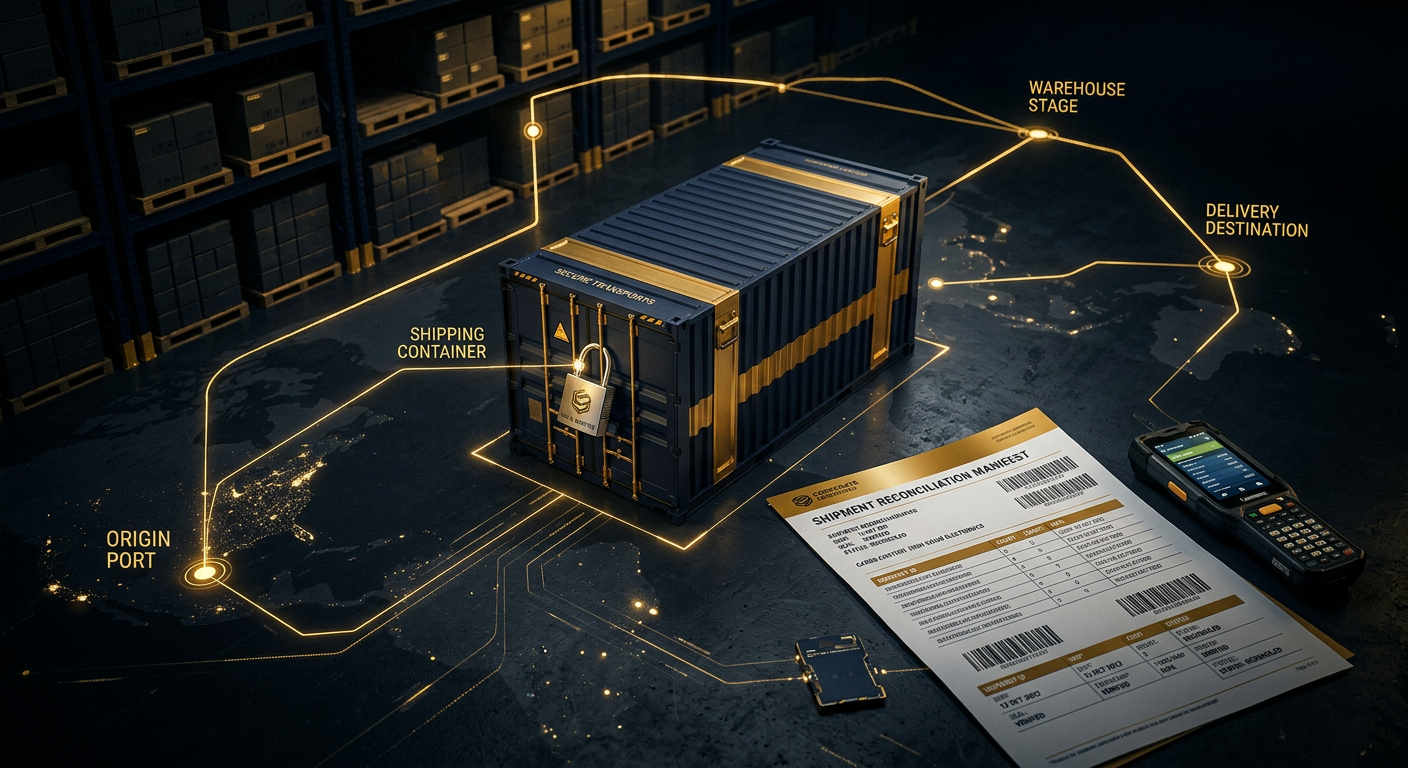
Supply-chain fraud is the deliberate manipulation of the flow of goods—not merely the invoices—to steal value or conceal loss. The core schemes are product diversion, substitution of inferior or counterfeit goods, short-shipment against paid quantities, and counterfeit-component insertion. It is detected by reconciling what was ordered, shipped, received, and paid against physical evidence, then confirmed through data analytics, forensic accounting, and targeted audits under privilege.
Most executives learn about supply-chain fraud the expensive way: a customer receives counterfeit parts, a warehouse count comes up short, or an internal auditor notices that a supplier’s margins are impossibly good. By then the loss has usually been compounding for quarters. Unlike vendor billing fraud—which lives in the accounts-payable ledger—supply-chain fraud lives in the gap between the paper record and the physical reality of the goods. It thrives precisely because most organizations trust their own three-way match and never test whether the pallets, cartons, and components actually contain what the paperwork says. This is the operational guide to the schemes, the detection methods elite investigators use, and the controls that stop them.
What Is Supply-Chain Fraud, and How Is It Different From Vendor Billing Fraud?
Supply-chain fraud is any scheme that corrupts the movement, quantity, quality, or authenticity of physical goods as they travel from manufacturer to end user. Vendor billing fraud is a financial deception—overbilling, duplicate invoices, phantom vendors—and it is detected in the ledger. Supply-chain fraud is a material deception: the money may be entirely accurate on paper while the goods themselves have been diverted, downgraded, or faked. That difference is decisive, because it means an investigation cannot be confined to financial records. It has to follow the product.
The distinction also changes who commits it. Billing fraud is usually an insider with signing authority. Supply-chain fraud is frequently a collusive network—a warehouse manager and a driver splitting diverted inventory, a quality inspector waved off by a supplier, a broker inserting counterfeit chips into an otherwise legitimate parts order. Because the deception is embedded in operations rather than in a single approval, it is harder to see and far harder to unwind. It is also more dangerous: substituted brake components, counterfeit semiconductors, or adulterated pharmaceuticals create product-liability and safety exposure that dwarfs the direct theft.
What Are the Main Supply-Chain Fraud Schemes?
Elite investigators categorize supply-chain fraud by where in the flow the deception occurs and what is being falsified—quantity, quality, authenticity, or destination. The schemes below account for the overwhelming majority of matters, and each leaves a distinct evidentiary signature that a disciplined investigation can isolate.
| Scheme | How it works | Primary red flags | Where the evidence lives |
|---|---|---|---|
| Diversion | Goods paid for by one buyer are redirected—to the gray market, a colluding third party, or resale—while records show normal delivery. | Unexplained shrinkage, product appearing in unauthorized channels, delivery addresses that change mid-route. | Telematics/GPS, gate logs, receiving scans, resale-market listings. |
| Product substitution | Inferior, expired, refurbished, or off-spec goods are supplied in place of what was ordered and certified. | Quality complaints, failed testing, certificates of conformance that don’t trace, margins too good to be real. | Incoming inspection records, lab/assay results, certificates and their source documents. |
| Short-shipment / false counts | Fewer units, less weight, or lower volume is delivered than invoiced and paid. | Recurring variances at receiving, tampered seals, weight tickets that don’t match manifests. | Weigh-in tickets, seal logs, cycle-count reconciliations, dock camera footage. |
| Counterfeit components | Fake, relabeled, or recycled parts—especially electronics—are inserted into an otherwise legitimate order. | Date-code inconsistencies, remarked packages, brokers with no authorized-distributor pedigree. | Component provenance/pedigree, decapsulation and X-ray testing, distributor audit trail. |
| Gray-market / parallel import | Authentic goods are sold outside authorized channels, evading warranty, tax, or contract terms. | Product with foreign labeling, missing serial ranges, pricing below authorized floor. | Serial-number tracking, distribution agreements, customs and import records. |
| Ghost / phantom shipments | Deliveries are recorded that never physically occurred, or returns are logged for goods never returned. | Proof-of-delivery signatures that don’t match, no receiving scan, credits without inbound freight. | Carrier records, e-POD data, receiving-dock scans, returns-authorization trail. |
These schemes rarely appear in isolation. A mature diversion ring, for example, will often pair short-shipment at the dock with ghost-return credits and falsified certificates to keep the books balanced. That interconnection is why a single-symptom response—tightening one control—usually just moves the loss rather than stopping it.
Why Is Supply-Chain Fraud So Hard to Detect?
Three structural features make it uniquely difficult. First, the fraud is distributed across organizations. A shipment may pass through a manufacturer, a freight forwarder, a customs broker, a distributor, and a last-mile carrier—each with its own records, none with an incentive to reconcile against the others. The seams between parties are exactly where goods disappear or change identity.
Second, the paper is designed to look correct. A capable fraudster produces a clean three-way match: purchase order, receiving report, and invoice all agree. The deception is not a mismatch in the documents—it is that the documents describe goods that were never delivered as specified. Standard financial controls, which test document-to-document consistency, are blind to it. Only document-to-physical reconciliation exposes it.
Third, certificates are trusted, not verified. Certificates of conformance, mill certs, and authorized-distributor letters are routinely accepted at face value. Counterfeiters and substituters know this, and forged or recycled certificates are a mature criminal product in their own right. As U.S. Customs and Border Protection documents through its intellectual-property-rights enforcement seizures, counterfeit and pirated goods enter legitimate supply chains at enormous scale, and the paperwork that accompanies them is frequently convincing.
How Do Investigators Detect Supply-Chain Fraud?
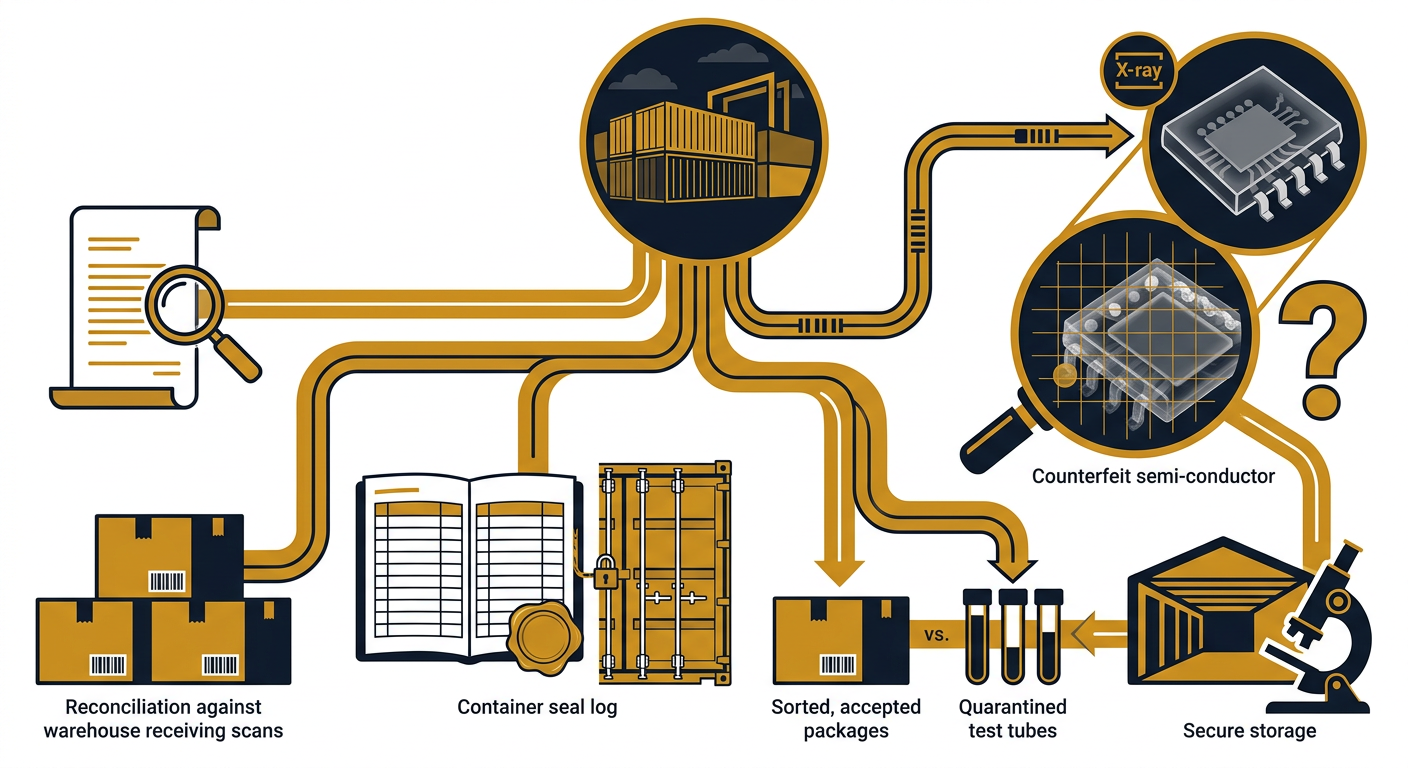
Detection is built on a single principle: reconcile the record against the reality at every handoff. A world-class investigation combines four disciplines—data analytics, forensic accounting, physical and technical audit, and provenance verification—so that no single falsified layer can survive scrutiny.
Data analytics across the logistics record
Investigators pull and join the datasets that most organizations never analyze together: purchase orders, advance shipping notices, receiving scans, warehouse-management movements, carrier proof-of-delivery, weigh tickets, and inventory cycle counts. Tests surface the anomalies that human review misses—receiving variances clustering with a single dock or shift, shipments that skip a scan point, weight-to-quantity ratios that drift outside tolerance, and returns credited without a matching inbound freight record. The analytics nominate the suspect lanes, SKUs, and people before anyone is interviewed, so the case rests on objective records and the subjects are not tipped off.
Forensic accounting and margin reconstruction
Forensic accountants rebuild the true economics. Substitution and diversion distort gross margin, yield, and scrap in ways that are visible when actual output is reconciled against material inputs. A supplier delivering a counterfeit or downgraded part earns a margin that the legitimate cost structure cannot explain; a diversion ring produces shrinkage that no operational cause accounts for. Following the money through the freight, brokerage, and settlement layers frequently exposes the colluding third party and the account where the diverted value lands.
Physical audit, seals, and technical testing
The physical layer is where supply-chain fraud is proven. Investigators conduct unannounced counts, inspect container-seal integrity against seal logs, pull dock and yard camera footage, and—critically—submit suspect goods for independent testing. For counterfeit electronics that means X-ray, decapsulation, and date-code analysis; for materials it means assay and metallurgical testing; for pharmaceuticals and consumables it means laboratory verification against specification. Testing converts suspicion into admissible fact.
Provenance and digital-evidence verification
Every certificate, distributor letter, and pedigree document is traced to its source rather than accepted. Investigators verify authorized-distributor status directly with the original manufacturer, validate serial ranges, and—where a broker is implicated—forensically examine the email and messaging record that arranged the transaction. Communications frequently contain the plainest evidence of intent, and the reporting mechanisms of programs such as the Government-Industry Data Exchange Program (GIDEP) often reveal that a suspect part or supplier has already surfaced elsewhere in the market.
What Does a Disciplined Supply-Chain Fraud Investigation Look Like?
The sequence matters as much as the technique. Alerting the wrong person, or seizing the wrong record first, can destroy a case before it begins. The following framework reflects how these matters are run at an elite level.
- Engage under counsel and set a tight need-to-know circle. Bring the investigation under attorney-client privilege and restrict knowledge to a small group that excludes anyone in the suspect lane. Supply-chain fraud is collusive; a single leak reaches the whole ring.
- Preserve the records before anyone is aware. Forensically preserve warehouse-management data, carrier and telematics feeds, email, and camera footage. Shipping and receiving records are trivially edited and dock video overwrites quickly—preservation is time-critical.
- Reconcile ordered-to-shipped-to-received-to-paid. Build the four-way reconciliation across the datasets and isolate where quantity, quality, or authenticity diverges from the paper.
- Run the analytics and rank the exposure. Quantify loss by lane, SKU, shift, and counterparty so the physical work targets the highest-probability nodes rather than the whole network.
- Verify physically and test technically. Conduct unannounced counts, inspect seals against logs, and submit suspect goods for independent laboratory or component testing.
- Trace provenance and the money. Confirm certificates and distributor pedigrees at the source, and follow diverted value through freight, brokerage, and settlement to the beneficiary.
- Interview outward-in, subjects last. Begin with peripheral witnesses and documentary custodians, then confront implicated insiders and suppliers only once the physical and financial case is built.
- Report to withstand challenge. Deliver findings that survive litigation, arbitration, insurance review, and—where warranted—law-enforcement referral, with chain of custody intact throughout.
How Do You Prevent Supply-Chain Fraud?
Prevention is cheaper than recovery by an order of magnitude, and the controls that work are the ones that force record-to-physical verification rather than record-to-record consistency. The priorities:
- Verify certificates at the source. Confirm authorized-distributor status and certificate authenticity directly with the manufacturer for high-risk categories—never accept the accompanying paper alone.
- Instrument the physical flow. Tamper-evident seals with logged numbers, weigh-in/weigh-out at custody changes, serialized tracking, and reconciled cycle counts close the seams where goods vanish or change identity.
- Segregate and rotate custody duties. Separate ordering, receiving, inspection, and inventory adjustment; rotate personnel and mandate vacation coverage so a single actor cannot own an entire lane indefinitely.
- Qualify and monitor suppliers continuously. Extend the diligence used for financial vendors to material integrity—audit rights, source-of-supply disclosure, and testing at incoming inspection for critical parts.
- Analyze continuously, not annually. Stand up recurring analytics on receiving variances, margin drift, and returns so anomalies surface in weeks, not quarters.
Frameworks such as the U.S. Government Accountability Office’s Fraud Risk Management Framework and the fraud-taxonomy work of the Association of Certified Fraud Examiners underscore the same lesson: controls fail where authority, custody, and outside relationships intersect without independent verification—which is a precise description of the modern supply chain.
What Separates a World-Class Supply-Chain Fraud Investigation?
Mediocre providers treat these matters as either a pure accounting exercise or a pure security exercise, and miss the fraud that lives between the two. A world-class investigation is integrated: forensic accountants, data analysts, digital-forensics examiners, and field investigators work a single case file, so the ledger, the data, the goods, and the communications are cross-checked against one another. Cost is driven by the number of parties in the chain, data availability and format, the volume of goods requiring testing, and the geographic spread of the lanes—a domestic single-warehouse matter is a fraction of a multi-country distribution investigation. The differentiator is discretion and defensibility: the ability to run the inquiry without alerting a collusive ring, and to produce evidence that holds up when a supplier’s counsel challenges every link.
Honeybadger Solutions runs these engagements nationwide and internationally, combining in-house financial investigation and digital forensics with field and security capabilities. Whether the exposure is a diverted-inventory ring, a counterfeit-component insertion, or a chronic short-shipment loss, explore our full corporate investigations capabilities or reach our teams through the Phoenix office to open a confidential matter.
Frequently Asked Questions
What is the difference between supply-chain fraud and vendor billing fraud? Vendor billing fraud is a financial deception found in the ledger—overbilling, duplicate invoices, or phantom vendors. Supply-chain fraud is a material deception in the goods themselves: diversion, substitution of inferior or counterfeit product, or short-shipment. The invoices can be perfectly accurate while the physical goods have been stolen, downgraded, or faked, so the investigation has to follow the product, not just the money.
How do investigators prove counterfeit or substituted goods? By converting suspicion into physical fact. Investigators trace certificates and distributor pedigrees back to the original manufacturer, and submit suspect goods for independent testing—X-ray, decapsulation, and date-code analysis for electronics; assay or metallurgical testing for materials; laboratory verification against specification for consumables. The test results, paired with the provenance trail and the communications that arranged the deal, establish authenticity or its absence.
Can supply-chain fraud be investigated without alerting the people involved? Yes, and it must be, because these schemes are usually collusive. Work is conducted under counsel within a tight need-to-know circle that excludes the suspect lane, the relevant data and video are forensically preserved before anyone is aware, and the analytics and physical reconciliation are completed first. Interviews proceed outward-in, with implicated insiders and suppliers confronted only after the objective case is built.
What records are most important to preserve early? Warehouse-management movements, receiving and shipping scans, carrier proof-of-delivery and telematics, container-seal logs, dock and yard camera footage, and the email or messaging that arranged suspect transactions. These are easily edited or quickly overwritten, so forensic preservation at the outset—before any interview—is the single most decisive step in protecting the case.
About Honeybadger Solutions
Honeybadger Solutions is an Arizona-licensed security and investigations firm serving all of Arizona, the nation, and international clients. We combine in-house digital forensics, cybersecurity, financial investigations, and background intelligence with a vetted network for field and protective operations. Our teams uncover diversion, substitution, short-shipment, and counterfeit-component schemes discreetly and build findings that withstand litigation, arbitration, insurance review, and law-enforcement referral.
Three offices: Casa Grande (HQ), Phoenix, and Oro Valley. To discuss a confidential matter, call 602-725-2818. Learn more about our corporate and internal investigations capabilities and request a discreet consultation.