
Corporate event security is a layered protection program that safeguards guests, executives, brand reputation, and business continuity across shareholder meetings, product launches, galas, and executive retreats. Delivered well, it is nearly invisible: advance risk assessment, credentialed access control, crowd management, close protection for principals, and rehearsed emergency response converge so attendees remember the event—not an incident. It scales from a boardroom to a stadium keynote, anywhere in the country.
For the board, the general counsel, or the chief of staff planning a marquee gathering, the calculus is simple and unforgiving: the same qualities that make an event valuable—concentrated leadership, press attention, disclosed locations, valuable assets, and sensitive conversations—also make it a target. A single disrupted keynote, a stalker who reaches a principal, or a medical emergency handled clumsily can eclipse months of preparation. Honeybadger Solutions builds and commands event security programs that hold to that standard: protective, discreet, and engineered so the guest experience stays polished from arrival to departure.
What does world-class corporate event security actually involve?
Mediocre event security posts a few uniformed guards at the door and hopes for a quiet night. Elite programs treat an event as a temporary, high-value operating environment and secure it in depth. The work spans five disciplines that must be integrated, not bolted together:
- Advance risk assessment — threat, venue, and reputational analysis conducted before anyone commits to a floor plan.
- Access control and credentialing — verifying who belongs inside each ring of the venue and keeping everyone else out gracefully.
- Crowd and floor management — managing density, flow, queuing, and behavior so a room never becomes a hazard.
- Executive protection — close, low-profile coverage for named principals, boards, and high-value guests.
- Emergency, medical, and continuity planning — rehearsed responses for the events you hope never happen.
What separates a world-class provider is the connective tissue: a single command element that owns the plan, coordinates the venue and local authorities, and can make protective decisions in seconds without disrupting the program. This is protective operations, not “guards for hire.”
How does advance risk assessment protect an event before it starts?
Every serious program begins with an advance—a structured reconnaissance and analysis phase that happens days or weeks before guests arrive. The advance answers the questions that dictate every downstream decision: Who or what could threaten this event? Where is the venue vulnerable? What happens if something goes wrong at the worst possible moment?
A rigorous advance covers:
- Threat and reputational review: current litigation, activist or protest interest, layoffs or labor disputes, controversial announcements, and the digital exposure of the principals attending. Publicly disclosed guest lists and geotagged social posts routinely reveal more than clients realize.
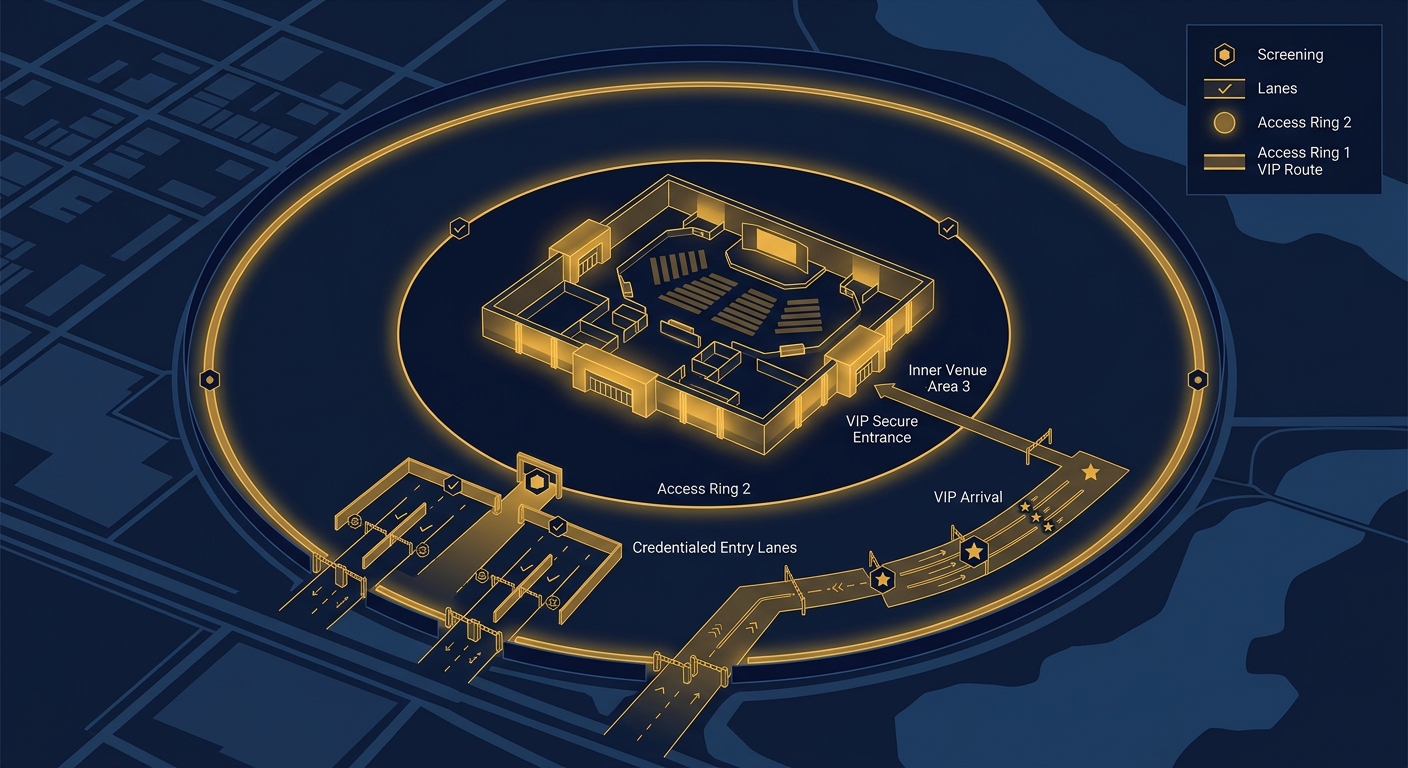
- Venue and route survey: ingress and egress, chokepoints, sightlines, loading docks, back-of-house access, parking, and the VIP arrival and departure path—often the highest-risk moments of any event.
- Adjacency and environment: what surrounds the venue—other events, construction, public access, and the nearest trauma-capable hospital.
- Emergency mapping: primary and secondary evacuation routes, muster points, shelter-in-place options, and medical staging.
The advance produces a written security plan and a risk rating that sizes the operation correctly. This is also where digital exposure enters the picture. Where a principal, product, or deal is a target, our in-house intelligence and background intelligence teams can vet a guest list, surface a known disruptor, or flag a hostile online campaign before it materializes at the door—work performed remotely and globally, with a documented chain of custody.
How is access control and credentialing handled without a checkpoint feel?
Security starts at the door, but it should never feel like a border crossing. The objective is a controlled perimeter that reads as gracious hospitality. Credentialing is layered so that each zone of the venue—public reception, main floor, executive green room, stage—admits only the people who belong there.
- Access verification: IDs, invitations, and registration lists are cross-checked at entry; tiered badges or wristbands distinguish guests, press, staff, and VIPs at a glance.
- BOLO monitoring: a discreet “be on the lookout” protocol identifies terminated employees, individuals under restraining or no-contact orders, known agitators, and prior-incident subjects—handled quietly by trained agents, not announced across a room.
- Vendor and staff screening: caterers, AV crews, temporary labor, and contractors are credentialed and monitored; back-of-house is a common and overlooked entry vector.
- Package and delivery control: a policy for gifts, deliveries, and equipment reaching sensitive areas.
Done correctly, guests experience a warm welcome and a fast line. The security architecture behind it—who was verified, who was flagged, who was redirected—stays invisible.
How do you manage crowds and the floor without disrupting the experience?
Crowd management is where event security most often fails—and where failure is most dangerous. Density, not malice, causes most serious event injuries. Professional interior coverage means agents who dress the part, blend into the environment, and remain alert to emerging risk while the room stays relaxed.
Effective floor management addresses:
- Occupancy and density monitoring at entrances, bars, stages, and photo lines to prevent crushing and bottlenecks.
- Discreet intervention with over-served or disruptive guests before a scene develops.
- Theft of purses, laptops, phones, and personal property in coat-check and seating areas.
- Unwanted recording, corporate espionage, and confidential-conversation awareness in executive zones.
- Suspicious behavior, unattended items, and unauthorized movement toward restricted areas.
Agents are positioned by design against the advance—covering chokepoints, sightlines, and the routes principals will actually walk—rather than clustered at a single visible post. The presence reassures without intimidating.
When does an event require executive protection?
General event security protects the room; executive protection (EP) protects a person. When a CEO, board member, celebrity keynote, foreign delegation, or UHNW principal attends, that individual may warrant dedicated close coverage layered on top of the venue plan.
At an elite level, EP at events means a low-profile detail that manages the arrival and departure (statistically the most exposed moments), controls the immediate space around the principal, holds a rehearsed emergency-movement plan, and coordinates seamlessly with venue security and the crowd-management team. The best EP is unremarkable to observers and decisive when it must be. It is never theatrical.
Honeybadger commands physical protection and armed executive-protection assignments through a vetted-partner network we vet, brief, and direct to a single standard. We maintain established operating theaters in California, Texas, and Florida, with Arizona as our home command; anywhere else in the country, we stand up a mandate-driven detail and run it to the same protocol. That model lets a national brand run a launch in Austin, a shareholder meeting in the Bay Area, and a gala in Miami under one accountable command element. Learn more about our security and security consulting capabilities.
What does emergency, medical, and continuity planning cover?
The measure of an event security program is what happens in the ninety seconds after something goes wrong. A guest collapses. A fire alarm sounds mid-keynote. A protest breaches the lobby. In each case, an unrehearsed team improvises and an experienced one executes.
A complete plan includes:
- Medical response: AED and first-aid staging, a pre-identified path for EMS, and, for larger or higher-risk events, on-site medical assets. Calm, immediate response to a cardiac or allergic event saves lives and protects reputations.
- Evacuation and shelter-in-place: primary and secondary routes, muster points, and clear trigger criteria communicated to staff in advance.
- Disruption protocols: defined, lawful responses to protesters, hecklers, or stage-rushers that protect principals without generating the viral footage the disruptor wants.
- Communications and continuity: a radio and escalation plan so security, venue, and event staff share one operating picture, and a plan to continue or gracefully conclude the program.
These procedures are briefed and, for high-stakes events, walked through with the team before doors open. Rehearsal is the difference between a controlled incident and a headline.
In-house guards vs. a commanded protective program: which do you need?
| Dimension | Basic guard staffing | Commanded protective program |
|---|---|---|
| Planning | Headcount booked for the date | Written advance, risk rating, and site survey |
| Access control | Guest list at the door | Tiered credentialing, BOLO, vendor screening |
| Principals | None or ad hoc | Dedicated executive protection detail |
| Emergencies | Call 911 | Rehearsed medical, evacuation, disruption plans |
| Coordination | Guards act independently | Single command element; venue and authority liaison |
| Footprint | Visible, uniformed | Discreet, blended, hospitality-forward |
| Best for | Low-risk internal functions | High-profile, VIP, or reputationally sensitive events |
Many events genuinely need only professional guard coverage. The moment named executives, press, valuable IP, disclosed locations, or reputational risk enter the equation, a commanded program is the responsible standard—and the cost delta is trivial against the exposure it retires.
A seven-step framework for securing a corporate event
- Define the mission. Confirm the event type, principals attending, guest count, disclosed location status, and specific concerns (litigation, layoffs, activism).
- Run the advance. Complete the threat review, venue survey, and emergency mapping; produce a written plan and risk rating.
- Size and place the team. Set agent numbers, EP details, and positions against the advance—not a generic ratio.
- Build the credentialing scheme. Define zones, badge tiers, BOLO list, and vendor screening before invitations go out.
- Rehearse contingencies. Brief and, for high-risk events, walk through medical, evacuation, and disruption responses.
- Coordinate externally. Liaise with venue management and, where warranted, local authorities and EMS.
- Execute and debrief. Run the event under one command element; capture a post-event debrief to harden the next one.
What drives the cost and quality of event security?
Pricing tracks risk and complexity, not simply headcount. The primary cost drivers are the risk rating from the advance, the number and profile of principals requiring close protection, guest count and venue footprint, event duration and overnight requirements, whether armed coverage is warranted, and the depth of medical and technical support. A stadium product launch with a celebrity keynote and known protest interest is a different mandate than a fifty-person board dinner.
What separates world-class providers from commodity vendors is rarely price. It is the quality of the advance, the discipline of the agents, the ability to stay discreet under pressure, and a single accountable command element that can coordinate venue staff, EP, crowd management, and—when needed—our in-house investigations and intelligence resources. Elite firms document their plans, rehearse their contingencies, and leave nothing to the night-of. For guidance from the U.S. government on protecting gatherings, see CISA’s resources on securing public gatherings; for professional standards in the protective industry, see ASIS International.
Can one firm secure our events nationwide?
Yes. National brands rarely host in one city, and fragmenting security across a different local vendor in every market is how standards slip and accountability disappears. Honeybadger commands corporate and VIP event security across the United States under one protocol and one point of contact. Our physical and executive-protection operations run through a vetted-partner network with established theaters in California, Texas, and Florida and Arizona as home command; in any other market we stand up a mandate-driven detail to the same standard. Our in-house digital forensics, cybersecurity, financial investigations, and background-intelligence teams support every engagement remotely and globally. The result is consistent protective quality from Phoenix to New York, with one firm answerable for the outcome.
Frequently asked questions
How far in advance should we book corporate event security?
For a routine internal function, one to two weeks is often workable. For high-profile events—named executives, press, disclosed locations, or elevated risk—engage a firm four to six weeks out so the advance, credentialing scheme, and any executive-protection details can be built properly. Honeybadger can also mobilize on short notice when circumstances demand it.
Will armed security make guests uncomfortable?
Not when it is done professionally. Elite event security is deliberately low-profile—agents dress to match the environment and blend in. Armed coverage, where warranted by the threat picture, is discreet and coordinated. The intent is reassurance, not intimidation; most guests never register the security architecture protecting them.
Do you provide executive protection for VIP guests, not just the venue?
Yes. Venue security protects the room; executive protection protects a specific person. For CEOs, board members, celebrity speakers, or UHNW principals, we layer a dedicated close-protection detail onto the event plan, managing arrivals, departures, and the immediate space around the principal in coordination with venue security.
Can you secure our events in multiple states?
Yes. We command event security nationwide under one protocol, with established theaters in California, Texas, and Florida, Arizona as home command, and mandate-driven details anywhere else in the country. One firm remains accountable for consistent quality across every market you host in.
About Honeybadger Solutions
Honeybadger Solutions is an Arizona-licensed security and investigations firm serving all of Arizona, the nation, and international clients. We command corporate and VIP event security, executive protection, and physical security through a vetted-partner network, backed by in-house digital forensics, cybersecurity, financial investigations, and background intelligence. Our teams operate from three offices: Casa Grande (headquarters), Phoenix, and Oro Valley, serving the Phoenix metro and clients coast to coast.
Plan your next event with confidence. Call Honeybadger Solutions at 602-725-2818 for a confidential consultation and advance risk assessment.