
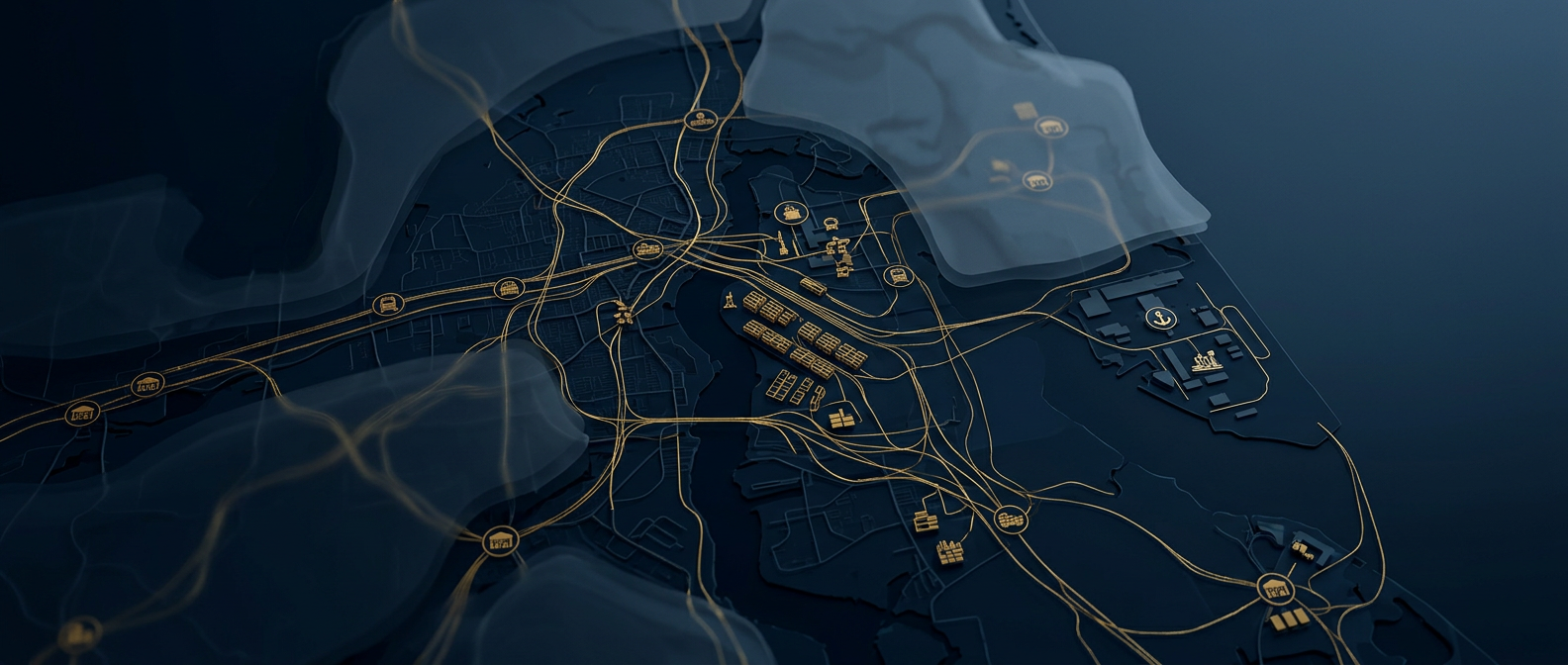
A private investigator in Jacksonville handles the cases the region’s port, logistics, and military economy create — cargo theft and freight diversion moving through JAXPORT, supply-chain and vendor fraud, workers’ compensation claim investigation for a warehouse and trucking workforce, and background intelligence tied to a large defense community. Florida requires a license under Chapter 493, and local fluency in port, transport, and military law is what separates credible, admissible work from liability.
Jacksonville is not a generic investigations market. It is one of the Southeast’s primary logistics hubs — a deep-water port complex on the St. Johns River, the headquarters city of a Class I railroad, the convergence of Interstates 95 and 10, and a dense belt of warehouses and distribution centers — layered on top of one of the largest concentrations of naval power on the East Coast. Those realities shape the caseload. A Jacksonville matter is far more likely than a case in Denver or Columbus to involve a stolen container, a fraudulent carrier or broker, an injured logistics worker, or a servicemember protected by federal statute. This guide, written for general counsel, litigation and insurance-defense attorneys, logistics and transportation executives, risk managers, and private clients, explains what a Jacksonville private investigator actually does, how Florida licensing works, and why port, freight, and military cases demand specialized handling.
What does a private investigator in Jacksonville actually do?
The core discipline is the same anywhere: lawful gathering, verification, and documentation of facts a client can act on — in court, in a claim, in a transaction, or in a personal decision. What changes in Jacksonville is the mix. Local demand concentrates around four families of work: supply-chain and cargo investigation (theft, freight diversion, fictitious pickups, and vendor fraud); insurance and workers’ compensation investigation (claim verification and fraud for a large blue-collar logistics and construction workforce); background and integrity intelligence (pre-hire, pre-partnership, carrier and broker vetting, and defense-adjacent screening); and litigation and family-law support, including matters touching the region’s military population.
A serious firm delivers these as intelligence-led engagements, not one-off record pulls. That means resolving a subject’s or an entity’s true identity before attributing anything to them, working under a documented lawful purpose, and producing findings that survive scrutiny — sourced, dated, and defensible. The value is never a raw database printout; it is analysis a court, a claims committee, or a board will accept and counsel can act on. Honeybadger delivers this through its investigations practice, with digital forensics, financial investigation, cybersecurity, and background intelligence handled in-house and coordinated with Florida-licensed field resources for on-the-ground work.
Do you need a licensed private investigator in Florida?
Yes. Florida is a licensed state, and conducting private investigations for compensation without the proper license is a crime. Under Chapter 493 of the Florida Statutes, licensing is administered by the Florida Department of Agriculture and Consumer Services (FDACS), Division of Licensing. The framework is tiered: an individual investigator holds a Class C license (a Class CC covers a supervised intern), the investigative agency itself must hold a Class A agency license, and any investigator who carries a firearm in the course of duty must additionally hold a Class G statewide firearm license. Qualifying for a Class C license requires documented investigative experience or equivalent training, and every applicant clears a state and federal criminal background check.
For a client, this is not bureaucratic trivia — it is the first due-diligence step. An unlicensed operator produces evidence that opposing counsel can attack and that may be excluded, and exposes the client to reputational and legal blowback. This matters acutely in cargo and workers’ compensation matters, where surveillance product and interview statements are litigated aggressively. Before engaging anyone in Jacksonville, verify the license through FDACS, confirm it is current, and confirm that any surveillance, pretext contact, or record access is performed under that license and a documented permissible purpose. A reputable firm volunteers its licensing posture; it never asks you to take it on faith.
Why do the port and logistics economy define Jacksonville cases?
Jacksonville moves goods at national scale. The Jacksonville Port Authority (JAXPORT) operates deep-water marine terminals along the St. Johns River — Blount Island, Talleyrand, and Dames Point among them — and the region is one of the busiest vehicle-handling ports in the United States, alongside heavy container and breakbulk volume. A Class I railroad is headquartered in the city, I-95 and I-10 cross here, and the surrounding logistics belt is packed with distribution centers, cross-docks, and trucking yards. Wherever high-value freight sits, stops, or changes hands, it attracts organized theft and fraud — and Florida consistently ranks among the top states for cargo crime. That gravity produces investigative work that hinges on knowledge most generalist PIs do not have.
Cargo theft and freight diversion. Modern cargo loss is far more than a trailer stolen from a lot. It includes fictitious pickups, where thieves pose as a legitimate carrier using stolen or spoofed motor-carrier identities; strategic theft through identity fraud and double-brokering; and insider-enabled diversion where a load is routed to the wrong destination and disappears. The FBI treats cargo theft as a significant organized-crime problem with cascading supply-chain cost. Investigating it means reconstructing the movement of a shipment lawfully — bills of lading, carrier and broker records, gate and yard logs, GPS and telematics data, and surveillance — and identifying whether the loss was external, insider-enabled, or a paper fraud.
Supply-chain and vendor fraud. The same density of intermediaries that makes Jacksonville efficient also creates exposure: shell brokers, phantom carriers, kickbacks in procurement, duplicate or inflated freight invoicing, and counterfeit or substituted goods entering the chain. Developing these cases blends corporate-registry and beneficial-ownership research, financial investigation, and document analysis to expose who actually controls a counterparty and where the money and goods really went.

How is a cargo theft or supply-chain fraud case actually investigated?
Cargo and freight cases reward method and punish improvisation. A disciplined engagement follows a repeatable sequence, coordinated with the carrier, insurer, and law enforcement rather than around them:
- Preserve the record immediately. Lock down the bill of lading, rate confirmation, broker and carrier onboarding file, gate and yard logs, and any GPS or telematics feed before data ages off — the first 24 to 72 hours decide whether recovery is realistic.
- Validate the carrier identity. Cross-check the motor-carrier authority, insurance, and contact details against federal registration and the onboarding packet to detect fictitious-pickup and double-brokering fraud.
- Reconstruct the movement. Build a timeline from origin to loss point using telematics, toll and license-plate reader data where lawfully available, and facility surveillance.
- Test for insider enablement. Correlate access logs, dispatch decisions, and communications for signs the diversion had inside help — handled as a discreet workplace inquiry that protects due process.
- Follow the goods and the money. Trace resale channels, corporate ownership behind suspect brokers, and payment flows through financial investigation.
- Preserve the digital trail. Where spoofed email, account takeover, or falsified documents are involved, capture the evidence forensically through digital forensics so it holds up in court.
- Document for recovery and litigation. Deliver a sourced, chain-of-custody-sound report that supports insurance recovery, civil action, and referral to law enforcement.
The through-line is coordination and admissibility. A load recovered but poisoned by an unlawful search, or a fraud proven with evidence a court excludes, is a loss dressed as a win.
What about workers’ compensation and insurance investigations?
A logistics economy runs on physical labor — dockworkers, warehouse staff, drivers, and equipment operators — and that workforce generates a steady volume of workers’ compensation and liability claims. Most are legitimate; a meaningful minority are exaggerated or fabricated, and Florida law treats workers’ compensation fraud as a felony with a dedicated state enforcement apparatus. For self-insured employers, carriers, and insurance-defense counsel, the investigator’s role is to verify a claim objectively: lawful activity checks, documentation of a claimant’s actual physical capability through surveillance conducted in public spaces, verification of concurrent employment, and social-media and open-source corroboration.
The discipline here is legal precision. Surveillance of a claimant in public view is lawful; trespass, harassment, pretextual intrusion into private space, or recording a private conversation without all-party consent is not. Evidence gathered outside those lines does not merely fail — it can expose the client to counterclaims and sanctions. A credible firm documents what it observes without embellishment, resists the temptation to editorialize, and produces footage and reports that a mediator, judge, or claims committee can rely on. The same rigor applies to premises-liability and cargo-loss claims, where the question is often what really happened and whether the loss matches the story told.
What role does Jacksonville’s military community play?
Jacksonville hosts one of the densest concentrations of naval activity in the country, anchored by Naval Station Mayport, Naval Air Station Jacksonville, and a major Marine Corps logistics presence on Blount Island, along with a large retired and veteran population. That footprint puts a recurring military dimension into the local caseload that generalist investigators mishandle at their clients’ peril, particularly in family-law and location matters.
The Servicemembers Civil Relief Act (SCRA) protects active-duty personnel from certain civil actions. Before a court enters a default judgment against a defendant, the plaintiff must file an affidavit stating whether the defendant is in military service, and a servicemember can obtain a stay of proceedings. Investigators support counsel by lawfully confirming a subject’s military status through the Department of Defense verification service and by locating servicemembers for lawful service of process — getting this wrong can void a judgment. Deployments, sea duty, and permanent-change-of-station moves complicate custody, support, and asset matters, where an investigator helps establish the true financial picture, including base pay, allowances, and any concealed civilian income. The defense and defense-contractor ecosystem also drives demand for careful background intelligence and, when a matter touches devices, accounts, or exfiltration, in-house cyber and digital-evidence capability. Investigators gather facts and support the attorney; they do not give legal advice.
Which Jacksonville case types map to which drivers?
The table below connects the region’s defining features to the concrete investigations they generate, what a rigorous engagement delivers, and the primary legal or compliance anchor an experienced firm works within.
| Case type | Local driver | What the investigation delivers | Key legal / compliance anchor |
|---|---|---|---|
| Cargo theft & freight diversion | JAXPORT, rail, and I-95/I-10 freight corridors | Reconstructed shipment timeline; carrier-fraud and insider findings; recovery support | FMCSA authority checks; chain of custody |
| Supply-chain & vendor fraud | Dense broker, carrier, and distribution network | Beneficial ownership behind suspect entities; documented money and goods trail | Florida evidence rules; GLBA (no pretexting) |
| Workers’ comp & insurance fraud | Large dock, warehouse, and trucking workforce | Lawful surveillance and activity verification; objective, admissible claim record | Fla. Stat. 440 fraud provisions; all-party consent |
| Carrier & broker vetting | High-volume intermediary marketplace | Verified authority, insurance, ownership, and integrity before onboarding | FCRA (when applicable); permissible purpose |
| Military family-law & location | Mayport, NAS Jacksonville, veteran population | Verified military status; true financial picture; lawful service support | SCRA affidavit & stay provisions |
| Digital & communications forensics | Spoofed email, account takeover, falsified docs | Court-ready recovery and analysis of the digital trail | Chain of custody; two-party recording law |
How should you select and engage a Jacksonville private investigator?
The difference between a defensible result and a wasted retainer is decided at engagement, not at delivery. Use this framework before you sign:
- Verify the Florida license. Confirm a current Class C investigator license and Class A agency license through FDACS, plus the Class G firearm license if protective or armed work is contemplated. No license, no engagement.
- Establish permissible purpose. Insist the firm document the lawful basis for the work — litigation, insurance claim, fraud, or due diligence — which governs what records may be accessed and how findings may be used under statutes such as the DPPA, GLBA, and FCRA.
- Test supply-chain and cargo depth. For freight matters, confirm the firm understands motor-carrier authority verification, double-brokering and fictitious-pickup fraud, telematics, and coordination with carriers, insurers, and law enforcement.
- Confirm insurance-investigation discipline. For workers’ comp and liability work, confirm surveillance stays in lawful public space and that reporting is objective and free of embellishment.
- Require in-house digital and financial capability. Cargo, fraud, and asset matters increasingly turn on devices, accounts, and records; confirm forensics and financial investigation are handled by qualified in-house examiners, not subcontracted blind.
- Confirm military-law fluency. For any family-law or location matter, confirm the firm understands SCRA verification and coordinates with your counsel.
- Demand court-ready reporting. Findings must be sourced, dated, chain-of-custody sound, and written so counsel can act — and so an examiner can defend them under cross-examination.
A firm that welcomes each of these questions is telling you how it works. A firm that deflects them is telling you something too.
What are the legal limits a Jacksonville investigator must respect?
The value of any investigation is only as durable as its legality, and Florida is not a permissive jurisdiction. Florida is a two-party (all-party) consent state under its security-of-communications law, so surreptitiously recording a confidential conversation without the consent of everyone involved is a crime — a trap that ensnares operators accustomed to one-party states, and one that matters greatly in workers’ compensation interviews and workplace inquiries. Financial privacy is federally protected: obtaining a person’s bank information from an institution by deception — pretexting — is a federal offense under the Gramm-Leach-Bliley Act, so any operator promising “guaranteed account balances” is describing an illegal act. Motor-vehicle records are restricted by the Driver’s Privacy Protection Act to permissible purposes, and GPS placement, trespass, and pretext contact each have bright lines that separate admissible evidence from suppression and liability.
Cargo and port matters add a further dimension: much of the record lives with private carriers, terminals, and brokers, and reaching protected data often requires litigation, subpoenas, and coordination with law enforcement rather than a freelance workaround. Serious firms build the case on lawful public records, open-source intelligence, in-house forensic analysis, cooperative access with the client’s own supply-chain partners, and properly channeled legal process — and they say plainly what cannot be obtained lawfully. That candor is what protects the client’s case, and it is the line between an intelligence partner and a liability.
How does Honeybadger deliver investigations in Jacksonville?
Honeybadger Solutions serves Jacksonville clients as an intelligence-led firm built for exactly this terrain. Our in-house disciplines — digital forensics, cybersecurity, financial investigation, and background intelligence — are global and remote-by-design, so the analytical core of a case is handled by our own examiners regardless of where the shipment, subject, or asset sits. On-the-ground work in Florida is delivered through properly licensed field resources and, for physical and executive protection, a commanded vetted-partner network with Florida as an established operating theater. This lets us run cargo-theft and supply-chain investigation, workers’ compensation and insurance inquiry, carrier and broker vetting, and military family-law support under one coordinated engagement.
We are candid about structure: Honeybadger is an Arizona-licensed firm headquartered in Casa Grande, with additional offices in Phoenix and Oro Valley, serving clients across Arizona, nationwide, and internationally. For Jacksonville matters we combine that in-house depth with Florida-appropriate licensing and local capability, and we tell clients the truth about what can and cannot be obtained lawfully. Learn more about our reach into the region on our Jacksonville page, or call to discuss a matter in confidence.
Frequently asked questions
Does a private investigator in Florida need a license?
Yes. Investigating for compensation in Florida without the proper license is a crime under Chapter 493. An individual investigator holds a Class C license, the agency must hold a Class A license, and carrying a firearm on duty requires a separate Class G license. Licensing is administered by the FDACS Division of Licensing, and every applicant clears a state and federal background check. Always verify a current license through FDACS and confirm that any surveillance or record access is performed under it and a documented permissible purpose before you engage anyone.
Can an investigator help recover stolen cargo?
Often, especially when engaged quickly. The work preserves the shipment record, validates carrier identity to detect fictitious-pickup and double-brokering fraud, reconstructs the movement using telematics and surveillance, tests for insider enablement, and traces resale channels and money flows — all documented to support insurance recovery, civil action, and law-enforcement referral. Speed matters: the first 24 to 72 hours often decide whether recovery is realistic, so a coordinated response with the carrier, insurer, and police is critical.
Is workers’ compensation surveillance legal in Florida?
Yes, within limits. Observing and recording a claimant in public view is lawful and routinely used to verify actual physical capability against a claimed injury. What is not lawful is trespass, intrusion into private space, harassment, or recording a private conversation without all-party consent, since Florida is a two-party consent state. Evidence gathered outside those lines can be excluded and expose the client to counterclaims. A credible firm documents observations objectively, without embellishment, so the record holds up before a mediator or judge.
How does the SCRA affect a case involving a servicemember?
The Servicemembers Civil Relief Act protects active-duty personnel from certain civil actions. Before a court enters a default judgment, the plaintiff must file an affidavit stating whether the defendant is in military service, and a servicemember can obtain a stay of proceedings. In a Navy-heavy market like Jacksonville this is common: an investigator supports counsel by lawfully verifying military status through the Department of Defense and by locating a servicemember for proper service. Ignoring SCRA can void a judgment, so it must be handled correctly.
About Honeybadger Solutions
Honeybadger Solutions is an Arizona-licensed security and investigations firm delivering intelligence-led investigations, cargo-theft and supply-chain investigation, workers’ compensation and insurance inquiry, background intelligence, digital forensics, and military family-law support to general counsel, litigators, logistics and transportation companies, insurers, and private principals in Jacksonville, across the United States, and internationally. Digital forensics, cybersecurity, financial investigations, and background intelligence are handled in-house; physical and executive protection is delivered through a commanded vetted-partner network, with Florida an established operating theater and Arizona as home command.
Offices: Casa Grande (HQ), Phoenix, and Oro Valley, Arizona — serving Jacksonville, all Arizona, nationwide, and international clients.
Phone: Book a consultation online
Confidential consultation: discuss a cargo, supply-chain, workers’ compensation, or military-community matter with our investigations team.
Browse by topic
Security guard services · Private investigations · Cybersecurity · Digital forensics · Financial fraud investigation · Executive protection · All articles