
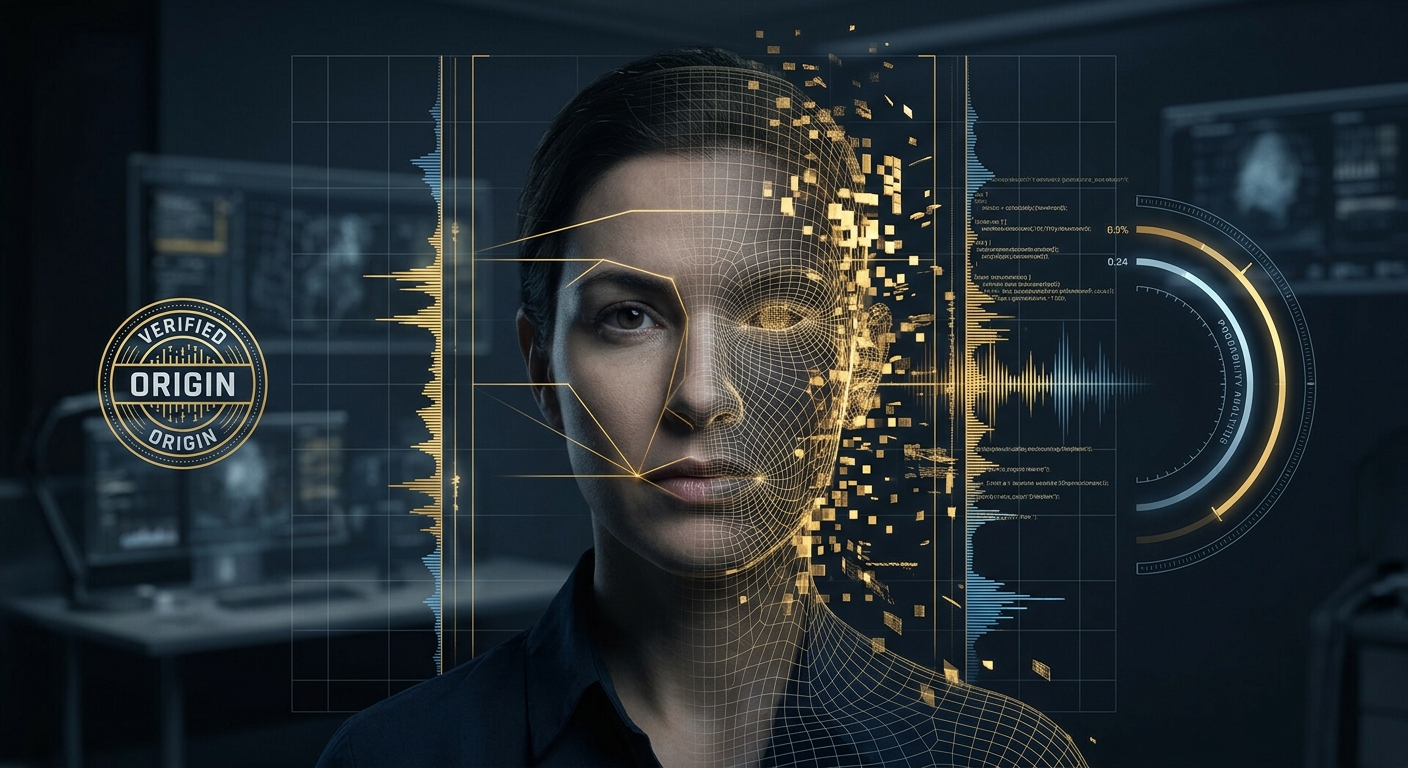
Deepfake and synthetic-media forensics authenticates audio, video, and images—determining whether a file is a genuine, unaltered recording or an AI-generated or manipulated fake. Because modern generators leave subtle, probabilistic traces rather than one obvious flag, examiners combine metadata and container analysis, compression and sensor-noise artifacts, physiological and spectral inconsistencies, and content provenance to reach a defensible opinion—not a simple yes-or-no verdict.
Synthetic media has moved from novelty to operational threat. A convincing voice clone can be built from a few seconds of a public earnings call; a face-swap or fully generated video can be produced on consumer hardware; and manipulated photographs now circulate as “evidence” in litigation, insurance claims, and internal investigations. For general counsel, litigators, and corporate security leaders, the question is no longer whether a fake exists somewhere on the internet—it is whether the specific recording in front of you is authentic, and whether your position on it will survive cross-examination. This guide explains how elite examiners approach that question, why honest answers are expressed as probabilities, and what separates a defensible authentication opinion from a dangerous guess.
What is the difference between deepfake detection and media authentication?
The two terms are often used interchangeably, but they are not the same discipline, and conflating them is the first mistake amateurs make. Deepfake detection asks a narrow question: does this file bear the statistical signatures of AI generation or face-swapping? It is typically probabilistic, model-driven, and aimed at a specific class of manipulation. Media authentication is the broader, older forensic discipline: is this file what it purports to be—an original, unaltered recording from the device and time claimed—regardless of how any alteration was accomplished?
The distinction matters because most contested media is not a flawless deepfake. It is a genuine recording that has been selectively edited, re-encoded, cropped, sped up, or stripped of context—or a real photograph with a single object cloned in or out. A detector trained to spot generative artifacts may return “no deepfake detected” on a file that is nonetheless thoroughly manipulated. World-class practice treats deepfake detection as one instrument inside a full authentication examination, not as the examination itself. The governing question is always authenticity and integrity, and the deepfake analysis is a supporting workstream.
Why can’t a detector give a simple yes-or-no answer?
Because authentication is a problem of accumulated evidence, not a single measurement. Every serious detector and analytical technique produces a likelihood, a confidence band, or a set of anomalies—never a certified verdict. There are structural reasons for this that any expert must be prepared to explain on the stand.
- Generators improve continuously. A detector tuned to yesterday’s models degrades against tomorrow’s. This is an adversarial arms race, and any tool’s accuracy is a snapshot, not a constant.
- Compression destroys evidence. Social platforms and messaging apps re-encode media aggressively. The same re-compression that erases generative artifacts also erases the traces a detector relies on, pushing results toward the uncertain middle.
- Real recordings contain anomalies too. Low light, motion blur, cheap sensors, and heavy compression produce artifacts that mimic manipulation. A responsible examiner must distinguish benign artifacts from probative ones.
- Training-data bias is real. A model that performs well on benchmark datasets can perform poorly on the specific codec, resolution, or demographic of the file at issue.
The honest output, therefore, is a reasoned opinion supported by converging independent indicators, with the limitations stated plainly. An examiner who testifies “this video is 100% a deepfake” on the strength of one tool is offering an impeachable opinion. An examiner who testifies “multiple independent analyses—metadata, compression history, and physiological inconsistency—converge on manipulation, and here is what would falsify that conclusion” is offering a defensible one.
What does the analytical toolkit actually examine?
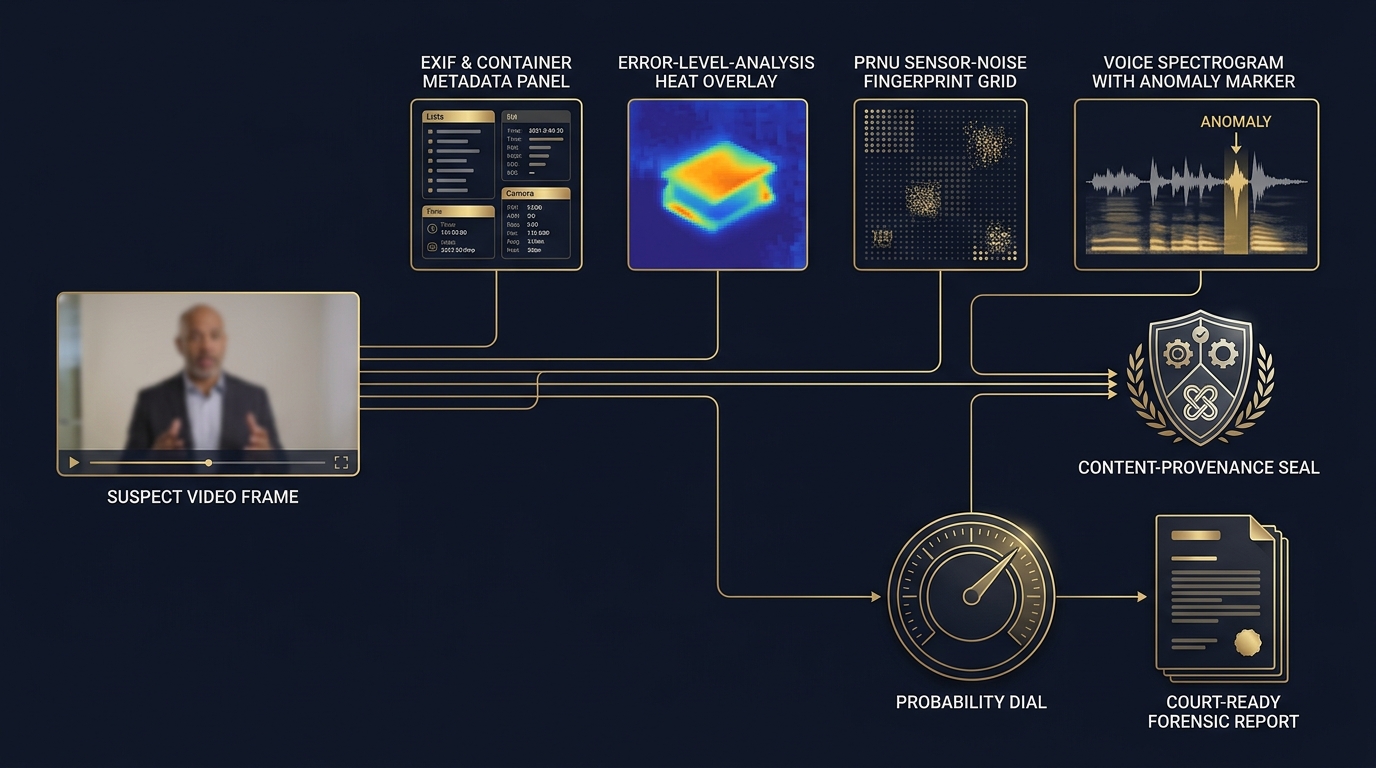
Authentication is a layered examination. No single technique is decisive; each interrogates a different property of the file, and the strength of the opinion comes from how the layers agree or disagree. The table below maps the core techniques to what each detects and where each falls short—a limitation column an elite examiner will always volunteer, because opposing counsel certainly will.
| Technique | What it detects | Key limitation |
|---|---|---|
| Metadata / EXIF & container analysis | Origin, device, timestamps, editing-software signatures, encoder history | Trivially stripped or spoofed; absence proves little |
| Error level analysis (ELA) | Regions recompressed at different rates, suggesting local edits | Screening aid only; unreliable alone and easily misread |
| PRNU / sensor-noise pattern | Whether an image matches a specific camera’s unique noise fingerprint | Needs reference images; degraded by heavy compression and edits |
| Compression & re-encoding artifacts | Double-JPEG traces, quantization inconsistencies, splicing seams | Confounded by platform re-encoding and format conversion |
| Physiological / temporal cues (video) | Unnatural blinking, pulse, lip-sync, lighting and frame-to-frame flicker | Newer generators reduce these; subjective without measurement |
| Voice spectral analysis | Cloned-voice artifacts: unnatural pitch, formants, breathing, spectral gaps | Phone-quality audio and codecs obscure the signal |
| C2PA / content provenance | Cryptographically signed capture-and-edit history when present | Only works if provenance was captured and preserved end-to-end |
How do you authenticate manipulated images and video?
Image and video authentication begins away from the pixels. Metadata and container analysis is the first pass: EXIF fields, the file’s container structure (MP4 atoms, JPEG segments), encoder and editing-software signatures, and internal timestamps often reveal that a file was produced or last written by editing software rather than a camera, or that its structure is inconsistent with the device it claims to come from. Metadata is easily stripped, so its absence proves nothing—but its presence, and especially its internal contradictions, is highly probative.
At the pixel level, error level analysis highlights regions that have been recompressed differently from their surroundings, which can flag a spliced or cloned area. ELA is genuinely useful as a screening tool, but it is also the single most abused technique in amateur “forensics”: it produces suggestive heat maps that untrained eyes over-interpret, and it is confounded by ordinary editing, resizing, and platform re-encoding. It is a lead, never a conclusion. Sensor-noise (PRNU) analysis is far more powerful when reference material exists: every camera sensor imprints a faint, unique noise pattern, and matching—or failing to match—that fingerprint can tie an image to a specific device or expose a composite. Compression and re-encoding artifacts, such as double-JPEG quantization traces and blocking discontinuities along splice seams, round out the picture.
For video, examiners add physiological and temporal analysis. Face-swapped and generated footage historically betrayed itself through unnatural or absent eye-blink cadence, imperceptible-pulse inconsistencies in facial skin, lip movements that do not track the audio, warping around the hairline and teeth, and frame-to-frame flicker where a synthesized region fails to remain temporally stable. These tells are shrinking as generators mature, which is precisely why they are treated as corroborating indicators measured against a baseline—not as a lie-detector.
How is cloned or synthetic audio detected?
Voice cloning is now the most operationally dangerous form of synthetic media, because a short sample is enough to reproduce a target’s voice convincingly on a phone call. Audio authentication relies heavily on spectral analysis—examining the recording as a spectrogram and a set of acoustic features rather than as a waveform. Synthesized speech frequently exhibits telltale signatures: unnaturally smooth or absent breathing and mouth noises, pitch and formant transitions that are too regular, spectral energy that cuts off sharply at a vocoder’s ceiling, and micro-timing in phonemes that lacks the natural variability of a human speaker.
Authentication also considers the acoustic environment: genuine recordings carry consistent room reverberation, background noise, and electrical-grid hum (the ENF, or electric network frequency) that should be internally coherent and consistent with the claimed time and place. A cloned message injected into a call, or an edit splicing multiple takes, often disturbs that continuity. As with imagery, the honest limitation is that telephone codecs and compression strip much of the fine spectral detail that detection depends on, so low-quality audio yields lower-confidence opinions—a boundary the examiner must state, not paper over.
Can content provenance (C2PA) settle the question?
Content provenance flips the problem from detection to verification. Rather than hunting for traces of manipulation after the fact, provenance standards such as C2PA (the Coalition for Content Provenance and Authenticity) attach a cryptographically signed, tamper-evident manifest to media at the moment of capture and through each edit—recording what device made it, what software touched it, and how. Where an intact, verifiable C2PA manifest is present, authentication becomes a matter of validating a signature chain rather than interpreting noise.
The catch is coverage. Provenance only helps when it was captured at the source and preserved end-to-end; a screenshot, a re-upload, or a platform that strips metadata breaks the chain, and most media in circulation carries no manifest at all. Provenance is a powerful affirmative signal when present and a growing part of the ecosystem, but its absence is not evidence of fakery. For the foreseeable future, examiners must be fluent in both worlds—verifying provenance where it exists and falling back on traditional multi-layer authentication where it does not.
Why are deepfakes now a fraud and litigation problem?
Two threat patterns dominate enterprise exposure. The first is synthetic-media fraud. Voice-clone “CEO fraud”—an urgent call or voicemail impersonating an executive to authorize a wire transfer or credential reset—has already produced real losses, and video-conference impersonation has been used to lend false legitimacy to fraudulent payment instructions. These attacks weaponize authority and urgency, and they defeat controls that assume a familiar voice or face is proof of identity. The forensic role here is rapid triage: authenticating the artifact, preserving it correctly, and supporting the incident response and any recovery or law-enforcement referral.
The second is fabricated or manipulated evidence. As synthetic media becomes trivial to produce, parties in employment, commercial, family, and insurance disputes may introduce doctored audio, video, or images—or, just as consequentially, allege that genuine evidence is a deepfake to neutralize it. This second-order effect, sometimes called the liar’s dividend, means authentication now cuts both ways: examiners are retained not only to expose fakes but to defend the authenticity of real recordings against an unfounded deepfake challenge. Both roles demand the same disciplined, reproducible methodology.
How are deepfakes authenticated under the Federal Rules of Evidence?
Digital media is authenticated under Federal Rule of Evidence 901, which requires the proponent to produce evidence “sufficient to support a finding that the item is what the proponent claims it is.” Historically, that bar was low for photos and recordings—often a witness testifying that the media fairly and accurately depicts what they saw. Synthetic media strains that model, because a recording can now look and sound authentic while being wholly fabricated, and a lay witness’s say-so may no longer be enough when authenticity is genuinely contested.
Courts and rule-makers are actively grappling with this. The practical consequence for litigators is that when the authenticity of a recording is challenged on deepfake grounds, a bare 901 foundation may be tested by expert forensic analysis, and the party offering—or attacking—the evidence should be prepared with a qualified examiner. Expert testimony itself is governed by the reliability standard for scientific opinion, so the examiner’s methods must be validated, reproducible, and honestly bounded. The defensible posture is to authenticate proactively: establish provenance, chain of custody, and a multi-technique analysis before the media becomes contested, rather than scrambling after opposing counsel cries “deepfake.”
How do you build a defensible authentication opinion?
A courtroom-grade opinion is a process, not a tool output. The following framework is how elite examiners move from a suspect file to a conclusion that withstands cross-examination.
- Preserve the original and its provenance. Obtain the highest-fidelity version available—ideally the source file from the capture device—not a re-uploaded or messaging-app copy, and hash it immediately. Every layer of re-compression destroys evidence.
- Document chain of custody. Record how, when, and from whom the media was obtained, and every subsequent handling step, so the exhibit’s integrity is provable.
- Analyze the container and metadata first. Examine structure, encoder signatures, and internal timestamps for contradictions before touching the pixels or audio.
- Run multiple independent techniques. Combine metadata, compression analysis, ELA screening, sensor-noise or spectral analysis, and physiological/temporal review—so the conclusion rests on convergence, not one instrument.
- Verify any provenance signals. Validate C2PA or platform-provenance manifests where present, and note their absence neutrally.
- Weigh benign explanations. Explicitly test whether compression, low light, device quirks, or ordinary editing account for each anomaly before attributing it to manipulation.
- State confidence and falsifiability. Express the finding as a reasoned probability, identify the limitations, and specify what evidence would change the conclusion.
- Report in court-ready form. Produce a reproducible report that a non-technical fact-finder can follow, distinguishing what is recorded from what is inferred.
Representative scenario: the voicemail that authorized a wire
Consider a representative treasury-fraud matter. A finance manager received a voicemail, seemingly from the company’s chief executive, directing an urgent same-day payment to a new vendor. The voice was familiar and the request plausible. When the transfer was later questioned, the recording was preserved and examined. Spectral analysis showed pitch and formant transitions that were unnaturally regular, breathing that was absent where a human speaker would pause, and a sharp high-frequency cutoff consistent with a synthesis vocoder; the acoustic environment lacked the room ambience and grid hum present in the executive’s genuine recordings. Metadata on the message file was inconsistent with the phone system’s normal output. No single indicator was conclusive, but together they supported a high-confidence opinion that the voice was synthetic—and that opinion, with its limitations stated, anchored the incident response and the fraud claim. This is an illustrative scenario, not a named client or claimed outcome, but it reflects how synthetic-media authentication is done: convergent, bounded, and reproducible.
Do you handle deepfake and media-authentication matters nationwide?
Yes. Media authentication and deepfake analysis are delivered from our Arizona home command across all U.S. jurisdictions and internationally, because acquisition, artifact analysis, and reporting are in-house and remote-by-design. Whether the disputed recording surfaced in Phoenix, another state, or abroad, the same standards apply—hash-verified handling, continuous chain of custody, multi-technique analysis, and court-ready opinions that separate demonstrated fact from reasoned inference.
Frequently asked questions
Can a forensic examiner prove a video is definitely a deepfake?
Rarely with the word “definitely.” Authentication produces a reasoned, probabilistic opinion built from converging independent techniques—metadata and container analysis, compression artifacts, sensor-noise or spectral analysis, and physiological or temporal inconsistencies—rather than a single certified verdict. When several independent indicators agree and benign explanations have been excluded, an examiner can reach a high-confidence conclusion of manipulation. But because generators improve and compression destroys evidence, a credible expert states confidence levels and limitations rather than claiming absolute certainty.
Is metadata enough to authenticate a photo or recording?
No. Metadata and EXIF fields are valuable—internal contradictions in timestamps, encoder signatures, or editing-software traces can be highly probative—but they are trivially stripped or spoofed, so their absence proves nothing and their presence can be fabricated. Authentication treats metadata as the first layer of a multi-technique examination, corroborated by pixel- or audio-level analysis and, where available, cryptographic content provenance. A conclusion resting on metadata alone is fragile under cross-examination.
How is a deepfake authenticated for use in court?
Digital media is authenticated under Federal Rule of Evidence 901, which requires evidence sufficient to support a finding that the item is what it is claimed to be. Where authenticity is genuinely contested on deepfake grounds, a lay witness’s testimony may be tested by expert forensic analysis, and the examiner’s methods must be validated, reproducible, and honestly bounded. The strongest posture is proactive authentication—preserving the original, documenting chain of custody, and running a multi-technique analysis—before the recording is challenged.
What should we do first if we suspect a voice-clone or fake video?
Preserve the highest-fidelity original immediately and stop redistributing it. Every re-upload, screenshot, or messaging-app forward re-compresses the file and destroys the very artifacts authentication depends on—so capture the source file where possible, hash it, and document how it was obtained. Then engage a qualified examiner before drawing public or legal conclusions. In fraud scenarios, preserve related call logs and system records in parallel and coordinate with counsel and, where appropriate, law enforcement.
About Honeybadger Solutions
Honeybadger Solutions is an Arizona-licensed security and investigations firm providing digital forensics, cybersecurity, and full-spectrum investigations to organizations, counsel, insurers, and principals nationwide and internationally. Our forensics, cybersecurity, financial-investigations, and background-intelligence capabilities are in-house and remote-by-design, conducted under recognized methodologies with hash-verified acquisitions, continuous chain of custody, and board- and court-ready reporting. We operate three Arizona offices—Casa Grande (headquarters), Phoenix, and Oro Valley—and support engagements across every Arizona venue, all U.S. jurisdictions, and abroad.
Facing a suspected deepfake, cloned voice, or a challenge to the authenticity of a genuine recording? Call 602-725-2818 to brief a digital-forensics lead and preserve the original before re-compression erases the evidence. Confidential. Defensible. Nationwide.
Authoritative references: Federal Rules of Evidence, Rule 901 (Authenticating or Identifying Evidence) and the NIST Open Media Forensics Challenge (OpenMFC).