
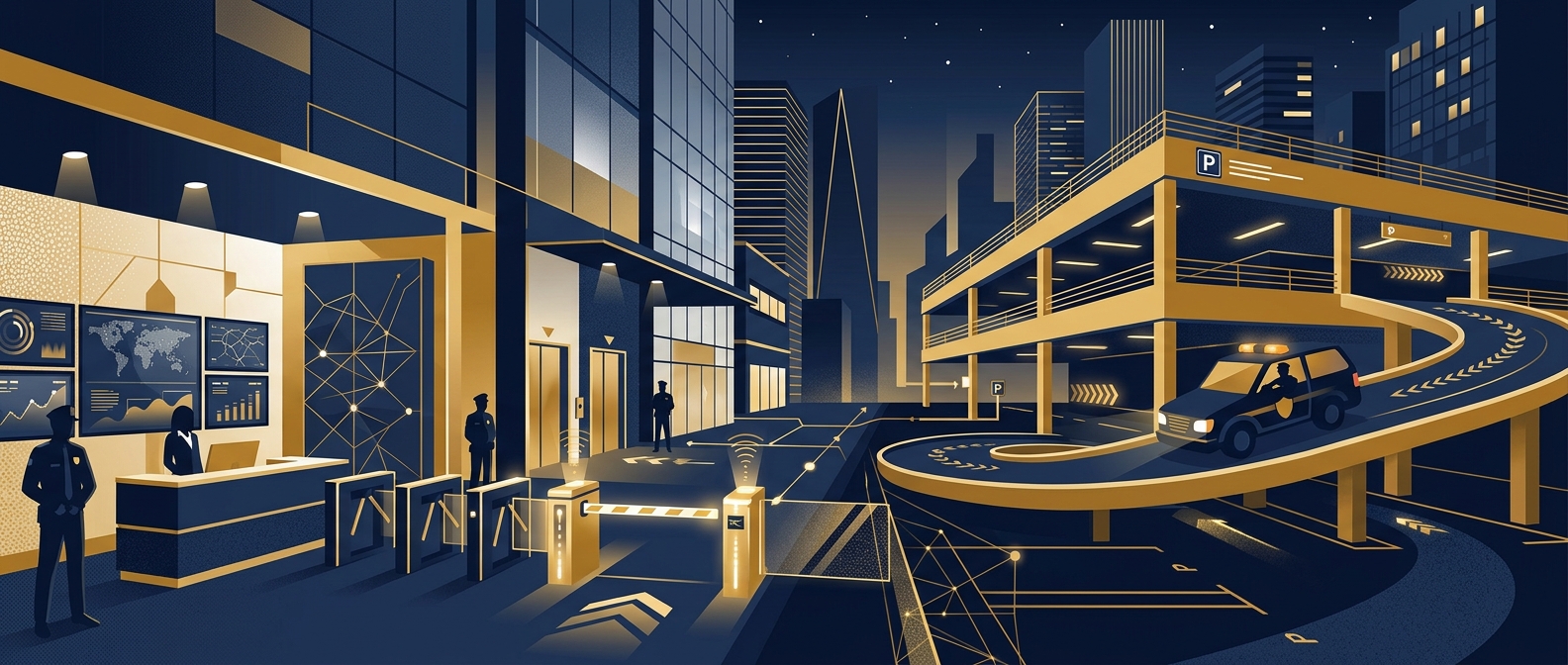
Commercial property security protects an office or mixed-use asset, its tenants, and its visitors through layered controls: lobby and concierge access control, visitor and tenant credentialing, roving foot and vehicle patrol, parking-structure coverage, after-hours and vacancy checks, trespass and transient management, alarm and incident response, and CPTED-informed design — all run against documented post orders and coordinated with life-safety and property management.
In dense, high-footfall submarkets like Tempe — the corridor around Arizona State University, Mill Avenue, and Tempe Town Lake — commercial property security is not a cost line to minimize. It is a risk-transfer and liability-management function that determines whether a Class A office tower, a mixed-use podium, or a suburban business park reads as controlled or as an open target. The difference between a program that reduces incidents and defensible liability exposure, and one that simply parks a person in a chair, comes down to how it is designed, staffed, supervised, and documented. This guide is written for the property manager, CRE owner, and corporate security lead who has to make that call.
What does commercial property security cover across an office or mixed-use asset?
A mature program treats the property as a series of concentric layers — the perimeter and approach, the parking structure or lot, the building envelope and entrances, the lobby and elevator lobbies, tenant floors, and after-hours dead zones — and assigns a control to each. The professional standards bodies frame this the same way: ASIS International publishes the physical-security and risk-assessment guidance that defines the discipline, and BOMA International sets the emergency-preparedness and building-operations benchmarks that CRE owners are measured against.
Across a typical Tempe office or mixed-use asset, the scope includes access control at all public and service entrances; tenant and visitor management; roving foot and vehicle patrol on posted routes; parking-structure security (the single highest-liability zone in most portfolios); after-hours and weekend coverage; management of trespass, loitering, and transient activity; alarm and incident response with proper escalation; CPTED-informed lighting, sightline, and landscaping recommendations; and tight coordination with fire/life-safety systems and property management. Each element should map to a written post order and a reporting standard — if an activity is not documented, for liability purposes it did not happen.
How should lobby and concierge access control and visitor management work?
The lobby is the property’s control point and its brand statement at once. Done well, concierge-level access control is simultaneously welcoming and rigorous: it verifies who belongs, deters who does not, and creates an auditable record without turning the entrance into a checkpoint that tenants resent. The officer at the desk is not a receptionist with a uniform; they are the human layer of your access-control system, trained to read behavior, enforce policy consistently, and act as the first responder to anything that comes through the door.
Visitor management should be system-driven, not paper-driven. Pre-registration by tenants, credential verification against a badge or government ID, temporary badge issuance with expiry, escort rules for sensitive floors, and denial protocols for unauthorized or trespassed individuals all belong in the post order. Tenant management is the parallel discipline: maintaining access lists, coordinating after-hours access, and handling the reality that in a multi-tenant building the officer serves many masters with different risk tolerances. The concierge function also feeds intelligence — an officer who notices the same unfamiliar individual studying the directory three days running is the early-warning system a camera alone can never be.
What does roving foot and vehicle patrol deliver, and how do you set post orders?
Patrol converts a static guard into active deterrence and detection. Roving foot patrol covers stairwells, back-of-house corridors, loading docks, roof access, tenant-floor common areas, and the exterior envelope; vehicle patrol extends reach across large business parks, surface lots, and multi-building campuses common in the Tempe/ASU market. The value is threefold: visible presence that deters opportunistic crime, early detection of problems (propped doors, water intrusion, fire hazards, unauthorized persons) before they become incidents, and a documented record that the property was actively monitored.
Post orders are the operating manual for the site. A professional set of post orders specifies, at minimum:
- Scope and authority — what the officer is and is not authorized to do, aligned to Arizona law and the client’s risk posture.
- Patrol routes and frequency — randomized timing (never predictable), specific checkpoints, and expected coverage per shift.
- Checkpoint verification — electronic tour systems (scan tags/GPS) that prove patrols actually occurred, defeating the “guard slept through the shift” liability.
- Incident classification and response — what to observe/report, what to intervene on, and what triggers escalation to police, fire, or management.
- Communication protocols — radio discipline, dispatch check-ins, and the notification chain for after-hours events.
- Reporting standards — the format, detail, and timeliness of daily activity reports and incident reports.
How do you secure parking structures, the top liability zone?
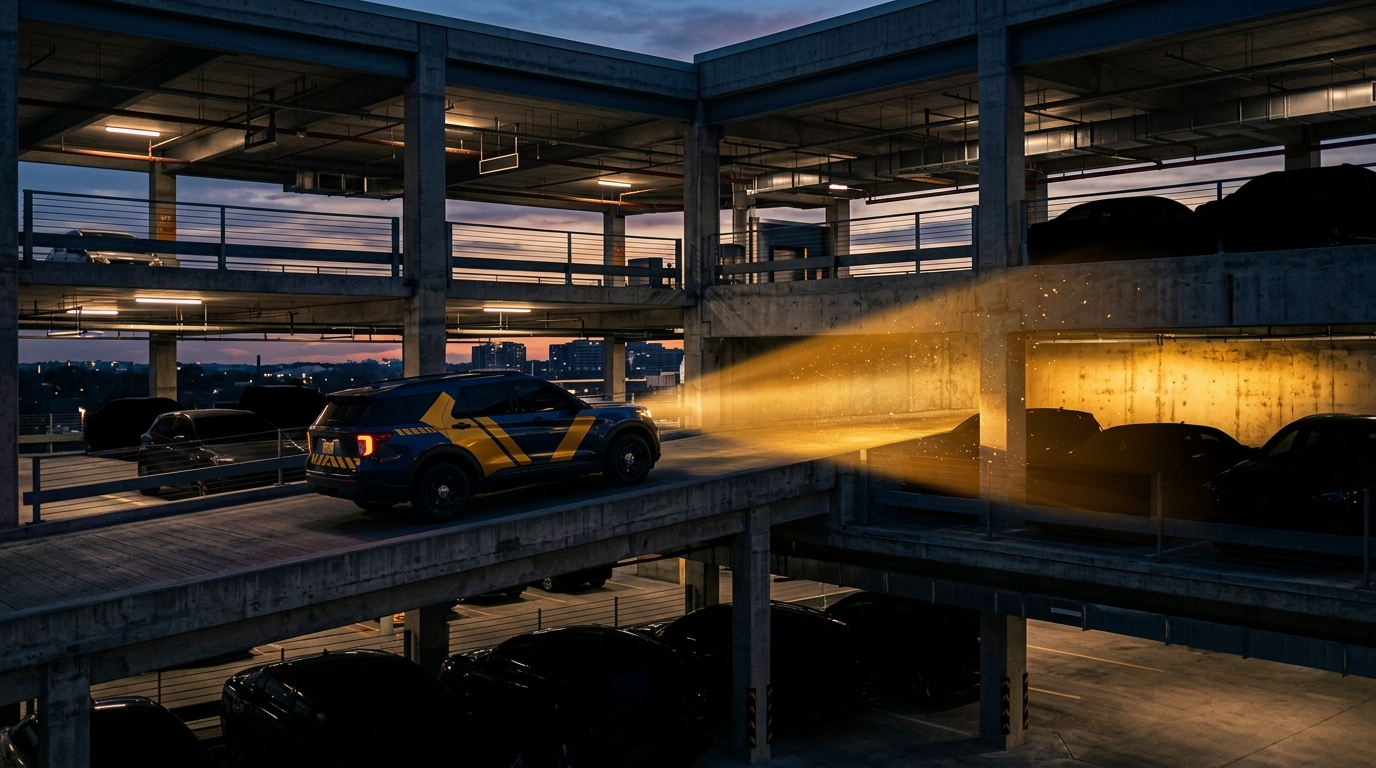
Parking structures and lots generate a disproportionate share of premises-liability claims because they combine isolation, poor sightlines, vehicle and personal-property value, and predictable pedestrian vulnerability — people walking alone to their cars, often after dark. In a mixed-use Tempe asset serving office tenants, retail, and event traffic, the garage is where foreseeability arguments in negligent-security litigation most often land. Securing it well is both a safety obligation and the sharpest lever on liability exposure.
Effective parking-structure security blends design and presence. On the CPTED side: high, uniform lighting with no dark pockets; open sightlines and mirrors at blind corners; trimmed landscaping that eliminates concealment; clear wayfinding and level identification; functional emergency call stations; and camera coverage at entries, stairwells, and elevator lobbies. On the human side: scheduled and randomized officer patrols through every level, escort services on request, stairwell and elevator-lobby sweeps, after-hours access control at vehicle and pedestrian entries, and rapid response to activated call stations. The combination is what a court reads as reasonable care; a camera recording an assault that no one was positioned to prevent is not.
How do you manage trespass, transients, and after-hours vacancy without escalation?
The Tempe/Mill Avenue corridor’s density and 24-hour activity bring persistent challenges with loitering, transient encampment in stairwells and loading areas, and trespass on private commercial property. The professional standard here is firm, lawful, and de-escalation-first. Officers must understand Arizona trespass law under ARS Title 13 — the distinction between criminal trespass degrees, the property owner’s authority to designate and enforce, and the correct sequence of notice, request to leave, and law-enforcement involvement — and apply it without improvisation. The goal is consistent enforcement that protects the asset and its tenants while avoiding the confrontation, liability, and reputational damage that a poorly trained officer creates.
After-hours and vacancy patrol is the complementary function. Vacant floors, tenant build-outs, weekend and holiday periods, and buildings in lease-up are prime targets for theft (especially copper and equipment), vandalism, squatting, and undetected water or fire damage. A disciplined vacancy-patrol program — interior and exterior checks on a verified schedule, utility and door-status confirmation, and immediate escalation of anomalies — protects value during exactly the windows when a static day-shift model leaves the property blind. De-escalation training, body-worn documentation where appropriate, and a clear “observe, document, and summon law enforcement” doctrine keep interventions safe and defensible.
How does negligent-security liability shape the program?
Negligent-security litigation turns on two questions: was the harm foreseeable, and was the security adequate to that foreseeable risk? Foreseeability is built from the history of incidents on the property and in the immediate area, the nature of the use, and known conditions. Adequacy is measured against what a reasonable property owner in the same circumstances would have done — which is precisely why alignment with recognized standards from bodies like ASIS and BOMA, and with law-enforcement guidance such as that curated by the International Association of Chiefs of Police, matters so much. A program documented against a real risk assessment is the difference between a defensible position and an indefensible one.
Practically, this means the property owner needs three things on record: a current risk/threat assessment that establishes what was foreseeable; a security program demonstrably matched to that assessment (staffing levels, patrol coverage, lighting, access control); and contemporaneous documentation proving the program actually operated as designed. The cheapest “warm body” vendor is the most expensive choice in litigation, because untrained, unsupervised, poorly documented guarding invites the exact adequacy challenge that drives large verdicts. Investing in a defensible program is risk management, not overhead.
How does security coordinate with life-safety and property management?
Security does not operate in isolation — it is one node in the building’s life-safety and operations ecosystem. Officers are frequently the first humans to reach a fire alarm, medical event, elevator entrapment, or utility failure, so the program must integrate with fire-command procedures, evacuation and shelter plans, elevator recall, and the building’s emergency action plan. Coordination with property management covers work-order handoffs (a patrol that finds a leak or a failed door), vendor and contractor access control, key and access-credential management, and after-hours event support.
The officers also serve as the property manager’s eyes after hours and the tenant’s point of reassurance. A well-run program produces daily activity reports and incident reports that give management a continuous operating picture, feeds maintenance and risk trends back into the asset plan, and rehearses emergency procedures so that when a real event occurs the response is practiced rather than improvised. This integration is what separates a security program from a security expense.
Static “warm body” guard vs. a professional commercial security program
| Dimension | Cheap “warm body” guard | Professional commercial security program |
|---|---|---|
| Basis of deployment | Bodies to a headcount | Staffing driven by a documented risk assessment |
| Post orders | Generic or absent | Site-specific, written, enforced, and updated |
| Patrol verification | Unverified; “trust me” | Electronic tour/GPS proof of coverage |
| Supervision | Little to none | Field supervision, QA visits, accountability |
| Training | Minimum licensing only | De-escalation, trespass law, life-safety, reporting |
| Documentation | Sparse or backfilled | Contemporaneous DARs and incident reports |
| Liability posture | Invites adequacy challenge | Defensible against foreseeability/adequacy |
| Coordination | Isolated | Integrated with life-safety and management |
What is the framework to design or upgrade a property security program?
- Assess. Conduct a risk and vulnerability assessment: incident history, crime data for the immediate area, physical vulnerabilities, tenant profile, and foreseeable threats specific to the asset and submarket.
- Design. Map controls to risk — access-control points, patrol routes and frequency, parking-structure coverage, after-hours model, and CPTED improvements to lighting, sightlines, and landscaping.
- Document. Write site-specific post orders, escalation trees, emergency procedures, and reporting standards; align them with recognized industry standards.
- Staff and train. Deploy licensed, vetted, supervised officers trained in de-escalation, Arizona trespass law, life-safety response, and professional reporting.
- Operate and verify. Run electronic patrol verification, field supervision, and quality audits so coverage is proven, not assumed.
- Review and improve. Reassess on a set cadence and after any significant incident, feeding findings back into staffing, design, and post orders.
What drives the cost of commercial property security?
Cost is driven by coverage hours (24/7 versus after-hours only), officer count and post configuration, whether patrol is foot, vehicle, or both, the size and complexity of the parking structure, and the level of officer training and supervision you require. Armed versus unarmed posts, specialized skills, and event or surge coverage add to the figure. The largest hidden cost driver is quality: heavily supervised, well-trained, properly documented officers cost more per hour but dramatically reduce incident frequency, turnover, and litigation exposure. The lowest bid usually reflects minimal training, thin supervision, and high turnover — the exact profile that fails in an incident and in court. Evaluate on total risk-adjusted value, not the hourly rate alone.
How does Honeybadger secure Tempe commercial properties?
Within Arizona, Honeybadger Solutions staffs commercial and mixed-use properties with our own in-house, Arizona DPS-licensed, supervised security officers — not subcontracted labor. Because Tempe is in Arizona, the officers protecting your lobby, patrolling your parking structure, and covering your after-hours windows are our own personnel, licensed and regulated under the standards administered by the Arizona Department of Public Safety, working from documented, site-specific post orders. We build each program from a real risk assessment, deploy verified patrols, and produce the contemporaneous documentation that keeps your liability posture defensible.
Operating from offices in Casa Grande, Phoenix, and Oro Valley, we serve the entire Tempe/ASU corridor, Mill Avenue, and Tempe Town Lake commercial market, and we extend coverage across Arizona, nationwide, and internationally through a commanded network of vetted partners where owned officers are not available. Whether you manage a single Class A tower or a portfolio of mixed-use assets, we design and run the program that protects your tenants, your visitors, and your asset value.
Frequently asked questions
Are Honeybadger’s Tempe security officers your own employees?
Yes. In Arizona — which includes Tempe — our commercial security and patrol officers are our own in-house, AZ DPS-licensed, supervised personnel, not subcontractors. We manage hiring, training, post orders, and field supervision directly. Nationwide coverage outside Arizona is delivered through a commanded network of vetted partners.
Why are parking structures such a high liability concern?
Parking structures combine isolation, poor sightlines, valuable property, and pedestrians who are alone and often in low light. That makes them the most common setting for premises-liability and negligent-security claims. Uniform lighting, open sightlines, functional call stations, camera coverage, and scheduled officer patrols together demonstrate the reasonable care courts look for.
How do officers handle trespassers and transients on our property?
Firmly, lawfully, and de-escalation-first. Officers apply Arizona trespass law under ARS Title 13 — proper notice, a request to leave, and law-enforcement involvement when warranted — and document every encounter. The objective is consistent enforcement that protects tenants while avoiding the confrontation and liability that untrained guarding creates.
What separates a professional program from a cheap guard vendor?
A risk-based staffing plan, site-specific post orders, electronic patrol verification, real field supervision, trained officers, and contemporaneous reporting. A “warm body” vendor offers none of these, which is exactly what invites an adequacy challenge in litigation. The professional program costs more per hour and far less in total risk-adjusted terms.
About Honeybadger Solutions
Honeybadger Solutions is an Arizona-licensed security and investigations firm. Within Arizona, our commercial security and patrol officers are our own AZ DPS-licensed, supervised in-house guards — not subcontracted labor — protecting office, retail, and mixed-use properties across the Tempe/ASU market and statewide. We extend nationwide and international coverage through a commanded network of vetted partners.
Offices: Casa Grande (HQ), Phoenix, and Oro Valley, Arizona.
Phone: 602-725-2818
Confidential consultation: Speak with a commercial security advisor about a risk assessment and program design for your Tempe property.