
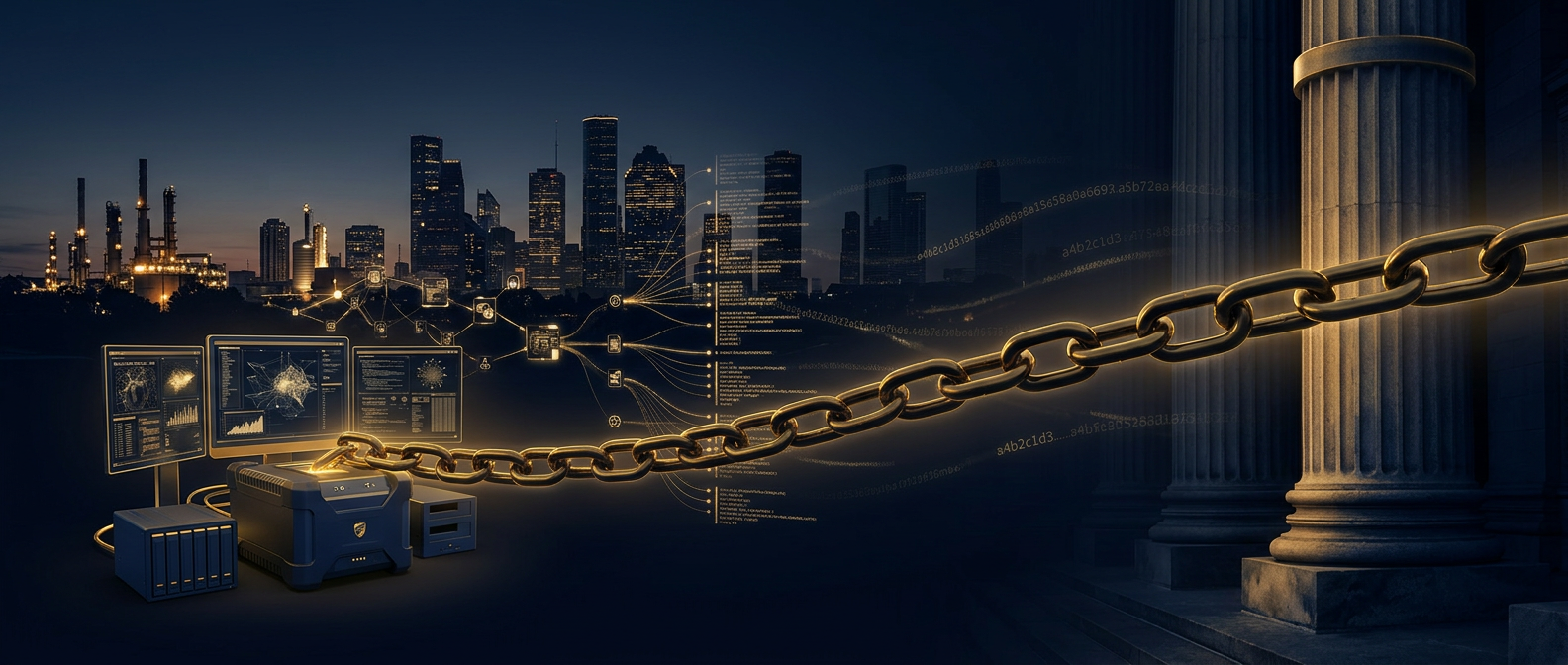
Digital forensics in Houston is the forensically sound preservation, acquisition, and analysis of electronically stored information so it holds up in Harris County courts, the Southern District of Texas, and arbitration. Whether the matter is energy trade-secret theft, a maritime casualty, or a commercial breakup, admissibility turns on write-blocked imaging, cryptographic hash verification, a continuous chain of custody, and an examiner who can defend the method under Texas Rule of Evidence 702. Done to standard, the recovered file is admitted; done casually, it is excluded.
No U.S. market concentrates data-intensive, high-value disputes quite like Houston. The energy corridor from downtown to the Energy Corridor district runs on assets that exist only as electronic records: seismic and reservoir models, drilling and completion designs, midstream throughput and nomination data, LNG offtake terms, and trading books worth nine figures. Layered on top is the Port of Houston and the Ship Channel, one of the busiest petrochemical and maritime complexes on earth, where casualty, cargo, and charter-party disputes are decided by vessel data recorders, ECDIS logs, and email between operators and charterers. This guide is written for the general counsel, litigation partner, energy executive, and principal who need to know exactly what makes electronic evidence defensible in Texas, where Houston matters come apart, and how an elite forensic partner differs from a drive-copying vendor.
How do Texas courts decide whether digital evidence is admissible?
Before a Texas judge lets a jury weigh what an email, a text thread, or a drive image says, the proponent must clear a threshold that has nothing to do with how compelling the content is. Under Texas Rule of Evidence 901 the item must first be authenticated — shown, by evidence sufficient to support a finding, to be genuine and unaltered. For electronically stored information that means a provable route from the original source to the exhibit, mathematical proof the working copy is bit-identical to the source, and a witness who can describe how the data was captured without changing it. A printout or a forwarded screenshot rarely carries that weight on its own.
Texas then filters expert and scientific method through a reliability gate. In civil litigation the controlling authority is E.I. du Pont de Nemours & Co. v. Robinson (1995), the state’s Daubert analog, applied under Rule 702, with the trial judge acting as gatekeeper over whether an opinion rests on a sound, tested foundation rather than an expert’s assurance. In criminal matters Texas applies the separate Kelly v. State (1992) test, which asks whether the underlying theory is valid, whether the technique applying it is valid, and whether it was correctly applied in the case at hand. Write-blocked imaging, hashing, and independently validated extraction tools clear both gates comfortably because they are testable and accepted — which is precisely why improvised handling is dangerous. Lawful acquisition is equally non-negotiable: Texas permits one-party-consent recording, but reaching into another person’s device or account without authority can violate the Texas Penal Code Chapter 33 Breach of Computer Security provisions and taint the very evidence it produces.
| Forum / posture | Governing reliability test | What the examiner must show |
|---|---|---|
| Texas civil (Harris County district courts) | Robinson factors under TRE 702 | Method is tested, has known error rates, and fits the facts |
| Texas Business Court, Eleventh Division (Houston) | Robinson under TRE 702, sophisticated bench | Documented, reproducible methodology for high-value commercial ESI |
| Texas criminal | Kelly v. State three-part test | Valid theory, valid technique, correct application |
| S.D. Texas (federal) | Daubert under FRE 702; FRE 902(14) self-authentication | Hash-verified copy certified by a qualified person |
Why does Houston’s energy and maritime economy raise the stakes?
Harris County runs one of the highest-volume civil dockets in the nation, and since late 2024 Texas has operated specialized Business Courts, whose Houston-seated Eleventh Division hears large commercial cases before a bench chosen for complex-litigation fluency. That sophistication raises the evidentiary bar: opponents are well funded, and they will probe every collection decision for an opening to exclude. The energy sector compounds it because the “secret” in dispute is usually a dataset rather than a document — a proprietary reservoir simulation, a seismic survey, a completion recipe, or a customer-and-pricing book whose value evaporates the moment a departing engineer or trader copies it.
Maritime adds a second evidentiary universe. When a vessel, terminal, or cargo incident occurs on the Ship Channel or offshore, the record lives in voyage data recorders, ECDIS and AIS logs, engine-management systems, and the email and messaging traffic between owners, charterers, and agents — data governed by preservation duties that attach the instant a claim is foreseeable. Both worlds share one trait: the decisive evidence is voluminous, heterogeneous, and perishable, so a provider that treats a Houston engagement as a routine hard-drive copy is a liability before the first motion is filed.
Which Houston disputes are decided by digital evidence?
Engagements in this market cluster into recognizable patterns, each with its own evidentiary center of gravity. The table maps the most common Houston matter types to where the proof usually lives and what forensic analysis is asked to establish. These are representative scenarios, not case files.
| Matter type | Where the evidence lives | What forensics establishes |
|---|---|---|
| Energy technical-data & trade-secret theft | Engineering workstations, USB history, cloud sync, model repositories | Exfiltration channel and timeline under TUTSA and the federal DTSA |
| Departing petroleum engineers & traders | Company laptops, personal cloud, encrypted messaging | What data left, by what route, and when relative to resignation |
| Maritime casualty, cargo & charter disputes | Voyage data recorders, ECDIS/AIS logs, operator email | Sequence of events and communications around the incident |
| JOA, EPC & midstream contract disputes | Email, accounting systems, document metadata | When records were created or altered, and by whom |
| Royalty & joint-venture accounting fights | Financial systems, spreadsheets, correspondence | Concealment, diversion, and authenticity of the numbers |
| FCPA-adjacent & internal investigations | Corporate mail, chat, payment and vendor records | Intent, relationships, and money movement across a timeline |
The Texas-specific thread is that trade-secret exposure runs through the Texas Uniform Trade Secrets Act (Civil Practice and Remedies Code Chapter 134A) alongside the federal DTSA, so the forensic timeline of exactly when and how data moved is frequently dispositive — and in energy matters that timeline is reconstructed from artifacts, not testimony.
What is the defensible acquisition sequence for a Houston matter?
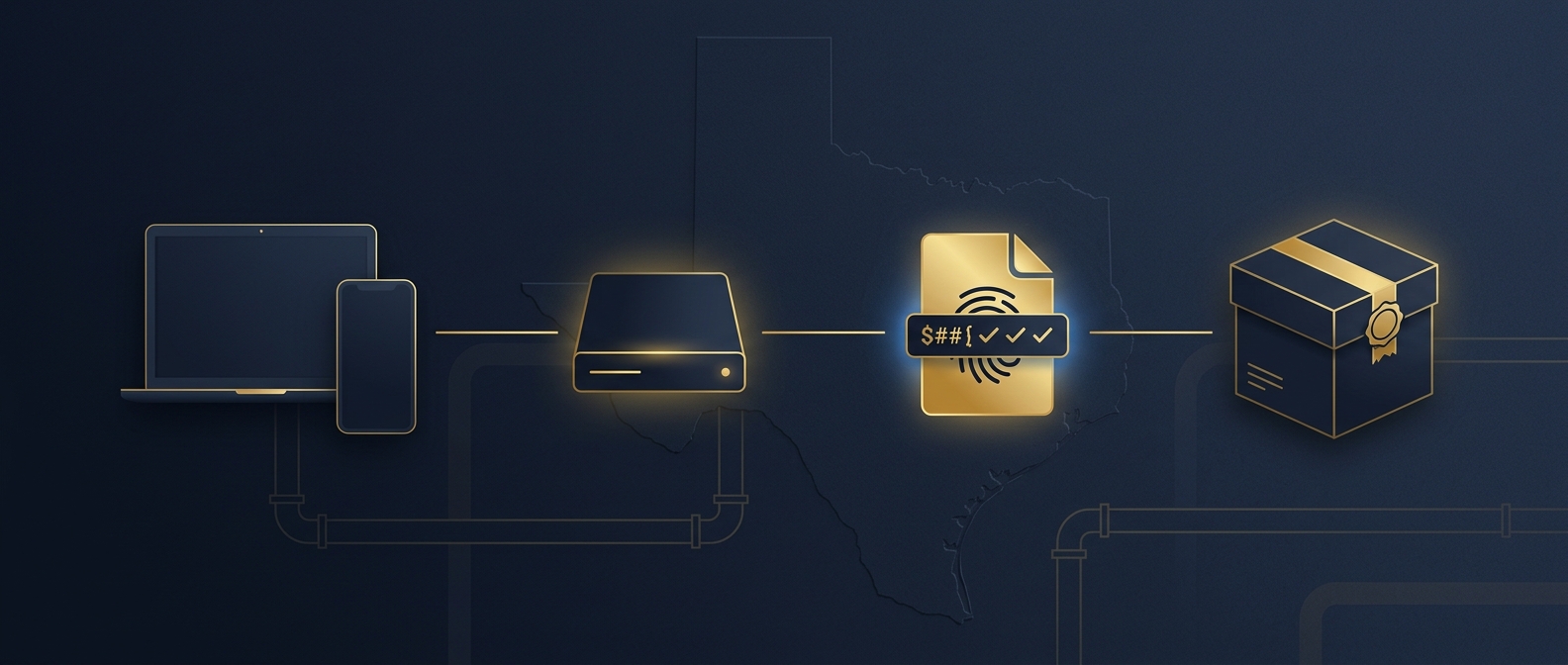
Elite collection is a documented sequence performed in real time, not reconstructed after the fact, and it is built specifically to survive cross-examination. The steps below reflect how large energy datasets and mixed device populations are actually captured, and they track the tool-validation reference maintained by the NIST Computer Forensics Tool Testing program.
- Confirm authority before touching anything. With counsel, fix the custodians, systems, and datasets in scope and verify the legal right to collect, so nothing is gathered in violation of Penal Code Chapter 33.
- Map and freeze the sources. Locate every workstation, server share, cloud tenant, and device — and stop ongoing change, including network isolation to prevent remote wipe or continued sync.
- Record original state. Photograph and log each device’s condition, connections, and power status before any interaction.
- Image through a write-blocker. Capture a bit-for-bit image; the original is never booted, browsed, or analyzed.
- Hash at the source. Compute SHA-256 for source and image, confirm they match, and record both values contemporaneously.
- Handle large technical datasets deliberately. For multi-terabyte seismic, simulation, or trading data, document the collection method and verify completeness so volume never becomes an excuse for gaps.
- Log every custody transfer. Capture who held the evidence, when, why, and in what condition, leaving no unexplained interval.
- Work only on verified copies. All examination runs against working images; the master stays sealed, encrypted, and access-logged.
- Re-verify before production and testimony. Confirm the hash still matches before analysis and again before the exhibit is offered, and preserve the notes and custody record that let the method be defended under Robinson.
The sequence is deliberately unglamorous. Court-ready work looks methodical because every step is engineered to be explained, reproduced, and defended in front of a hostile examiner months or years later.
Improvised collection versus forensic acquisition: why the gap decides matters
The most common way a strong Houston case dies is well-intentioned self-help: a departing engineer’s laptop is booted “just to check,” an administrator exports a mailbox, or a custodian drags files to a shared drive. Each act rewrites metadata, breaks custody, and hands a sophisticated opponent an authenticity fight. Where a single dataset can carry nine-figure value, that is a catastrophic trade.
| Consideration | Improvised / IT handling | Forensic acquisition |
|---|---|---|
| Large technical datasets | Partial copies; completeness unproven | Verified full capture with documented method |
| System & file metadata | Overwritten on access | Preserved intact |
| Deleted & unallocated data | Lost | Recoverable |
| Integrity proof | No hash baseline | SHA-256 captured and re-verified |
| Chain of custody | Gaps and unlogged access | Continuous and documented |
| Courtroom posture | Exposed to a Robinson / Rule 901 challenge | Built to withstand adversarial scrutiny |
The lesson for Houston counsel is to route the data to a forensic examiner before anyone opens it. Once a device is booted or a mailbox exported by untrained hands, the fight shifts from the merits to the reliability of the evidence — exactly where a well-funded opponent wants it.
What distinguishes an elite forensic partner in Houston?
Providers diverge sharply under pressure, and sophisticated buyers weigh capability rather than the per-gigabyte rate. In an energy or maritime matter, look for:
- One accountable chain. When acquisition, analysis, and testimony run under a single in-house team rather than a subcontractor relay, custody does not fragment and privilege is easier to hold.
- Fluency with energy and maritime data. Handling seismic volumes, reservoir models, VDR and ECDIS logs, and trading systems requires domain literacy a generalist vendor lacks.
- Validated tooling and documented method. The partner should cite the independent validation that satisfies the Robinson reliability inquiry.
- Testimony experience. An examiner who has survived cross writes reports and keeps records with the witness stand in view from the first hour.
- Speed on perishable data. Evidence is fleeting after a resignation or a casualty; the right partner mobilizes immediately without cutting a procedural corner.
- Full-spectrum reach. Forensics rarely stands alone, so a partner who also brings investigations, cyber, and financial intelligence can follow the evidence without a hand-off to a stranger.
The common denominator is defensibility: work designed from the outset to be explained and survived on the record, not merely to reach an answer.
How does Honeybadger deliver court-ready forensics to Houston?
Honeybadger Solutions delivers digital forensics to Houston through in-house, remote-by-design laboratories, so the team that scopes a matter carries it through acquisition, analysis, and production under one chain of custody and command. Because our forensic, cybersecurity, financial-investigation, and background-intelligence capabilities are handled internally rather than farmed out, evidence never fragments across vendors, and privilege and confidentiality hold end to end — as decisive in an energy trade-secret fight as in a maritime casualty or a family-office matter.
These disciplines are global and remote-by-design, so we serve Houston and the broader Texas market without a hand-off, mobilizing quickly to preserve perishable data before it is overwritten, and coordinating any on-the-ground steps through vetted resources while the chain of custody and command stays intact. Texas is an established operational theater for the firm, and our examiners build methodology and documentation meant to be defended on the record — by written certification or live testimony — under Rule 702 and the Robinson factors. That discipline extends across the full arc of a dispute through our investigations practice. Operating from Arizona home command, with offices in Casa Grande, Phoenix, and Oro Valley, we close the gap between what the data shows and what a Texas court will actually admit.
Frequently asked questions
How fast must we move to preserve evidence after a key engineer resigns?
Immediately. Digital evidence is perishable — cloud accounts re-sync, laptops are re-imaged and reissued, and messaging apps auto-purge — so the artifacts that prove exfiltration can vanish within days. The right move is to isolate the person’s devices and accounts, avoid powering them on or browsing them, restrict who knows, and have a forensic examiner acquire them under a documented chain of custody. Preserving properly on day one is far cheaper than litigating a broken collection later.
Which Texas standard governs forensic expert testimony?
In civil cases, the Robinson factors applied under Texas Rule of Evidence 702, with the trial court acting as gatekeeper over reliability — the state’s Daubert analog. In criminal cases, Texas applies the separate Kelly v. State test for valid theory, valid technique, and correct application. Established forensic methods such as write-blocked imaging and hash verification satisfy both because they are tested, repeatable, and generally accepted.
Can evidence from offshore rigs or out-of-state operations be handled remotely?
For most digital evidence, yes. Our laboratories are in-house and remote-by-design, so acquisition, analysis, and reporting run under one accountable team regardless of where the data sits, and we mobilize quickly to preserve it before it is overwritten. Where hands-on collection is required at a remote or offshore site, we coordinate it through vetted resources while keeping the chain of custody and command unbroken.
Can we forensically image a company device an employee also used personally?
Usually yes for a company-owned device under a clear policy, but authority should be confirmed with counsel first, because personal accounts and data accessed through that device can raise privacy and Penal Code Chapter 33 issues. A disciplined engagement scopes the collection to what the company is entitled to access and documents that authority, so the resulting evidence is both lawful and admissible rather than a liability.
About Honeybadger Solutions
Honeybadger Solutions is an Arizona-licensed security and investigations firm delivering intelligence-led forensics, investigations, and cyber services to executives, general counsel, energy and maritime companies, families, and organizations across Houston, Texas, and worldwide. Digital forensics, cybersecurity, financial investigations, and background intelligence are handled in-house and remote-by-design, so every step from preservation through production runs under a single accountable chain of custody and command.
Offices: Casa Grande (HQ), Phoenix, and Oro Valley, Arizona.
Phone: 602-725-2818
Confidential consultation: discuss a Houston forensic-collection or evidence-preservation matter with our command team.