
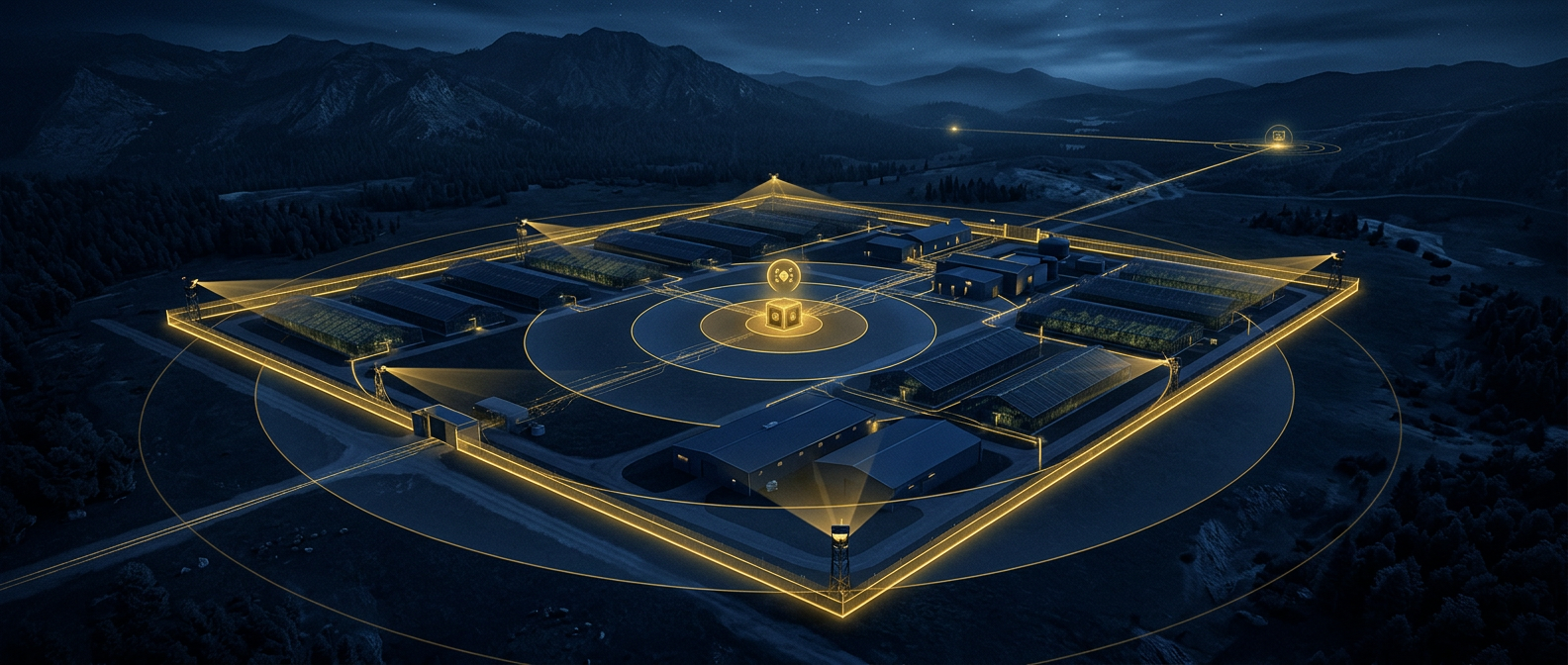
A cannabis cultivation facility security plan is a documented, defense-in-depth program protecting a licensed grow site from theft, diversion, and regulatory failure across its unique attack surface. It integrates hardened perimeter and greenhouse controls, layered access zoning, seed-to-sale tracking integrity, insider-diversion deterrence, and cyber-physical monitoring — engineered to satisfy state licensing conditions while surviving the real threats a high-value, cash-and-crop operation faces on often remote land.
A licensed cultivation facility is one of the most target-rich and most poorly defended assets in the legal cannabis economy. It concentrates enormous value — living plants, drying biomass, extracted concentrate, and, in many operations, cash — on sprawling, often rural parcels far from the layered protection a downtown retail location enjoys. Regulators treat it as a controlled-substance handling site, which means a single lapse is not merely a loss event but a potential license-ending compliance failure. This guide is written for the operator, general counsel, or investor chartering security for a grow operation. It addresses the vulnerabilities specific to cultivation — perimeter and greenhouse exposure, seed-to-sale data integrity, insider diversion, access zoning, remote-site protection, and the compliance floor beneath all of it — and it is deliberately distinct from retail dispensary security, which solves a different problem.
Why is a cultivation facility a different security problem than a dispensary?
Operators frequently make the costly mistake of copying a dispensary security template onto a grow site. The two are governed by the same regulators but face structurally different risk. A dispensary is a compact, staffed, urban retail box with limited inventory on the floor and a vault behind it; its threat model is armed robbery and after-hours burglary over a short, well-lit footprint. A cultivation facility is a large-acreage industrial and agricultural operation with product distributed across greenhouses, grow rooms, drying and curing spaces, and extraction areas — frequently in low-density, low-patrol locations where response times are measured in tens of minutes, not minutes.
| Dimension | Cultivation / grow facility | Retail dispensary |
|---|---|---|
| Footprint | Large acreage, multiple structures, greenhouses, outdoor canopy | Compact single retail unit |
| Location | Often rural / remote, low patrol density | Usually urban / commercial corridor |
| Primary asset | Living plants, biomass, concentrate — high volume, traceable | Packaged product and daily cash |
| Dominant threat | Insider diversion, perimeter breach, crop theft, remote-site vulnerability | Armed robbery, smash-and-grab burglary |
| Detection challenge | Long response times; large area to cover; night operations | Fast law-enforcement response; small area |
| Compliance focus | Seed-to-sale tag integrity, waste destruction, canopy accountability | Point-of-sale limits, ID verification, purchase caps |
| Highest-loss failure | Slow, undetected diversion of grams across a growing cycle | Single-event robbery loss |
The defining difference is that a dispensary’s worst day is a single violent event, while a cultivation facility’s worst outcome is usually quiet and cumulative: a trusted employee skimming a small, deniable fraction of every harvest for months. A world-class cultivation plan therefore weights insider deterrence and inventory accountability at least as heavily as it weights fences and cameras.
What are the biggest physical vulnerabilities at a grow facility?
Cultivation sites fail at predictable seams. The first is the perimeter: expansive parcels are expensive to fence to a genuine security standard, so operators install agricultural fencing that delays a determined intruder by seconds. Effective perimeters combine anti-climb fencing, cleared sightlines (crime prevention through environmental design), thermal and analytics-enabled cameras that see in darkness, and lighting designed to eliminate shadow rather than merely illuminate a sign. The perimeter’s job is not to stop entry but to detect and delay it long enough for a monitored response — which on remote land must be planned around realistic law-enforcement and guard-response timelines.
The second seam is the greenhouse and grow structure itself. Polycarbonate and film greenhouses are engineered for light transmission and climate, not intrusion resistance; their walls can be breached without tools, and their many service doors, roll-up vents, and irrigation penetrations multiply the entry points a hardened concrete building would never have. Ground-floor grow rooms, drying rooms, and extraction areas each hold different value densities and demand different hardening. The third seam is power and connectivity: an intruder or insider who kills power or network uplink can blind the surveillance and access systems, so a serious plan includes battery/UPS backup, cellular failover for alarm signaling, tamper alarms on the network and power infrastructure, and local recording that survives an internet outage.
Most states codify a baseline for these controls, and industry bodies such as ASIS International publish physical-security standards that mature operators exceed rather than merely meet. The federal CISA physical-security guidance on facility hardening, standoff, and layered defense applies directly to the cultivation context even though cannabis sits outside federal legality.
How does seed-to-sale tracking integrity get attacked?
Every regulated cultivation facility operates under a state-mandated track-and-trace system — in most states the Metrc platform — that assigns a unique tag to every plant and package and reconciles inventory from seed to sale. On paper, this makes theft difficult. In practice, the tracking system is itself an attack surface, and its integrity is a security discipline, not merely a compliance chore.
Diversion schemes exploit the gaps between the physical plant and its digital record. Common vectors include mis-weighing wet versus dry biomass to create untracked “shrinkage,” recording inflated waste and destruction to mask product walking out the back, tag swapping or cloning, understating yield per plant, and manipulating the moisture-loss and trim allowances that legitimately exist in the workflow. Because a small percentage skimmed at each step is individually deniable and collectively enormous, the tracking record can look pristine while grams bleed out of every cycle. Protecting integrity means treating the track-and-trace data as regulated financial data: enforced segregation of duties between the person who weighs, the person who records, and the person who destroys; dual-control and witnessed destruction of waste; reconciliation of physical counts against system counts on a defined cadence; and cyber controls on the accounts and endpoints that touch the system. This is where physical security and cybersecurity converge — credential hygiene, access logging, and anomaly detection on the tracking platform are as load-bearing as the fence line.

How do you stop insider diversion at a cultivation site?
Industry loss data and law-enforcement experience point to the same uncomfortable truth: the largest share of cultivation loss is not the masked intruder cutting a fence but the badged employee with legitimate access. Cultivation is seasonal, labor-intensive, and reliant on temporary trimming and harvest crews who handle enormous volumes of loose product with the most opportunity and the least screening. A plan that spends heavily on cameras while hiring harvest labor without meaningful vetting has defended the wrong flank.
Countering insider diversion is a program, not a device. Its pillars are: rigorous pre-hire background intelligence on permanent and seasonal staff within the bounds of state cannabis-worker rules and employment law; segregation of duties so no single person controls weighing, recording, and destruction; mandatory two-person integrity in high-value areas (extraction, drying, vault); camera coverage engineered specifically over scales, trim tables, and waste points rather than merely at doors; controlled bag-check and clean-room protocols on entry and exit; and behavioral awareness that correlates lifestyle and access anomalies without descending into unlawful surveillance. When a discrepancy surfaces, it must be worked as a documented investigation — evidence preserved, chain of custody maintained, interviews conducted lawfully — so the outcome survives an employment tribunal or a criminal referral rather than collapsing into a wrongful-termination claim.
What does effective access zoning look like?
Access zoning is the single most powerful concept in cultivation security because it converts a large, porous site into a series of nested, individually defended compartments. The principle is least privilege applied to physical space: a person is admitted only to the zones their role requires, transitions between zones are controlled and logged, and value density rises as zone depth increases. A disciplined zoning model layers a cultivation facility as follows:
- Zone 0 — Public buffer. The approach, parking, and property line. Controls: fencing, gates, signage, lighting, license-plate and overview cameras, and a single defined vehicle entry.
- Zone 1 — Controlled site. The interior grounds inside the fence. Controls: badge-gated pedestrian and vehicle access, visitor escort and log, perimeter analytics, and a staffed or virtually monitored entry point.
- Zone 2 — Operational areas. Vegetation and flowering rooms, greenhouses, and general work areas. Controls: role-based badge access, interior cameras over work surfaces, and enforced entry/exit routing.
- Zone 3 — High-value processing. Drying, curing, trim, and extraction. Controls: two-person rule, elevated camera density over scales and tables, restricted badge list, and tamper alarms.
- Zone 4 — Secure vault and finished product. Concentrate, packaged inventory, and any cash. Controls: rated vault or safe, dual-authentication access, continuous recording, motion detection, and audited entry logs reconciled against track-and-trace.
The strength of the model is that a breach of one zone does not compromise the next, and every transition generates an auditable record that ties a person to a place and time — the same record that later resolves a diversion investigation. Access-control logs, camera timelines, and the seed-to-sale ledger should reconcile against one another; where they diverge is precisely where loss hides.
How do you protect remote and rural cultivation sites?
Many cultivation operations sit on agricultural or industrial land chosen for zoning and cost, not for security — which means long response times, limited utilities, and neighbors who are few and far between. Remote-site protection reframes the objective from “prevent entry” to “detect early, deter credibly, and buy time for a planned response.” That demands technology that functions without constant human presence: analytics cameras that distinguish a person from wildlife and trigger verified alarms, remote video monitoring by an operator who can issue live audio challenges, thermal imaging for perimeter and canopy coverage at night, and communications resilience so a cut line or dead cellular tower does not silence the site.
Because a monitoring center in another state cannot physically intervene, the plan must pre-arrange the response: relationships with local law enforcement, a defined guard or patrol posture appropriate to the site’s value and isolation, and escalation protocols that specify exactly who is called and what they do. Physical, executive-protection, and armed-response capabilities are delivered through a commanded, vetted-partner network rather than assumed to exist locally — a distinction that matters enormously when a facility sits hours from the nearest qualified responder. This is core commercial and corporate security work: matching a credible, lawful response posture to the realistic threat and geography rather than selling equipment the site cannot act upon.
What compliance requirements shape the plan?
Cannabis remains federally illegal, so there is no single national security standard; instead, each state’s cannabis authority sets licensing conditions that function as the mandatory floor. While specifics vary, cultivation licenses commonly require some combination of: a defined and monitored perimeter; continuous video surveillance with mandated resolution and retention periods (frequently measured in weeks or months); alarm systems on entrances and limited-access areas; secure storage for product and waste; documented limited-access-area designations and visitor logs; enrollment in the state seed-to-sale system; and a written, submitted security plan that the regulator approves as a condition of licensure. Waste destruction is a distinct and heavily scrutinized requirement, because mishandled waste is a classic diversion channel.
The strategic error is treating these requirements as the ceiling. Regulators define the minimum needed to hold a license; they do not define what protects a multimillion-dollar operation from a determined insider or an organized crew. A genuine security program satisfies the state’s checklist as a byproduct of a defense-in-depth design that would be sound even if no regulator required it — and it documents that design so the licensing submission is a description of reality rather than an aspiration.
How does Honeybadger secure cultivation operations?
Honeybadger Solutions builds and hardens cultivation-facility security programs as an independent partner that spans the physical, investigative, and cyber dimensions the work demands. We design the layered perimeter, greenhouse hardening, access-zoning model, and surveillance coverage; align them to the governing state’s licensing conditions; and stress-test the seed-to-sale integrity controls where physical accountability meets data security. Our security and consulting teams translate a large, exposed site into defensible compartments with a response posture matched to its geography.
Because digital forensics, cybersecurity, financial investigations, and background intelligence are handled in-house and delivered nationwide and internationally, we close the gaps that defeat most cultivation plans: pre-hire vetting of permanent and seasonal crews, cyber hardening of the track-and-trace environment, and rigorous investigation of diversion when the numbers do not reconcile. Physical, executive-protection, and armed-response services are delivered through a commanded, vetted-partner network — with established theaters in California, Texas, and Florida and Arizona as home command — so an operation on remote land is matched to a credible, lawful responder rather than left with an alarm that no one can answer. An Arizona-licensed firm with offices in Casa Grande, Phoenix, and across Arizona and serving clients nationally, Honeybadger gives cultivation operators one accountable command team from plan design through the hardest contested loss.
Frequently asked questions
How is grow-facility security different from dispensary security?
A dispensary is a compact urban retail box whose dominant threat is armed robbery and burglary over a small, fast-response footprint. A cultivation facility is a large, often rural industrial-agricultural site whose dominant threat is slow, cumulative insider diversion across a growing cycle, compounded by long response times and porous greenhouse structures. Cultivation plans weight insider deterrence, access zoning, and seed-to-sale integrity far more heavily than a retail template does.
What is the most common way product is diverted from a grow?
The most common losses exploit the gap between the physical plant and its track-and-trace record: skimming small, deniable amounts during weighing and trimming, inflating recorded waste and destruction, understating yield, and tag manipulation. Because each skim is individually small and collectively large, the digital ledger can look clean while grams bleed out every cycle. Segregation of duties, witnessed destruction, and camera coverage over scales and waste points are the core countermeasures.
Do state regulations dictate the entire security plan?
No. State cannabis authorities set licensing conditions — perimeter, surveillance retention, alarms, limited-access areas, secure storage, waste destruction, and seed-to-sale enrollment — that form the mandatory minimum. They do not define what actually protects a high-value operation from a determined insider or organized crew. A sound program satisfies the state checklist as a byproduct of a defense-in-depth design that would be justified even absent any regulatory mandate.
How do you secure a cultivation site that is far from law enforcement?
Remote sites shift the goal from preventing entry to detecting early, deterring credibly, and buying time for a pre-arranged response. That means analytics and thermal cameras with verified-alarm remote monitoring and live audio challenge, communications resilience against cut lines or cellular outages, and a documented escalation plan tied to local law enforcement and a vetted guard or patrol posture appropriate to the site’s isolation and value.
About Honeybadger Solutions
Honeybadger Solutions is an Arizona-licensed security and investigations firm helping cannabis cultivators, operators, and investors design and harden grow-facility security programs nationwide and internationally. Digital forensics, cybersecurity, financial investigations, and background intelligence are handled in-house; physical, executive-protection, and armed-response services are delivered through a commanded, vetted-partner network with established theaters in California, Texas, and Florida and Arizona as home command.
Offices: Casa Grande (HQ), Phoenix, and Oro Valley, Arizona.
Phone: 602-725-2818
Confidential consultation: discuss a cultivation-facility security assessment with our command team.