

Return and refund fraud is investigated by treating the returns counter as a financial-crime surface, not a customer-service desk. Elite retailers use return analytics to flag anomalous refund patterns — wardrobing, receipt and label fraud, empty-box returns, cashier collusion, and gift-card schemes — then corroborate each lead with transaction-linked video, point-of-sale forensics, and audit before acting. Detection is statistical; the case is built with evidence.
The return counter is the most under-policed cash-out point in retail. Every legitimate return is a controlled reversal of a sale — money and merchandise moving backward across the same threshold that inventory and revenue moved forward. Fraudsters understand this better than most operators do: a refund is a way to convert stolen, borrowed, or never-purchased goods into cash, store credit, or a transferable gift card, often with a smile and a story rather than a weapon. Because returns are framed internally as service, the controls that guard the front of the transaction frequently evaporate at the back of it. This guide is written for the retail principal, CFO, general counsel, or head of asset protection who owns refund shrink — explaining the anatomy of the major return-fraud schemes, how return analytics and pattern detection surface them, how a defensible investigation is built, and which policy and technology controls actually close the gap without punishing honest customers.
What is return and refund fraud, and why does it matter?
Return fraud is the abuse of a retailer’s return, refund, or exchange process to extract cash, credit, or merchandise the claimant is not entitled to. It sits at the intersection of external theft, internal theft, and organized crime, which is precisely what makes it dangerous: the same refund transaction can be exploited by an opportunistic customer, a dishonest cashier, or a coordinated crew running the same play across dozens of stores. Unlike shoplifting, refund fraud frequently produces a clean paper trail — a completed, authorized transaction — which is exactly why it hides so well inside ordinary returns data.
It matters because refunds strike at margin twice. When a fraudulent refund is paid, the retailer loses the cash and either loses the merchandise entirely or takes back goods it cannot resell at full value. Return fraud and abuse is a recognized, multi-billion-dollar drain on the sector tracked in the National Retail Federation’s annual research on returns, and the volume rises with e-commerce, where liberal return policies and remote purchasing widen the attack surface. The strategic point is not that returns are bad — generous returns drive sales — but that an ungoverned return process quietly converts a sales-driving policy into a fraud subsidy.
What are the main types of return and refund fraud?
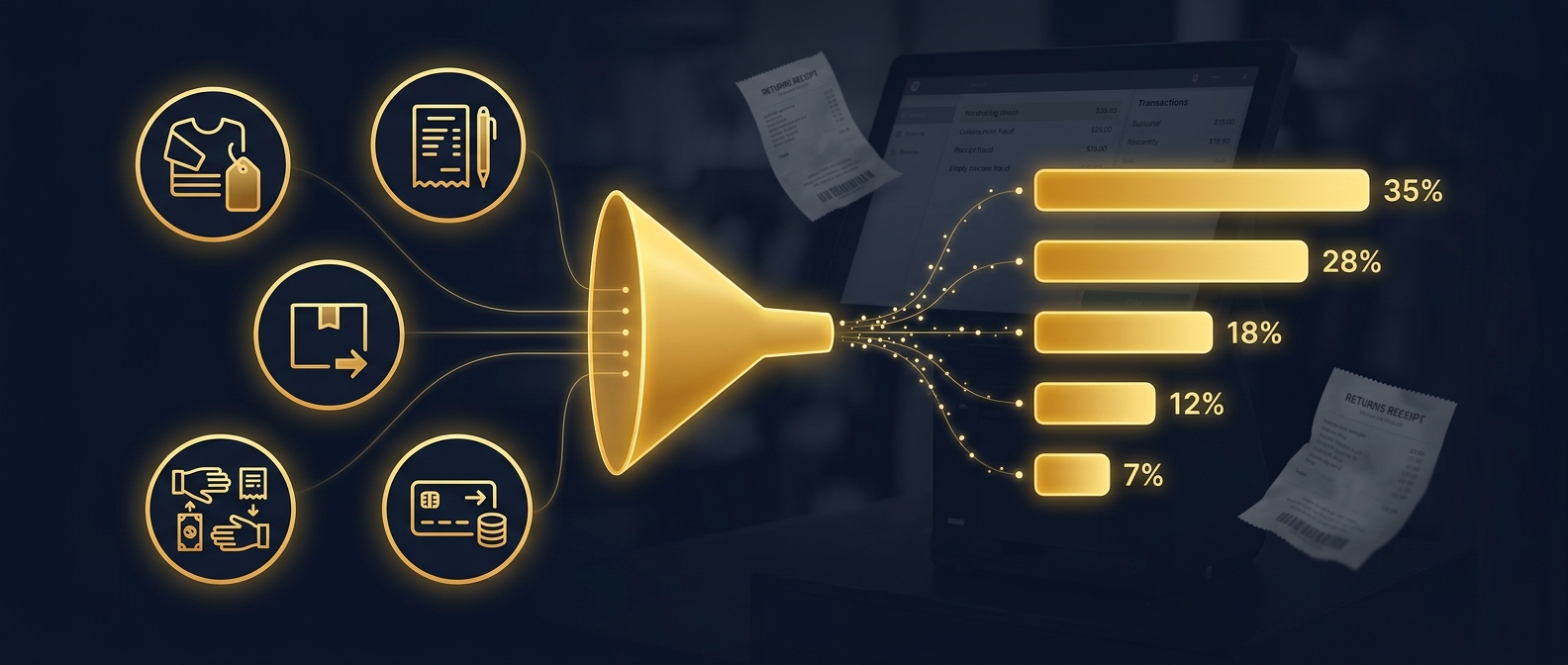
Effective investigation begins with recognizing that “refund fraud” is a family of distinct schemes, each with a different mechanism, a different perpetrator profile, and a different evidentiary signature. Treating them as one blur is how programs miss the organized and collusive variants that do the most damage. The table below sets out the principal schemes and how each behaves.
| Scheme | How it works | Typical signal | Primary detection |
|---|---|---|---|
| Wardrobing / “free renting” | Buying an item, using it once, then returning it as new (apparel, tools, electronics, event goods) | Worn/used goods returned within the window; repeat returners of seasonal or occasion items | Condition inspection, return-rate analytics per customer |
| Receipt & label fraud | Returning with forged, borrowed, reused, or manipulated receipts; switching price tags/labels | Receipts that don’t match tender, SKU, or store; price mismatches | Receipt validation, tender matching, POS reconciliation |
| Empty-box / product swap | Returning an empty box, a substituted lower-value item, or a broken unit in a new box’s place | Weight/serial mismatch; returned units that fail QA on reopening | Serial-number capture, weight checks, teardown audit |
| Collusive / employee refund fraud | Cashier issues refunds with no return, to accomplices, or to their own cards/gift cards | Refunds without matching sales; refunds clustered to one operator or tender | Exception-based reporting, operator-level analytics |
| Gift-card & store-credit schemes | Converting stolen goods or fraudulent refunds into gift cards; refund routed to a controlled card | Refunds to gift cards, rapid card draining, sequential card activity | Refund-tender analytics, gift-card lifecycle tracking |
| Organized return fraud (ORC-linked) | Crews returning shoplifted or fraudulently obtained goods for cash/credit across many stores | Same identities/patterns across locations; high-value resellable SKUs | Cross-store correlation, identity linkage, intelligence |
Two of these deserve emphasis because they are the costliest and the most frequently under-investigated. Collusive employee refund fraud is uniquely damaging because the insider controls the very system meant to catch fraud — a cashier who can issue a refund can issue one to nowhere. Organized return fraud is damaging because it is not a single-store problem: the same crew, receipt template, or synthetic identity appears across a region, and any store viewing its own data in isolation sees noise rather than a pattern. Both require analytics and investigation, not policy tweaks alone.
How do return analytics detect refund fraud?
Return analytics — a specialized form of exception-based reporting — is the detection engine. Rather than inspecting every return, the system ingests point-of-sale, refund, tender, inventory, and where available customer-identity data, then flags the statistical outliers that correlate with fraud. Its power is that abusive returns look ordinary one at a time and highly abnormal in aggregate. A single refund without a receipt is routine; the same operator issuing dozens of no-receipt cash refunds per shift is a case.
The patterns mature programs isolate include:
- Refunds without matching sales — refund transactions with no corresponding original purchase in the record, the clearest signature of fabricated returns.
- Operator-clustered refunds — a disproportionate share of no-receipt, manual-override, or cash refunds tied to a specific cashier, register, or shift.
- Serial-return identities — a customer, card, phone number, or address whose return rate and return value sit far outside the norm, the signature of wardrobing and habitual abuse.
- Refund-tender anomalies — cash refunds on card purchases, or refunds routed to gift cards and store credit at rates that deviate from the store baseline.
- Cross-store linkage — the same identity, receipt image, or SKU pattern appearing across multiple locations, the signature of organized crews.
- Post-void and manual-override abuse — returns manipulated through voids, price overrides, and cancellations that mask where the money actually went.
Return analytics does not accuse; it prioritizes. A flagged pattern is a lead, never a verdict, and the discipline that separates a credible program from a reckless one is what happens next: corroboration before conclusion. That discipline is also what keeps a finding defensible if it becomes an employment action, an insurance claim, or a criminal referral.
How is a return-fraud investigation actually built?
An analytic flag is the start of an investigation, not the end. The value a professional adds is turning a suspicious pattern into a corroborated, defensible finding that will survive scrutiny from a suspect’s counsel, an arbitrator, an insurer, or a prosecutor. The sequence below is how elite programs build that case without generating legal exposure of their own.
- Preserve before you probe. Lock down the relevant POS logs, refund records, gift-card lifecycle data, and video before anyone is aware of the inquiry — digital and transactional evidence is easily overwritten or deleted once a subject suspects scrutiny.
- Reconcile the transaction record. Match every flagged refund against its claimed original sale, tender, SKU, serial number, and receipt. Refunds with no matching sale, or with mismatched tender or serials, are the spine of most cases.
- Corroborate with transaction-linked video. Pull the point-of-sale footage tied to the exact flagged transactions — confirming whether merchandise crossed the counter, who was present, and whether the return happened at all.
- Examine the systems forensically where warranted. Where collusion or manipulation is suspected, a digital-forensic examination of the POS and back-office systems establishes who did what, when, and how — independent of what any single log claims.
- Establish the pattern and the loss. Quantify the scheme’s frequency, duration, and dollar value; a documented pattern defeats the “one honest mistake” defense and sizes the recovery.
- Correlate across locations. For organized or identity-based fraud, link the pattern across stores and time to distinguish a lone abuser from a crew and to meet the threshold for law-enforcement engagement.
- Interview and confront last, on evidence. Any interview of an employee or confrontation of a customer happens only after the evidence is assembled — conducted lawfully, documented, and never on the strength of an analytic flag alone.
- Route to remedy. Depending on findings, refer for prosecution, pursue civil recovery, support an insurance claim, or take defensible employment action — each supported by the same evidentiary record.
The through-line is that refund fraud is a financial crime, and it is investigated like one. The most common failure is skipping to confrontation on the strength of a data anomaly — which tips the subject, destroys evidence, and manufactures wrongful-accusation and defamation risk. The second most common is failing to preserve the digital record, so a provable scheme becomes an unprovable suspicion.
What policy and technology controls prevent refund fraud?
Investigation catches fraud after it happens; controls reduce how much happens at all. The objective is to close the gaps fraudsters exploit while preserving the frictionless returns that legitimate customers reward with loyalty — a balance, not a lockdown. The highest-yield controls fall into policy, process, and technology layers.
Policy controls set the rules of the reversal: clear, published return windows and condition requirements; receipt or proof-of-purchase standards; identification capture for no-receipt returns; refund-to-original-tender defaults that stop cash and gift-card diversion; and limits or verification on high-value and high-abuse categories. A written, consistently enforced policy is also the legal backbone that makes any subsequent action defensible.
Process controls govern how the reversal is executed: condition inspection at the counter, serial-number and weight verification on high-value electronics to defeat empty-box and swap schemes, manager authorization thresholds for large or no-receipt refunds, separation of duties so the person who can refund cannot also adjust inventory unwitnessed, and receiving-style audits of returned merchandise before it re-enters stock or is written off.
Technology controls are the force multiplier: return-authorization systems that validate each return against the original sale in real time; third-party return-tracking services that score returns and identify serial abusers across retailers; exception-based reporting that surfaces the operator- and identity-level patterns above; gift-card lifecycle monitoring that flags refund-to-card diversion; and POS logging configured to preserve the forensic trail an investigation later depends on. Consumers should note that many chains use shared return-authorization networks precisely to detect cross-retailer abuse — a legitimate, disclosed practice, not a secret dossier.
What separates a world-class refund-fraud program from a mediocre one?
The gap is analytical honesty, cross-store visibility, and investigative rigor. Mediocre programs treat every return as service, inspect nothing, view each store in isolation, and either ignore refund shrink entirely or lurch into thin-evidence confrontations that create more legal exposure than they recover. World-class programs treat the returns counter as a financial-crime surface, measure refund patterns continuously, correlate identities and schemes across every location, and carry a data anomaly all the way through to a corroborated forensic and financial finding before anyone is confronted. They also recognize the two adversaries that ordinary controls miss — the colluding insider who owns the refund button and the organized crew that only reveals itself across stores — and they build the analytics and investigation to catch both. Critically, they hold the balance between fraud prevention and customer experience, so honest returns stay easy and only the anomalies draw scrutiny.
How does Honeybadger support retail refund-fraud investigations?
Honeybadger Solutions supports retailers as an integrated investigative and security partner rather than a single-line vendor. Where return analytics surface collusive employee refunds or point-of-sale manipulation, our in-house digital forensics and financial investigation capabilities examine POS and back-office systems, trace the money and the gift-card flow, and build a defensible case through our investigations practice. Where the exposure is organized return fraud, our intelligence work correlates identities and schemes across locations and develops the evidence to stop repeat crews. And where a program needs physical retail security and loss prevention and returns-counter controls, they are delivered and directed to an enterprise standard.
Based in Arizona with offices in Casa Grande, Phoenix, and Oro Valley, we serve retailers across all of Arizona, nationwide, and internationally. Digital forensics, cybersecurity, financial investigations, and background intelligence are handled in-house and delivered globally. Physical and protective retail deployments are executed through a commanded, vetted-partner network with established theaters in California, Texas, and Florida and other regions served on a mandate basis, directed from Arizona home command. The result is one coherent program — detection, investigation, and control — pointed at the refunds that are quietly draining your margin.
Frequently asked questions
What is the most damaging type of return fraud?
Collusive employee refund fraud and organized return fraud tend to be the costliest. An insider who controls the refund function can issue refunds to nowhere or to accomplices, defeating the very system meant to catch fraud, while organized crews return stolen or fraudulently obtained goods for cash and credit across many stores. Both hide from single-store, policy-only defenses and require return analytics plus real investigation to detect and stop.
How do stores detect wardrobing and serial returners?
Through condition inspection at the counter and return analytics that track return rate and return value at the customer, card, or identity level. Wardrobing — buying, using once, and returning as new — produces worn goods returned within the window and habitually high individual return rates. Many retailers also use disclosed, shared return-authorization services that score returns and flag serial abusers across stores, so the pattern is visible even when each store sees only part of it.
Can an employee be fired or prosecuted on a return-analytics flag alone?
No, and acting on a flag alone is a serious mistake. An analytic exception is a lead, not proof. Before any action, the flagged refunds must be reconciled against the transaction record, corroborated with transaction-linked video, and, where warranted, examined forensically to establish who did what and when. Action taken only on a statistical anomaly risks wrongful-accusation, defamation, and wrongful-termination exposure, and it tips the subject before the evidence is secured.
How do you stop refund fraud without hurting legitimate customers?
By targeting anomalies rather than blanketing every return with friction. Clear published policies, refund-to-original-tender defaults, condition and serial verification on high-abuse categories, and analytics that flag only outliers let honest returns stay fast while scrutiny concentrates on the small share of transactions that deviate from normal. Generous returns drive sales; the goal is to govern the process, not to punish the customers who make it valuable.
About Honeybadger Solutions
Honeybadger Solutions is an Arizona-licensed security and investigations firm delivering intelligence-led loss prevention, investigations, financial-crime and forensic services, and protective security to retailers and organizations nationwide and internationally. Digital forensics, cybersecurity, financial investigations, and background intelligence are handled in-house and delivered globally. Physical and protective retail deployments are delivered through a commanded vetted-partner network with established theaters in California, Texas, and Florida, directed from Arizona home command.
Offices: Casa Grande (HQ), Phoenix, and Oro Valley, Arizona.
Phone: Book a consultation online
Confidential consultation: discuss a return-fraud detection and investigation program with our team.
Authoritative Resources
Browse by topic
Security guard services · Private investigations · Cybersecurity · Digital forensics · Financial fraud investigation · Executive protection · All articles