
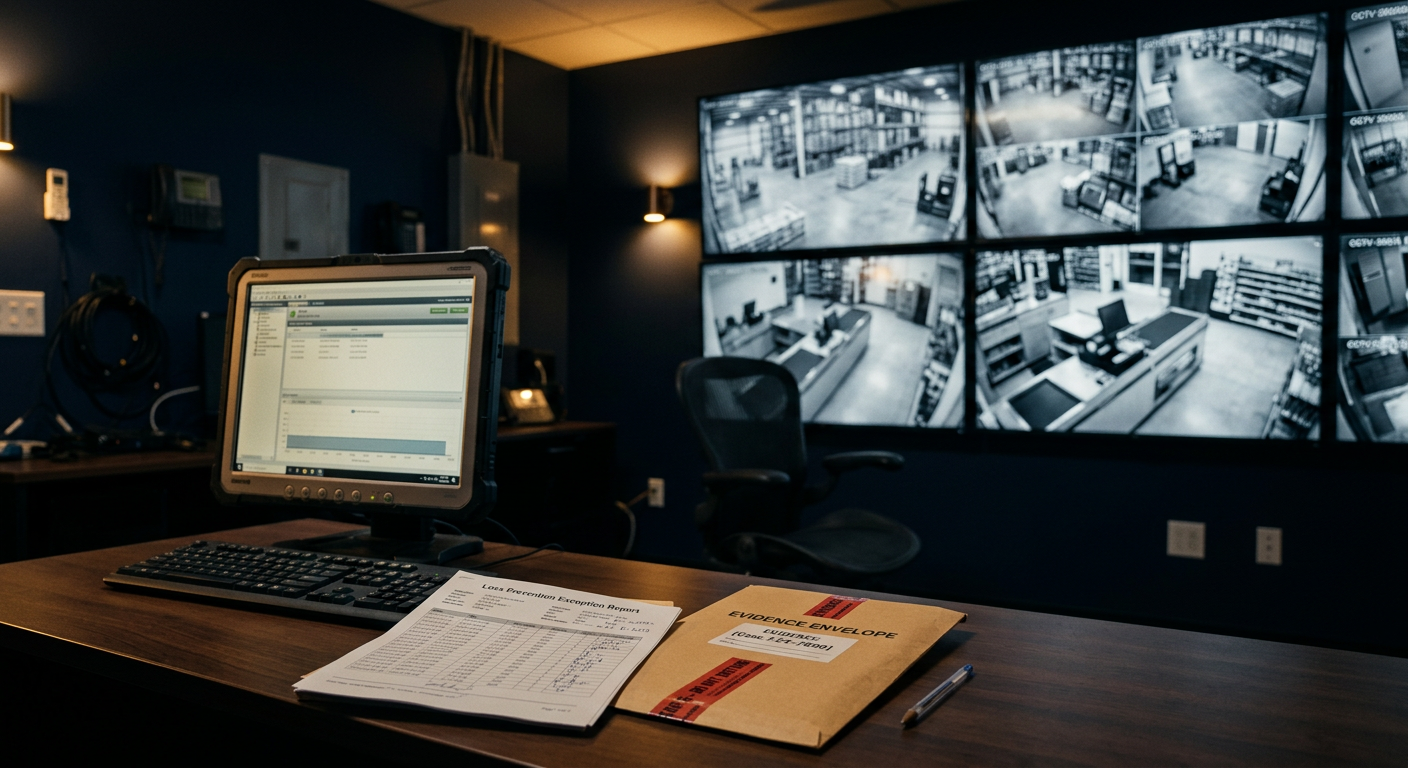
Investigating employee theft discreetly means building a documented, legally defensible case in silence—before the suspect knows they are watched. The disciplined sequence is: preserve records and video first, analyze point-of-sale and inventory data for exceptions, corroborate with covert surveillance or controlled test transactions, and interview last. Every step must respect privacy, labor, and evidence law, because a tipped-off thief destroys proof and a botched inquiry destroys the prosecution—and invites a lawsuit back.
Why Discretion Is the Whole Game in an Employee-Theft Case
Internal theft is not a security problem you solve with a confrontation; it is an evidentiary problem you solve with patience. The Association of Certified Fraud Examiners consistently finds that occupational fraud runs for a median of roughly a year before anyone catches it, and that the longer a scheme runs, the larger the loss. By the time a manager notices, the employee has usually normalized the theft into a routine—which is exactly what makes it provable, if the routine is captured before the person is spooked.
The moment a suspect senses scrutiny, three things happen at once: they stop the behavior, they destroy or alter records within their reach, and they begin constructing an innocent explanation. Confronting on suspicion—rather than on evidence—also hands the employee a menu of counter-claims: wrongful termination, defamation, false imprisonment, discrimination, or retaliation. A premature accusation that cannot be substantiated is frequently worth more to the employee in a settlement than the theft was worth to the employer. Discretion is not about secrecy for its own sake; it is the mechanism that keeps the evidence intact and the company out of the defendant’s chair.
What Kinds of Employee Theft Are You Actually Investigating?
“Employee theft” is a category, not a single act, and the method of proof changes with the scheme. Correctly classifying the suspected conduct at the outset determines which data sources matter and which investigative tools are proportionate.
- Cash and point-of-sale theft: under-ringing, voids and no-sale drawer openings, false refunds and returns, gift-card manipulation, and “sweethearting” (giving merchandise to friends by not scanning it).
- Inventory and merchandise shrinkage: product walking out the back door, falsified receiving counts, collusion with delivery drivers, and manipulated cycle counts.
- Financial and accounting fraud: fictitious vendors, altered invoices, expense-reimbursement abuse, payroll and ghost-employee schemes, and check tampering.
- Data and asset theft: exfiltration of proprietary files, customer lists, or trade secrets—often by a departing employee headed to a competitor.
- Time and benefits fraud: buddy-punching, falsified hours, and abuse of leave or reimbursement programs.
Each type leaves a different fingerprint. Cash schemes surface in transaction logs; inventory schemes surface in reconciliations and dock video; accounting schemes surface in the general ledger and vendor master file; data theft surfaces in access logs, USB history, and cloud-sync records. An investigator who treats all theft the same wastes the one advantage the employer has—the element of surprise—on the wrong evidence.
The Six-Phase Discreet Investigation Framework
Elite internal-theft investigations follow a deliberate order. The sequence is not stylistic—acting out of order (confronting before evidence, or alerting IT before imaging a device) is the most common way a strong suspicion becomes an unprovable one.
- Quiet intake and predication. Document what prompted the concern—an anomaly, a tip, a shortage—and confirm there is a reasonable, articulable basis before anyone is investigated. Restrict knowledge to the smallest possible circle: typically ownership or the general counsel plus the lead investigator. Never loop in the suspect’s direct manager if that relationship is unknown.
- Silent evidence preservation. Before any overt step, secure and back up the evidence the suspect could alter: POS journals, CCTV/DVR footage (which often overwrites in days), access-control and badge logs, email and file-access records, and—where a device is involved—a forensic image made without alerting the user. This is done in parallel with normal operations so nothing looks unusual.
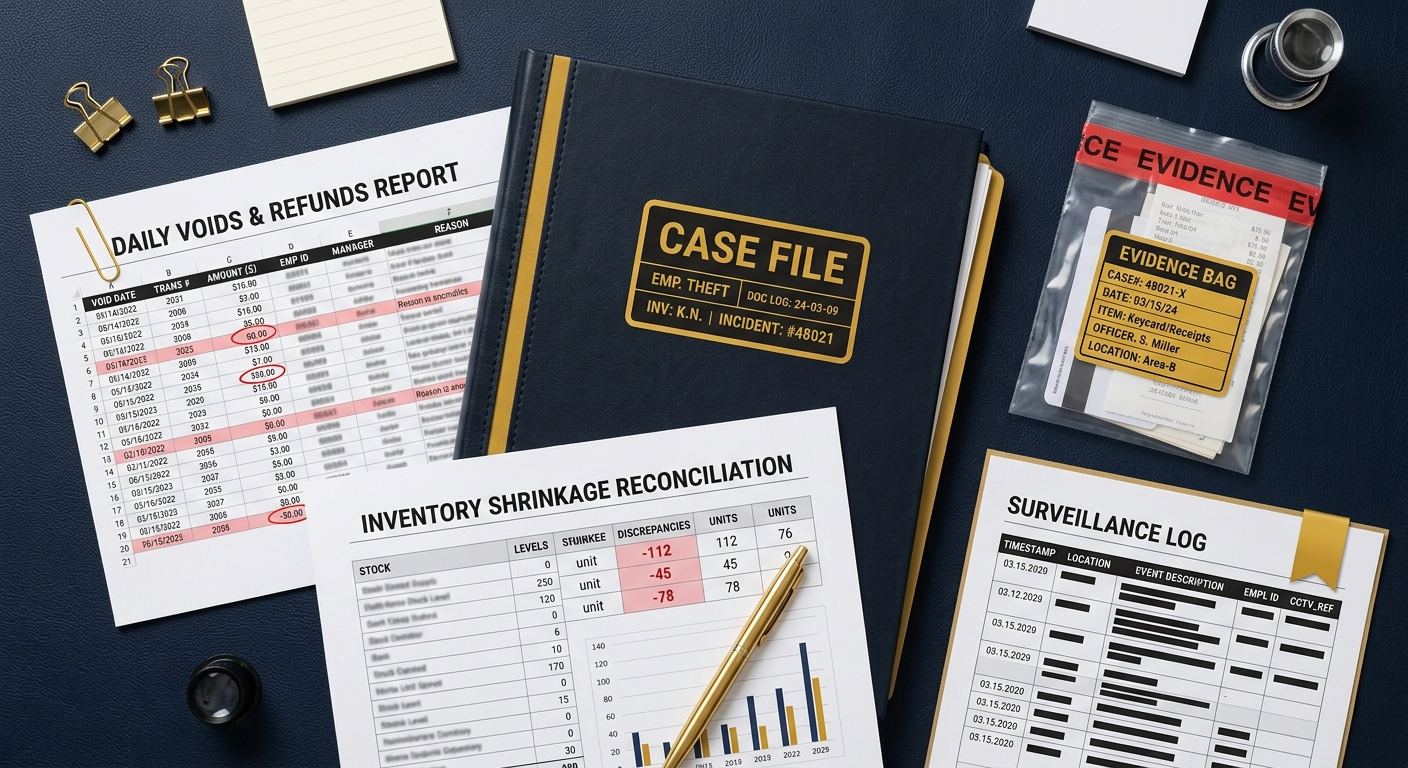
- Records and data analysis. Reconstruct the pattern from the numbers. Exception-based reporting on voids, refunds, discounts, no-sales, and after-hours transactions isolates the outlier employee against a peer baseline. Inventory reconciliations and vendor-file analysis do the same for merchandise and payables. The goal is a timeline showing who, when, how much, and how often.
- Corroboration through observation. Only once the data points to a person and a method do you confirm the mechanism in real time—through covert surveillance of the relevant area or, in cash and merchandise environments, controlled test transactions (integrity shops). Observation should confirm what the data predicts, not go fishing.
- The interview—last, never first. With the record built, a trained investigator conducts a non-accusatory, voluntary interview designed to obtain a truthful account and, where warranted, a signed statement. Facts established beforehand let the interviewer test the account rather than beg for a confession.
- Resolution and referral. Findings drive proportionate action—termination, restitution, civil recovery, insurance/bond claim, and, where appropriate, a criminal referral packaged so a prosecutor can charge it. Every decision is documented to the same standard a court would apply.
How Do You Use POS and Loss Data to Find the Thief Quietly?
Data analytics is the quietest and most powerful tool available, because it never tips the suspect. Modern point-of-sale, ERP, and access systems record far more than most operators review. The art is exception-based reporting—filtering millions of ordinary transactions down to the statistically abnormal, then attributing them to a person, a register, and a shift.
- Refund and void ratios: an employee whose refunds or voids run well above the peer average—especially cash refunds without a returned item—is a classic signature.
- No-sale and drawer-open events: frequent no-sales, particularly clustered around customer-less moments, indicate cash access without a recorded transaction.
- Discount and price-override abuse: manual price changes concentrated on one operator or tied to specific “customers.”
- Timing anomalies: transactions before opening, after closing, or during a lone shift, cross-referenced against schedule and badge data.
- Inventory-to-sales variance: shrink that localizes to a department, a receiving door, or a shift rather than spreading evenly.
The decisive move is correlation: overlay the transactional exceptions with CCTV timestamps, badge swipes, and schedules until a single employee sits at the center of the pattern. When the numbers and the video agree, you no longer have a suspicion—you have a case. For financial and payables schemes, the same discipline applies to the vendor master file, invoice sequencing, and bank records, which is where in-house financial investigation and digital forensics earn their keep.
Surveillance and Controlled Buys: What Is Legal and What Wins Cases?
Observation corroborates the paper trail, but it is also where employers most often cross a legal line. The governing principle is reasonable expectation of privacy. Video surveillance of open sales floors, cash-wraps, stockrooms, loading docks, and general work areas is broadly permissible; hidden cameras in restrooms, locker rooms, or changing areas are unlawful and will destroy both the case and the company’s defense. Many states also restrict recording where there is an expectation of privacy, and audio recording is governed by wiretap statutes—one-party-consent versus all-party-consent rules vary by state, so audio should never be added to covert video without legal sign-off.
Controlled test transactions—often called integrity shops or honesty tests—put a documented, marked transaction through the suspect employee: a shopper makes a purchase and observes whether the sale is rung correctly, the change is short-changed, or merchandise is passed unscanned. Serialized bills, pre-counted drawers, and marked merchandise turn a single controlled event into hard, repeatable evidence. Done properly, and under counsel’s guidance, these methods produce the cleanest proof of a live scheme without ever alerting the employee.
Two cautions separate professional work from amateur. First, avoid anything that resembles entrapment or coercion of an otherwise honest employee—the test confirms existing behavior, it does not manufacture it. Second, protect the labor-law line: the National Labor Relations Board treats surveillance of employees’ protected concerted activity (organizing, discussing wages and conditions) as unlawful, so surveillance must be scoped to the theft and documented as such. The National Labor Relations Board position is a real trap for employers who let a theft inquiry drift into monitoring union activity.
The Interview: Getting the Truth Without Getting Sued
The interview is the most misunderstood phase. Television has convinced managers that it is an interrogation ending in a dramatic confession. In reality, a defensible interview is voluntary, non-custodial, and non-coercive—and it happens only after the evidence is already sufficient to act. The professional standard in loss prevention has moved decisively toward non-confrontational, conversational methods that elicit a truthful account rather than pressure a suspect into whatever the interviewer wants to hear.
- Keep it voluntary and open. Do not lock doors, block exits, take the employee’s phone, or physically restrain—any of these can create a false-imprisonment claim regardless of guilt. Make clear the person is free to leave and to end the conversation.
- Two investigators, contemporaneous notes. A second person documents the exchange, which corroborates that no coercion occurred and preserves exactly what was said.
- Let the record lead. Present the opportunity to explain before revealing everything you hold. Truthful accounts are consistent with the data; deceptive ones collide with it.
- Never promise what you cannot deliver. Do not promise no police involvement, continued employment, or leniency to obtain a statement—false promises taint the statement and can void a later prosecution.
- Public-sector caveat. Government employers must account for Garrity protections; compelled statements can bar criminal use. This is a scenario where legal counsel must shape the interview in advance.
- Capture a written statement. Where the employee admits conduct, a voluntary, self-written statement in the employee’s own words—dated, signed, and un-coerced—is far stronger than a paraphrase.
Where Do Employers Cross the Legal Line?
The same investigation, run carelessly, becomes the employee’s lawsuit. The table below maps the most common self-inflicted wounds against the disciplined alternative.
| Legal risk | How employers trigger it | The disciplined alternative |
|---|---|---|
| False imprisonment | Blocking exits, confiscating phone/keys, refusing to let the employee leave | Voluntary interview, door unlocked, employee told they may leave |
| Defamation | Announcing “the thief” to staff or references before proof | Strict need-to-know; state facts, not conclusions; document findings |
| Invasion of privacy | Cameras in restrooms/lockers; searching personal property or phones | Surveillance only where no privacy expectation; consent-based searches per policy |
| Unlawful recording | Adding audio to covert video in an all-party-consent state | Video-only unless counsel clears audio; know the state wiretap rule |
| Wrongful termination / retaliation | Firing on suspicion, or after a wage/discrimination complaint | Terminate on documented findings; check for protected-activity timing |
| Coerced confession | Threats, false promises, marathon interrogation | Non-coercive, voluntary interview; no promises of leniency |
A useful discipline for owners and general counsel: assume every step will be read aloud in a deposition. If a tactic would look like bullying or a shortcut to a jury, it is not worth the marginal evidence it produces.
How Do You Preserve Prosecutability and Recover the Loss?
Most employers want two things: to stop the bleeding and to recover the money, ideally with a criminal charge that deters the next person. Both depend on evidence handled to a standard higher than internal HR files. Chain of custody is the pivot. Every item—an exported POS journal, a segment of DVR footage, a forensic image, a marked bill from a controlled buy, a signed statement—must be collected in a sound manner, logged, stored securely, and traceable from acquisition to production. Digital evidence is especially fragile: opening a file changes its metadata, and pulling video with a phone camera off a monitor is not the same as exporting the original file with its timestamps intact.
To make a case a prosecutor will actually take, package it the way charging authorities expect: a clear narrative of the scheme, the loss quantified and documented, the exception data and video tied to specific dates and dollar amounts, the chain-of-custody log, and any voluntary statement. Prosecutors decline weak referrals—vague totals, missing custody records, or evidence gathered in a way that looks coerced. Parallel to the criminal track, civil recovery, restitution as a condition of a plea, and claims against a fidelity or employee-dishonesty bond are often where the money actually returns. The National Retail Federation’s annual retail security research underscores how large aggregate internal-theft losses are; the recoverable portion depends almost entirely on the quality of the case file. See the National Retail Federation and the Association of Certified Fraud Examiners for the scope of occupational fraud and its cost drivers.
What Separates a World-Class Internal Investigation From a Mediocre One?
Every firm claims discretion. The difference shows under pressure—when the case is challenged, the employee lawyers up, or the footage is subpoenaed.
- Evidence before confrontation. Amateurs accuse and hope; professionals build the record silently and confront only when the outcome is already established.
- Data-led, not gossip-led. The case rests on transaction analytics, reconciliations, and forensics—objective sources that survive cross-examination—rather than on who someone “seems” dishonest.
- Legal boundaries as a design constraint. Privacy, wiretap, labor, and false-imprisonment law are engineered into the plan from hour one, not patched in after a complaint.
- Forensic capability in-house. Digital forensics, financial investigation, cybersecurity, and background intelligence under one command mean nothing is outsourced at the moment it matters. Honeybadger Solutions runs these functions in-house and remote-by-design, nationwide and internationally.
- A file built for court. Chain of custody, quantified loss, and un-coerced statements make the package prosecutable and the recovery collectible—the true measure of a completed investigation.
National Reach, Discreet Command
Honeybadger Solutions supports employers across Arizona, nationwide, and internationally. Our digital forensics, cybersecurity, financial investigations, and background intelligence functions are global and remote-by-design, so a theft inquiry can be stood up quickly and quietly wherever the loss is occurring. Field investigation and protective operations are commanded through a vetted-partner network, with Arizona as home command and established theaters in California, Texas, and Florida. Whether the matter is a single dishonest cashier or a multi-site inventory-and-payables scheme, the process and the standard are the same.
Frequently Asked Questions
Can I fire an employee I strongly suspect of theft? In most at-will states you can terminate without proving a crime, but doing so on mere suspicion invites wrongful-termination, defamation, and retaliation claims—and forfeits your ability to recover the loss. The disciplined path is to build a documented, defensible record first, then act on findings. Termination supported by evidence is far safer than termination supported by a hunch.
Is it legal to put a hidden camera on a suspected employee? Covert video is generally lawful in open work areas—sales floors, stockrooms, cash-wraps, docks—where there is no reasonable expectation of privacy. It is unlawful in restrooms, locker rooms, and changing areas. Adding audio triggers state wiretap laws, which vary between one-party and all-party consent, so audio should never be added without legal review.
Should I confront the employee myself before investigating? No. Confronting on suspicion is the single most common way cases collapse: it warns the suspect to destroy evidence, stops the provable behavior, and exposes the company to legal claims. Preserve records and video, analyze the data, corroborate, and interview last—in that order.
Will the police take my employee-theft case? Prosecutors take cases that are packaged to charge: a clear scheme narrative, quantified and documented loss, exception data and video tied to dates and amounts, an intact chain of custody, and any voluntary statement. Weak, undocumented referrals are declined. A professionally assembled file dramatically raises the odds of prosecution and court-ordered restitution.
About Honeybadger Solutions
Honeybadger Solutions is an Arizona-licensed security and investigations firm serving all of Arizona, the nation, and international clients. We combine in-house digital forensics, cybersecurity, financial investigations, and background intelligence with a vetted network for field and protective operations. Our teams build discreet, legally defensible employee-theft cases designed to survive litigation and support prosecution and recovery.
Three offices: Casa Grande (HQ), Phoenix, and Oro Valley. To discuss a confidential matter, call 602-725-2818. Learn more about our corporate and internal investigations capabilities, review our approach to enterprise security, or reach our Phoenix team to request a discreet consultation.