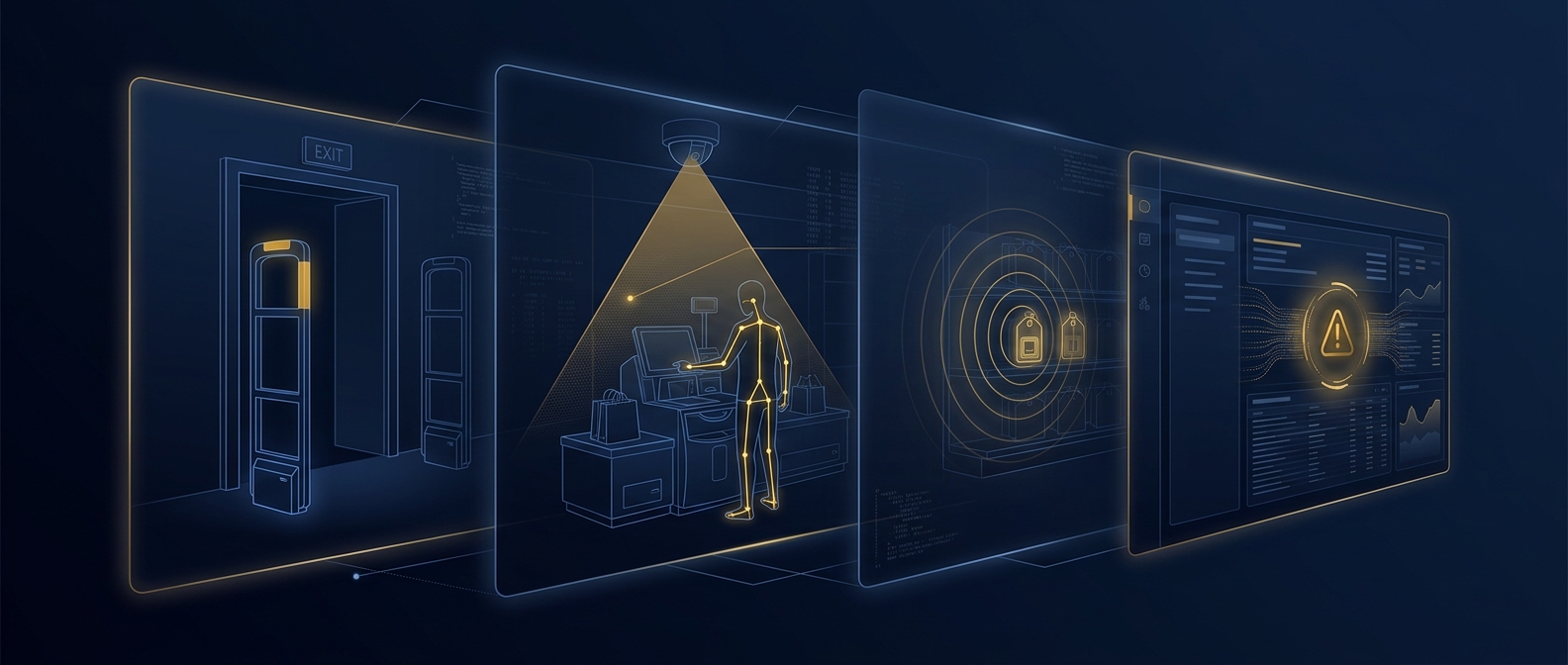
The right retail loss prevention technology is the stack that matches your actual loss profile, not the longest feature list. Electronic article surveillance deters casual theft, computer-vision analytics and self-checkout monitoring catch scan avoidance, RFID drives inventory accuracy, and point-of-sale exception software exposes internal fraud. No single tool solves shrink. The disciplined buyer measures where loss originates first, then buys the layers that address it and integrate cleanly.
Retail loss prevention has become a technology arms race, and the marketing has outrun the reality. Every vendor now attaches “AI” to its datasheet, promises double-digit shrink reduction, and demonstrates a highlight reel of caught thieves. For the retail principal, CFO, general counsel, or asset-protection leader signing the purchase order, the challenge is separating genuine capability from theater. A wrong buy is expensive twice: once for the hardware and integration, and again for the loss it was supposed to stop but did not. This guide explains what each major loss-prevention technology actually does, where it genuinely earns its keep, where it disappoints, how the pieces integrate, and how to judge return on investment without being sold a solution to a problem you do not have. It is written for the buyer who wants the truth beneath the demo.
What does a modern retail loss prevention technology stack include?
A complete loss-prevention technology stack is not one product but a set of overlapping layers, each aimed at a different loss vector. The mistake most retailers make is buying the layers in the wrong order — or buying one layer and expecting it to cover the others. External theft, internal theft, process error, and inventory inaccuracy are distinct problems, and the technologies below address them unevenly. The table sets out the principal categories, what each one truly does, its real strength, its real limitation, and the loss it is best suited to attack.
| Technology | What it actually does | Real strength | Real limitation | Best-fit loss |
|---|---|---|---|---|
| Electronic Article Surveillance (EAS) | Tags/labels trigger an alarm at exit pedestals | Cheap, proven deterrent for opportunistic theft | Defeated by tag removal/foiling; alarm fatigue; no evidence | Casual external shoplifting |
| Video surveillance / VMS | Records and stores camera footage | Evidence, deterrence, incident review | Passive without analytics; storage and review burden | Investigation and evidence across all vectors |
| Computer-vision analytics | Software interprets video to flag behaviors/objects | Turns passive cameras into active alerts | False positives; needs good cameras, tuning, oversight | Scan avoidance, sweethearting, ORC patterns |
| Self-checkout (SCO) monitoring | Detects non-scans and mis-scans at self-checkout | Directly targets the fastest-growing loss point | Friction risk; can annoy honest customers if crude | Self-checkout shrink |
| RFID | Item-level tags read in bulk for inventory | Near-real-time inventory accuracy | Tag cost; primarily inventory, not theft, ROI | Process/inventory loss, availability |
| POS exception-based reporting | Analyzes transaction data for fraud patterns | Exposes internal theft invisible on camera | Produces leads, not verdicts; needs investigators | Employee theft, refund/void fraud |
Read across the table and the strategic point becomes obvious: no single row solves shrink. EAS does nothing about a dishonest cashier; POS analytics does nothing about a grab-and-run crew; RFID does not deter anyone. A credible stack layers these deliberately against a measured loss profile. That is why the first investment is never hardware — it is measurement, which we cover below in the ROI framework.
Does electronic article surveillance (EAS) still work?
Electronic article surveillance is the oldest and most familiar loss-prevention technology — the pedestals at the door and the hard tags or adhesive labels on merchandise, in either acousto-magnetic (AM) or radio-frequency (RF) format. It endures because it is inexpensive per unit, easy to deploy, and a genuine deterrent to the casual, opportunistic shoplifter who does not want an alarm and a confrontation. For much of general merchandise, that psychological deterrent is worth the modest spend.
But EAS has hard limits that vendors rarely lead with. Determined and professional thieves defeat it routinely — removing hard tags with concealed detachers, lining bags with foil to block the field, or simply walking through an alarm no one responds to. Alarm fatigue is the quiet killer of EAS value: when most alarms are false (an un-deactivated label, a passing tagged item) and staff learn to ignore them, the system becomes expensive wallpaper. EAS also produces no evidence and identifies nothing; it makes noise and hopes for a response. The professional posture is to treat EAS as one deterrent layer for the specific high-theft, high-appeal SKUs the data flags — not as a store-wide theft solution — and to pair it with keeper cases or locking fixtures on the highest-value goods where the alarm alone is not enough.
Is AI computer-vision video analytics worth it, or is it hype?
This is where the marketing is thickest and the buyer must be most skeptical. Computer-vision analytics layers software on top of camera feeds to interpret what is happening — detecting behaviors, objects, and patterns rather than simply recording them. Done well, it converts a wall of passive cameras that no one watches into a system that raises a specific, actionable alert. That is a real and valuable shift. The credible use cases today are concrete: flagging scan-avoidance and non-scans at self-checkout, detecting merchandise leaving through unmonitored exits, recognizing repeat-offender vehicles or patterns across a chain, and directing a human to the moment that matters instead of forcing a manual scrub of hours of footage.
The hype, and the risk, lie in three places. First, accuracy: computer vision generates false positives, and a system that cries wolf trains staff to ignore it exactly as bad EAS does. Detection quality depends heavily on camera placement, resolution, lighting, and continuous tuning — the algorithm is only as good as the imagery and the configuration beneath it. Second, oversight: a vision alert is a lead requiring human confirmation, never an automated accusation; acting on an uncorroborated flag against a customer or employee invites both error and liability. Third, privacy and law: any deployment that touches facial recognition or biometric identification carries serious legal exposure that varies by jurisdiction, and several states regulate biometric data tightly. The Federal Trade Commission has warned businesses about the risks and obligations of biometric and facial-recognition technologies, and biometric-privacy statutes create real litigation risk for careless rollouts. The honest verdict: behavioral and object analytics are worth it when the cameras and tuning are right and a human stays in the loop; facial recognition is a legal and reputational minefield that most retailers should approach only with counsel.

How effective is self-checkout monitoring technology?
Self-checkout has moved a meaningful share of transactions from a trained cashier to the customer, and with it moved a new and fast-growing loss vector. The losses at self-checkout are a spectrum: honest mis-scans and confusion at one end, deliberate non-scans, the “banana trick” (ringing a cheap item for an expensive one), barcode swapping, and skipped items at the other. Self-checkout monitoring technology — usually computer vision trained on the lane, sometimes combined with weight and scan-event data — is aimed squarely at this gap, flagging the transactions where what was scanned does not match what was bagged.
The technology genuinely helps because it targets loss at the exact point it occurs, in real time, where intervention is still possible. But the design tradeoff is unforgiving and often mishandled: too aggressive, and the system halts honest customers repeatedly, creates friction, lengthens queues, and drives shoppers away — a customer-experience cost that can dwarf the shrink saved. Too lenient, and it does nothing. The best implementations intervene quietly and proportionately — a discreet re-scan prompt, a flag to a roving attendant, an escalation only on repeat or high-value anomalies — rather than accusing shoppers at the machine. Buyers should evaluate self-checkout monitoring not only on catch rate but on false-intervention rate and customer-experience impact, because a system that recovers shrink while alienating loyal customers is a net loss the demo will never show you.
What is RFID actually good for in loss prevention?
RFID (radio-frequency identification) is frequently sold as a theft-prevention technology, and that framing sets up disappointment. Item-level RFID tags can be read in bulk without line of sight, which delivers something genuinely transformative — fast, accurate, near-real-time inventory counts instead of slow, error-prone manual counts. Its dominant return is inventory accuracy, on-shelf availability, and the ability to reconcile what the system says you have against what is physically present. That accuracy is itself a powerful loss-prevention tool, because it exposes process and administrative loss and localizes shrink far faster than an annual physical count.
Where RFID contributes to theft prevention specifically, it does so through visibility rather than deterrence: it can identify when tagged items leave without a corresponding sale and pinpoint exactly which SKUs are disappearing and where. What it does not do is stop a determined thief at the door on its own, and tags can be removed or shielded much like EAS. The buyer’s discipline here is to justify RFID primarily on its inventory-accuracy and availability ROI — which is where the real dollars are — and to treat its loss-prevention benefit as a valuable secondary return, not the headline. Judged that way, RFID is often an excellent investment; judged as an anti-shoplifting device, it underwhelms.
Why is POS exception-based reporting the most underrated tool?
Point-of-sale exception-based reporting (EBR) software is the least glamorous item on most vendor shelves and, for many retailers, the highest-yield. While cameras and EAS point outward at the customer, EBR points inward at the transaction data, flagging the statistical outliers associated with internal theft and fraud that no camera will ever reveal on its own. Internal theft leaves a data trail even when it is invisible on video: a cashier running an unusual volume of refunds without matching sales, post-void transactions, no-sale drawer opens, manual price overrides, discount and loyalty abuse, or cancelled transactions will look ordinary on any single occasion and highly abnormal in aggregate.
EBR is underrated precisely because employee theft is chronically underestimated — many operators pour budget into anti-shoplifting hardware while their larger leakage sits behind the register. The technology surfaces the aggregate pattern and converts a firehose of ordinary transactions into a short, prioritized list of anomalies a human investigator can work. The critical discipline, identical to computer vision, is that an exception is a lead, not a verdict. Mature programs corroborate a flag with transaction-linked video review, drawer audits, and — where the exposure justifies it — a discreet forensic examination of the point-of-sale and back-office systems before anyone is confronted. That corroboration is what keeps a finding defensible if it becomes an employment matter or a criminal referral. For most retailers, EBR paired with disciplined investigation returns more recovered margin per dollar than any camera on the ceiling.
How should you evaluate ROI and integration before buying?
The single most expensive mistake in loss-prevention technology is buying hardware before measuring loss. Every category above addresses a different vector, so a purchase made without knowing your own shrink split is a guess dressed as a strategy. Integration compounds the risk: a stack of best-of-breed point products that do not talk to each other — cameras that cannot link to POS data, analytics that cannot feed a case-management system — multiplies cost and operational burden while fragmenting the very evidence an investigation needs. Use the framework below to sequence any loss-prevention technology decision.
- Measure and decompose loss first. Establish your true shrink rate and split it into external theft, internal theft, process error, and inventory inaccuracy. Buy technology to fit the profile you find — never the profile a vendor assumes.
- Match the tool to the vector. EAS and product protection for casual external theft; computer vision and self-checkout monitoring for scan avoidance; POS exception reporting for internal fraud; RFID for inventory accuracy. Refuse to let one layer be sold as the whole solution.
- Demand real accuracy metrics. For any analytics system, ask for false-positive and false-negative rates, and for self-checkout, the false-intervention and customer-experience impact — not just a highlight reel of catches.
- Test integration explicitly. Confirm the system links to your existing cameras, POS, inventory, and case management via documented, open interfaces. Siloed data is a hidden cost and an investigative liability.
- Model total cost of ownership. Include tags, licensing, storage, bandwidth, tuning, maintenance, and the staff time to respond to alerts — not just the sticker price. An unmonitored alert stream has negative ROI.
- Keep a human in the loop. Budget for the investigators and process to act on what the technology flags. Analytics without response is spend without return.
- Vet the vendor and the law. Scrutinize inflated shrink-reduction claims, and obtain counsel before any biometric or facial-recognition deployment given the jurisdictional legal exposure.
- Pilot, measure, then scale. Deploy to a subset of locations, measure the actual change against baseline, and expand only what demonstrably moves the number.
Because retail runs on thin margins, recovered shrink flows through almost entirely to profit, which makes well-targeted loss-prevention technology one of the highest-return investments a retailer can make. The corollary is that mis-targeted technology is one of the easiest ways to waste capital while the loss continues. The framework exists to keep spend behind evidence. Industry bodies such as the National Retail Federation and the Loss Prevention Research Council publish research on technology effectiveness that is worth consulting before any major purchase, precisely because it is not written by the vendors selling the hardware.
How do you avoid loss-prevention technology hype?
The tells of loss-prevention theater are consistent. Be skeptical of any vendor that promises a specific shrink-reduction percentage without first measuring your loss profile — they cannot honestly know. Be skeptical of “AI” used as a noun rather than a described capability with disclosed accuracy rates. Be skeptical of a demo built entirely on caught-thief clips and silent on false positives, customer friction, integration, and the human effort required to run the system. And be skeptical of any single product sold as a complete loss-prevention solution, because the loss vectors are genuinely different and no one tool covers them all.
The disciplined buyer inverts the sales process. Rather than asking “what can this technology do,” ask “what is my measured loss, and what is the least expensive, best-integrated way to address the losses that actually dominate my number.” That question reframes every purchase around evidence, sequences spend behind measurement, and quietly disqualifies most of the hype. It is the same discipline that separates a world-class loss-prevention program from a mediocre one: measure before you spend, layer proportionally, keep a human in the loop, and treat internal fraud with the same forensic rigor as any financial crime — because that is exactly what it is. For the broader program context, see our guide to reducing retail shrinkage.
How does Honeybadger support retail loss-prevention technology decisions?
Honeybadger Solutions supports retailers as an independent investigative and security partner rather than a technology reseller — which means our counsel on the stack is not tied to selling any particular box. Where a technology deployment surfaces internal theft, refund fraud, or point-of-sale manipulation, our in-house digital forensics and financial investigation capabilities examine POS and back-office systems, trace the money, and build a defensible case through our investigations practice. Where analytics flag patterns of organized retail crime or vendor collusion, our intelligence work correlates activity across locations and develops evidence to an evidentiary standard. And where a site requires a physical retail security and loss prevention presence to complement the technology, it is delivered and directed to an enterprise standard.
Based in Arizona with offices in Casa Grande, Phoenix, and Oro Valley, we serve retailers across all of Arizona, nationwide, and internationally. Digital forensics, cybersecurity, financial investigations, and background intelligence are handled in-house and delivered globally. Physical and protective retail deployments are executed through a commanded, vetted-partner network with established theaters in California, Texas, and Florida, and other regions served on a mandate basis, directed from Arizona home command. The result is a loss-prevention program in which technology, investigation, and protection are pointed at the losses that actually move your number — not at whatever a vendor most wanted to sell.
Frequently asked questions
What is the most effective retail loss prevention technology?
There is no single most effective technology, because the loss vectors differ. For casual external theft, EAS and product protection deter effectively. For internal employee theft — often the larger and most underestimated loss — point-of-sale exception-based reporting paired with investigation typically returns the most recovered margin per dollar. For self-checkout shrink, computer-vision monitoring is the direct fit. The effective choice is the one that matches your measured loss profile, which is why measurement must precede any purchase.
Is AI video analytics in retail worth the investment?
It can be, when the cameras, placement, and tuning are right and a human confirms every alert. Behavioral and object analytics genuinely convert passive cameras into actionable alerts for scan avoidance and organized-crime patterns. The risks are false positives that breed alarm fatigue, dependence on imagery quality, and — for any facial-recognition component — serious biometric-privacy legal exposure that varies by state. Treat alerts as leads requiring corroboration, and obtain counsel before deploying facial recognition.
Does RFID prevent theft?
Not directly. RFID’s dominant return is inventory accuracy and on-shelf availability through fast, accurate item-level counts. It contributes to loss prevention by exposing process loss and pinpointing which SKUs disappear and where, and it can flag tagged items leaving without a sale. But it does not deter a determined thief on its own, and tags can be removed or shielded. Justify RFID on its inventory ROI and treat its theft-prevention benefit as a valuable secondary return.
How do I avoid overpaying for loss-prevention technology?
Measure and decompose your shrink before buying anything, so spend follows evidence rather than a vendor’s assumptions. Match each tool to a specific loss vector, demand real false-positive and integration data instead of highlight reels, model total cost of ownership including tuning and the staff time to respond to alerts, and pilot before scaling. Be skeptical of guaranteed shrink-reduction percentages and of any single product sold as a complete solution.
About Honeybadger Solutions
Honeybadger Solutions is an Arizona-licensed security and investigations firm delivering intelligence-led loss prevention, investigations, financial-crime and forensic services, and protective security to retailers and organizations nationwide and internationally. Digital forensics, cybersecurity, financial investigations, and background intelligence are handled in-house and delivered globally. Physical and protective retail deployments are delivered through a commanded vetted-partner network with established theaters in California, Texas, and Florida, directed from Arizona home command.
Offices: Casa Grande (HQ), Phoenix, and Oro Valley, Arizona.
Phone: 602-725-2818
Confidential consultation: discuss a technology-and-investigation loss-prevention program built around your measured loss profile.