
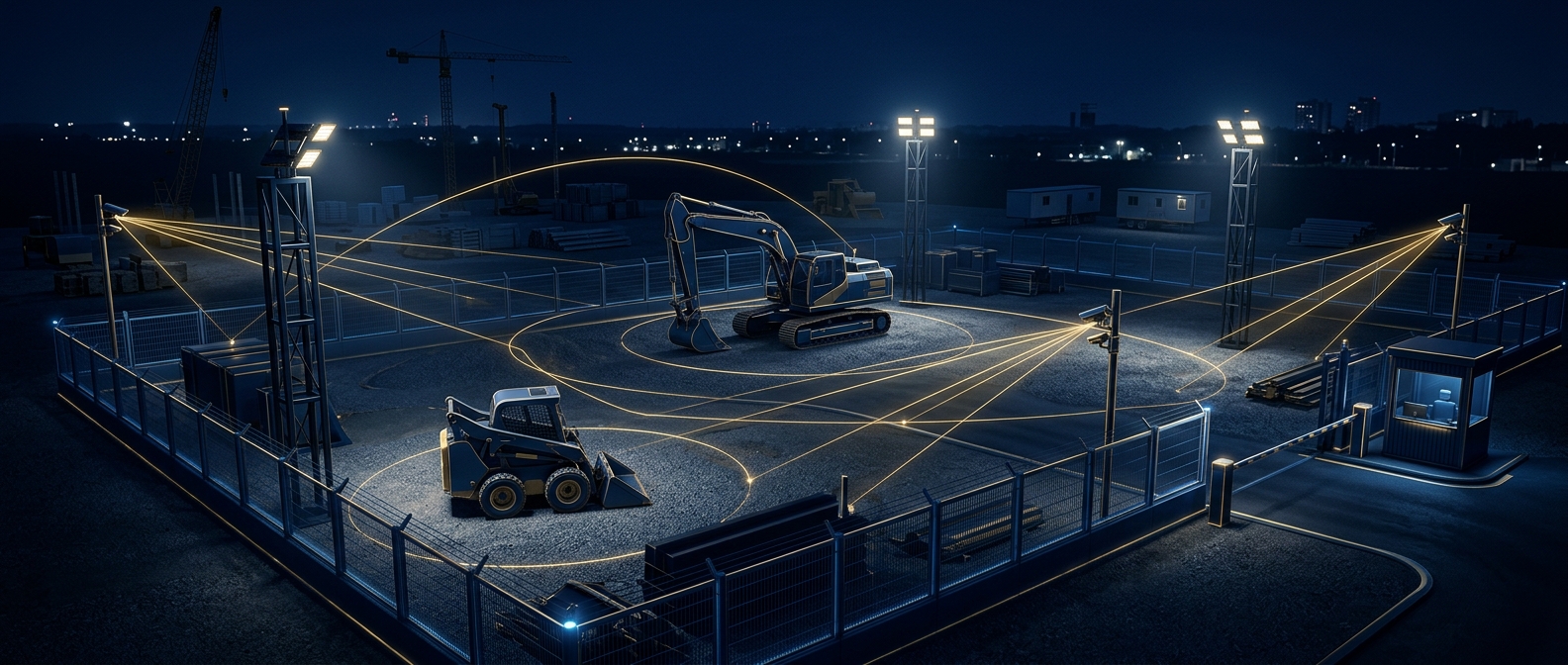
Construction equipment theft prevention is a layered program that combines hardened perimeter fencing and lighting, GPS and telematics tracking, equipment marking and PIN registration, controlled site access, and material-specific controls for copper, fuel, and tools. When a machine or load of material is stolen anyway, recovery depends on rapid reporting, telematics data, and professional investigation — because industry recovery rates for heavy equipment are far lower than for stolen cars.
To keep equipment from walking off in the first place, see our construction site security services in Arizona.
A construction site is one of the hardest assets in commerce to protect. It is, by design, temporary, open, and cash-rich in movable value: hundreds of thousands of dollars in excavators, skid-steers, generators, and compressors sit in an unlit lot at night; spools of copper wire and stacks of lumber wait in the open; and fuel, tools, and small equipment change hands among a rotating crew of employees, subcontractors, and vendors. The result is a target that thieves prize and that traditional security models struggle to defend. This guide is written for the developer, general contractor, project executive, risk manager, or general counsel accountable for these losses. It explains why job sites are targeted, how elite security programs actually prevent theft layer by layer, and — when prevention fails — how professional investigation and telematics turn a near-hopeless recovery rate into a realistic chance of getting equipment back and holding someone accountable.
Why are construction sites targeted so heavily?
Construction theft is a business decision for the criminal, and the economics favor them. Heavy equipment is expensive, portable, and — unlike a passenger vehicle — largely untitled and unregistered in any central database, so a stolen loader can be resold, exported, or stripped for parts with little fear of the machine tripping an alert at a checkpoint. Many older machines share a single generic key across an entire model line, meaning a thief with one key can start dozens of different units. Sites are unoccupied for twelve to sixteen hours a day, often unlit and unfenced early in a project, and located on the edges of development where a diesel engine starting at 2 a.m. draws no attention. And because so many people legitimately come and go — crews, subs, delivery drivers, inspectors — an extra truck loading a generator rarely looks out of place.
The consequences compound far beyond the sticker price of the stolen item. A stolen excavator on the critical path can idle a crew, blow a schedule, and trigger liquidated-damages exposure worth many times the machine’s value. Insurance deductibles, premium increases, and rental replacements pile on. The National Insurance Crime Bureau (NICB) and the National Equipment Register (NER) have long reported that heavy-equipment theft costs the industry hundreds of millions of dollars a year and that recovery rates lag dramatically behind those for stolen automobiles — a gap driven almost entirely by the absence of universal registration and the delay before an owner even notices a machine is gone. That last point is the quiet killer: a machine stolen Friday night from a site that will not be worked again until Monday has a thirty-six-hour head start before anyone reports it.
What actually gets stolen — and by whom?
Understanding the target set is the first step in defending it. Construction-site loss falls into distinct categories, each with its own thief profile and its own countermeasures:
- Heavy and compact equipment — excavators, backhoes, skid-steers, loaders, generators, air compressors, and light towers. High value, high resale, and the primary target of organized theft rings.
- Copper and metals — wire, cable, pipe, and fittings, stolen for scrap value and driven by commodity prices. A single spool of copper wire can be worth thousands, and demand at scrap yards makes it near-instantly liquid.
- Tools and small equipment — power tools, nail guns, saws, laser levels, and total stations. Easily concealed, easily fenced, and the most common target of opportunistic and internal theft.
- Materials — lumber, rebar, pipe, appliances, and fixtures, increasingly targeted as material prices rise.
- Fuel — diesel siphoned from equipment tanks and site storage, a recurring, low-visibility loss that rarely gets reported but adds up across a project.
The thief profiles matter as much as the targets. Opportunistic thieves take what is unsecured and easy — a tool left in a trench, an unlocked gang box. Organized rings target specific high-value machines, sometimes to order, often moving them across state lines or out of the country within days. And internal theft — by employees, subcontractors, or crew who know exactly what is on site, where it is, and when no one is watching — accounts for a large and frequently underestimated share of loss, particularly of tools, fuel, and materials. A serious program has to address all three, because the fence that stops a stranger does nothing about the crew member loading a spool of copper into his own truck at quitting time.
How do you harden the perimeter with fencing and lighting?
The perimeter is the first layer of defense in depth — the doctrine, formalized by physical-security bodies such as ASIS International, that no single control secures a site and that layers must collectively deter, detect, delay, and respond. On a job site the perimeter is fencing, and its purpose is less to make entry impossible than to make it slow, visible, and obviously unwelcome. Effective site fencing is anti-climb, anchored so it cannot be lifted or driven through, and reduced to a single controlled vehicle access point rather than the multiple open gaps most sites tolerate for convenience. Where high-value equipment is stored, an inner secured compound — a fenced-and-gated laydown yard within the site — concentrates the machines that matter most into one defensible zone rather than scattering them across an open lot.
Lighting is the perimeter’s force multiplier and one of the most cost-effective deterrents available. Engineered site lighting — positioned to eliminate shadow and blind spots, on the equipment compound and along the fence line — removes the darkness a thief depends on and dramatically improves the usefulness of any camera coverage. Motion-activated lighting on the equipment compound signals activity and startles the opportunist. The common failures are predictable: fencing with unsecured gaps and gates left open, equipment parked against the fence where it becomes a ladder or is simply lifted over, and dark corners where staged materials sit invisible. Landscaping and layout discipline — keeping the equipment compound in the open, well-lit center of the site rather than the concealed edges — costs nothing and denies the thief the cover he needs.
How does GPS and telematics tracking change the equation?
If fencing and lighting are the deterrent, GPS and telematics are the single most important tool for both prevention and recovery — the technology that has done more than any other to shift the odds back toward the owner. Most modern heavy equipment ships with factory telematics, and aftermarket GPS trackers can be fitted to older machines, tools, and even material containers. Well-configured telematics does three things: it enforces geofencing, alerting the owner the instant a machine leaves a defined site boundary or moves outside working hours; it supports remote immobilization and curfews, so a machine simply will not start after hours or can be disabled once flagged stolen; and it provides real-time location that turns recovery from a needle-in-a-haystack search into a map with a moving dot on it.
The value of telematics compounds when it is actually monitored. A geofence alert that lands in an unread inbox at 3 a.m. is worthless; the same alert routed to a monitoring function that verifies the movement and dispatches a response is the difference between a recovered machine and a written-off one. Elite programs treat telematics as a live sensor, not a passive record — they define geofences and curfews for every tracked asset, confirm the trackers are powered and reporting, place backup trackers in concealed locations a thief will not find and disable, and integrate the alerts into a real response protocol. Because location data and immobilization commands must survive as evidence and hold up when law enforcement acts on them, the tracking program and the investigative function belong on the same team.

Why do marking, PINs, and registration drive recovery?
The reason stolen equipment is so rarely recovered is that, once it leaves the site, nothing about the machine proves whose it is. Marking and registration attack that problem directly and are the foundation of any credible recovery strategy. Every serious owner should record and register the Product Identification Number (PIN) — the 17-character standardized identifier that functions for equipment much as a VIN does for a vehicle — with a recovery database such as the one operated by the National Equipment Register, so that when a machine surfaces at an auction, a border, or a traffic stop, its identity can be checked. Overt markings — the company name, unit numbers, and distinctive paint or decals — deter theft and make a stolen machine conspicuous. Covert markings — hidden stamps, etched identifiers, forensic marking compounds with unique codes, and RFID tags — survive the thief’s effort to grind off the obvious ones and give investigators a way to prove ownership even after a machine has been repainted and renumbered.
Registration only works if it is done before the theft. The single most common and most costly failure in the entire field is the owner who cannot produce the PIN, serial numbers, photographs, or purchase records of the equipment that was stolen — which makes a police report generic, gives the recovery databases nothing to match against, and hands the insurer grounds to question the claim. A disciplined asset register — PINs, serial numbers, photos, marking records, and telematics IDs for every machine and major tool, maintained current and stored off-site — is unglamorous, nearly free, and the difference between a recoverable asset and a total loss.
How do you control site access and internal theft?
Because so much construction loss is internal or committed by people with legitimate reasons to be on site, access control and accountability matter as much as the fence. On an active job site this rarely means badge readers, but it does mean a controlled single point of entry, a sign-in and sign-out discipline for personnel and deliveries, and verification that a vehicle leaving with equipment or material has authorization to do so. Tool and small-equipment control — secured, monitored gang boxes and conex containers, a check-out log for high-value tools, and end-of-shift accountability — addresses the opportunistic and internal theft that a perimeter cannot touch. Keys to equipment should be controlled rather than left in the ignition, and machines fitted with individualized keys or keypad ignition where the generic-key vulnerability is a concern.
The procedural disciplines are backed by surveillance. Site camera systems — increasingly solar-powered, cellular, and mobile so they can move as the project evolves — provide both live monitoring and the recorded evidence that identifies a thief and supports prosecution and insurance recovery. As with any camera program, coverage must be designed to purpose: the equipment compound, the access gate, and the material staging areas, at a resolution that will actually resolve a face and a license plate rather than produce a reassuring but useless blur. When cameras are monitored by a function empowered to verify an alarm and dispatch a response, they cross from passive documentation into active deterrence. Vetting of the workforce and subcontractors — confirming that the people with the keys and the access are who they claim to be — closes the loop on the insider risk that technology alone will never solve.
What makes copper, metal, and fuel theft different?
Copper and metal theft deserve their own treatment because the economics and the countermeasures differ from equipment theft. The thief is not reselling a branded machine; he is converting anonymous metal into cash at a scrap yard, and the loss is driven by commodity prices — when copper is high, sites bleed wire. The value stolen is often trivial next to the collateral damage: ripping copper out of a partially wired building, a switchgear, or a running system causes structural and electrical destruction, safety hazards, and rework worth many multiples of the scrap the thief walked away with. Prevention focuses on denying access and reducing the standing target — staging wire and pipe inside the secured compound or the building envelope rather than in the open, delivering copper close to installation rather than stockpiling it, securing spools, and marking metal where feasible.
Recovery of stolen metal leans on the scrap-yard chain. Many jurisdictions impose record-keeping, identification, and payment-hold requirements on scrap dealers precisely to create a paper trail, and investigators work that trail — canvassing yards, matching described material, and using transaction records — to identify sellers. Fuel theft, meanwhile, is the quiet, chronic loss most sites never quantify: diesel siphoned from equipment tanks and bulk storage overnight. Locking fuel caps, securing bulk tanks within the compound, telematics that flag anomalous fuel-level drops, and simple end-of-day fuel reconciliation turn an invisible leak into a measurable, controllable line item.
When theft happens, how does investigation and recovery work?
Prevention reduces theft; it does not eliminate it. When a machine, a load of copper, or a container of tools goes missing, the first hours decide the outcome, and a disciplined response dramatically outperforms the industry’s dismal baseline recovery rate. The immediate steps: report to law enforcement at once with the PIN, serial numbers, photographs, and marking details from the asset register; pull and preserve telematics history and any last-known location; register the theft with recovery databases such as NER and notify the insurer; and preserve site camera footage and access logs before they are overwritten. Speed is everything — the reporting delay that plagues weekend and holiday thefts is the single biggest reason equipment vanishes for good.
Professional investigation then extends what law enforcement, stretched across many priorities, often cannot pursue alone. Investigators exploit telematics and GPS to locate a moving asset, work the resale and scrap channels where stolen equipment and metal are converted to cash, canvass online marketplaces and auction listings for machines matching the description and identifiers, and — where the evidence points inward — conduct discreet internal investigation of employees or subcontractors. Where the loss involves collusion, falsified delivery records, or fraud layered on top of the theft, financial and digital-forensic capability reconstructs the paper and data trail. Because covert markings and registered PINs let investigators prove ownership even of a repainted, renumbered machine, the prevention program and the investigation are not separate exercises — the marking, registration, and telematics done before the theft are precisely the evidence that makes recovery possible after it.
Reactive response versus a layered prevention program
Most contractors discover their security posture only after a theft. The table below contrasts the common reactive posture with a genuine layered program so an owner can tell which one they actually have before the loss forces the question.
| Dimension | Reactive posture | Layered prevention program |
|---|---|---|
| Model | Respond after a loss | Deter, detect, delay, respond across layers |
| Perimeter | Partial or open fencing, dark site | Anti-climb fence, single gate, engineered lighting |
| Tracking | None or unmonitored factory telematics | Geofencing, curfews, immobilization, monitored alerts |
| Identification | No PIN record, no marking | Registered PINs, overt and covert marking, asset register |
| Access | Open site, keys in ignition | Controlled entry, tool control, key discipline, vetting |
| High-value metals | Copper stockpiled in the open | Staged in secured compound, delivered to installation |
| Recovery odds | Poor — delayed report, no identifiers | Materially improved — fast report, telematics, investigation |
How do you build the program? A seven-step framework
A credible construction-security program is built deliberately, from an asset baseline outward. The sequence below reflects the discipline elite operators follow on every site.
- Baseline the assets and the risk. Build a current register of every machine and major tool — PINs, serial numbers, photographs, and telematics IDs — stored off-site, and assess the site’s exposure by value, location, working hours, and loss history.
- Harden the perimeter. Install anti-climb fencing anchored against lift and ram, reduce to a single controlled gate, and engineer lighting to eliminate shadow across the equipment compound and fence line.
- Concentrate high-value assets. Establish a secured inner compound for equipment, tools, copper, and fuel rather than scattering them across the open site.
- Deploy and monitor telematics. Fit GPS to machines, tools, and containers; set geofences and after-hours curfews; enable immobilization; conceal backup trackers; and route alerts to a real response protocol.
- Mark and register everything. Apply overt and covert markings, register PINs with a recovery database, and keep the records current so ownership can be proven after a repaint.
- Control access and people. Enforce a single controlled entry, sign-in and delivery verification, tool check-out and end-of-shift accountability, key discipline, and vetting of the workforce and subcontractors.
- Prepare the response. Pre-stage the theft-response protocol — who reports, what evidence is preserved, which databases and insurers are notified — and treat every incident and near-miss as a diagnostic that hardens the layer that failed.
How does Honeybadger protect construction sites and recover stolen equipment?
Honeybadger Solutions treats construction-site protection as an integrated program spanning prevention and recovery, not a guard at a gate. Our industrial and manufacturing security and commercial and corporate security practices design the physical program — site risk assessment, perimeter and lighting, secured compounds, telematics and marking strategy, access control, and camera coverage — while our transportation and cargo security capability extends protection to equipment and material in transit between sites and yards. When theft occurs, our investigations team pursues recovery through telematics, resale and scrap-channel work, marketplace canvassing, and discreet internal inquiry — with in-house financial and digital forensics reconstructing any fraud or collusion layered on the theft.
Headquartered in Arizona with offices in Casa Grande, Phoenix, and Oro Valley, we serve developers, general contractors, and equipment owners across all of Arizona, nationwide, and internationally. Physical guarding and protective operations are delivered through our commanded, vetted-partner network — with established theaters in California, Texas, and Florida and other regions served on a mandate basis — all directed to a single, consistent program standard so a multi-site builder’s yards are secured the same way in every market. Our security consulting practice helps owners set the standard once and hold every project to it. To discuss a site or a portfolio, our Phoenix team is a direct line to the program.
Frequently asked questions
What is the single most effective way to prevent construction equipment theft?
There is no single control — the effective answer is layered. But GPS and telematics tracking, when actually monitored, does more than any other tool for both prevention and recovery: geofencing and after-hours curfews stop and flag unauthorized movement, immobilization prevents a machine from starting, and real-time location makes recovery realistic. Paired with a hardened, well-lit perimeter and a registered, marked asset base, it shifts the economics decisively against the thief.
Why is stolen heavy equipment so rarely recovered?
Because equipment, unlike vehicles, has no universal title or registration, so a stolen machine does not trip an alert when resold or moved; because owners often cannot produce the PIN, serial numbers, or photos needed to identify it; and because thefts from unoccupied weekend sites are reported late, giving thieves a long head start. Registering PINs, marking machines overtly and covertly, and fitting telematics before a theft are what convert a near-hopeless recovery into a realistic one.
How is copper theft different from equipment theft?
Copper is stolen for anonymous scrap value driven by commodity prices, not for resale as a branded asset, and the destruction caused by ripping wire out of a building often dwarfs the scrap the thief gains. Prevention focuses on denying access and shrinking the standing target — staging metal inside secured areas, delivering close to installation, and securing spools. Recovery works the scrap-yard chain, using dealer record-keeping requirements to trace sellers.
What should we do in the first hours after equipment is stolen?
Move fast. Report to law enforcement immediately with the PIN, serial numbers, photographs, and marking details; pull and preserve telematics history and last-known location; register the theft with a recovery database and notify your insurer; and preserve site camera footage and access logs before they are overwritten. Speed is decisive — reporting delay is the biggest single reason equipment is never recovered — and professional investigators can then extend the search across resale, scrap, and marketplace channels.
About Honeybadger Solutions
Honeybadger Solutions is an Arizona-licensed security and investigations firm delivering intelligence-led physical security, security consulting, investigations, protection, and cyber services to developers, contractors, equipment owners, and organizations nationwide and internationally. Digital forensics, cybersecurity, financial investigations, and background intelligence are handled in-house and delivered globally. Physical security and guard operations are delivered through a commanded, vetted-partner network with established theaters in California, Texas, and Florida, directed from Arizona home command.
Offices: Casa Grande (HQ), Phoenix, and Oro Valley, Arizona.
Phone: Book a consultation online
Confidential consultation: discuss construction-site theft prevention or a stolen-equipment recovery with our team.
Browse by topic
Security guard services · Private investigations · Cybersecurity · Digital forensics · Financial fraud investigation · Executive protection · All articles