
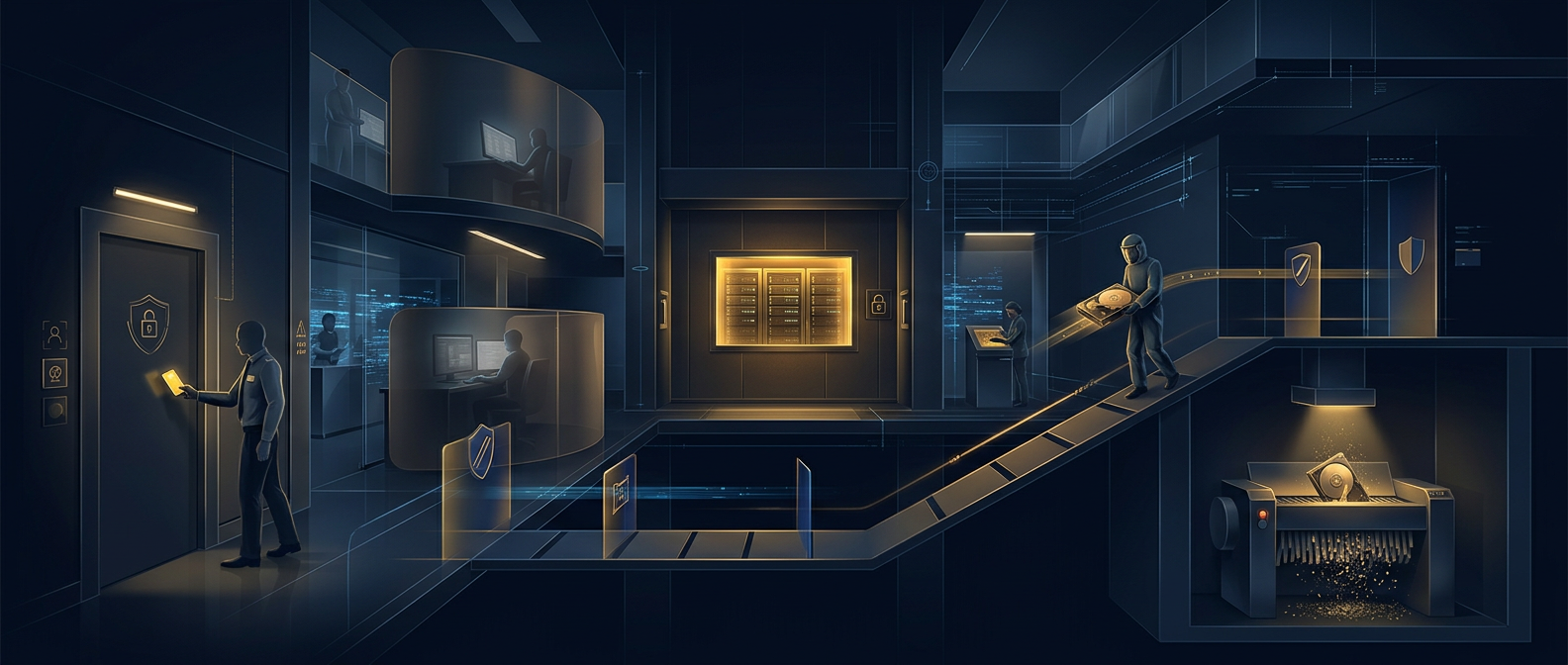
Physical security for protected health information (PHI) is the set of HIPAA-required physical safeguards that control who can physically reach the facilities, workstations, devices, and media where PHI lives. Codified at 45 CFR §164.310, these safeguards cover facility access controls, workstation use and security, and device and media controls — including secure disposal. They sit alongside the technical and administrative safeguards, and a breach of the physical layer is just as reportable as a cyber intrusion.
Ask most healthcare organizations where their protected health information is at risk, and they will point to the network: ransomware, phishing, cloud misconfiguration, a stolen credential. All real. But year after year, a stubborn share of the largest healthcare breaches on the U.S. Department of Health and Human Services (HHS) public portal have nothing to do with a hacker at all. They involve a laptop taken from a car, a server pulled from a decommissioned rack, a box of unshredded records left in a hallway, a hard drive sold on a resale site with the patient data still on it. The HIPAA Security Rule anticipated exactly this. It devotes an entire category of required safeguards to the physical world — and it is the category that executive teams, having spent their security budget on cyber, most often leave thin. This guide is written for the general counsel, chief compliance officer, privacy officer, CISO, and health-system executive who understand that a locked network behind an unlocked door is not secure at all.
Why do physical safeguards get ignored while cyber gets the budget?
Three forces push physical security to the bottom of the priority list. First, cyber threats feel urgent and physical ones feel mundane — a nation-state actor is a more compelling board slide than a poorly locked storage closet, even though the closet is statistically more likely to cause the breach. Second, physical safeguards cut across departments: facilities, IT, HR, biomedical engineering, and clinical operations all own a piece, so no single function is accountable, and shared accountability becomes no accountability. Third, physical controls are invisible when they work and catastrophic when they fail, which makes them easy to defer and impossible to un-defer after the incident.
The regulatory reality is unforgiving of this bias. The HIPAA Security Rule treats a physical exposure of electronic PHI — a stolen unencrypted device, an improperly disposed drive, an unauthorized person walking into a server room — identically to a network intrusion for breach-notification purposes. The four-factor risk assessment, the 60-day notification clock, the Office for Civil Rights (OCR) investigation, the civil monetary penalties, and the listing on the public breach portal all apply the same way. There is no discount for a breach that happened in the physical world rather than the digital one. An organization that has hardened its firewall while leaving its media disposal to an untracked recycling bin has simply moved the weakest link, not removed it.
What does the HIPAA Security Rule require for physical safeguards?
The Security Rule (45 CFR Part 164, Subpart C) organizes safeguards into three families: administrative, physical, and technical. The physical safeguards, at §164.310, comprise four standards, each with specification requirements that are either required or addressable. “Addressable” does not mean optional — it means the organization must implement the specification, or document why it is not reasonable and appropriate and implement an equivalent alternative. Skipping an addressable specification without that documented analysis is itself a compliance failure. The table below maps the four physical-safeguard standards and what each one actually demands.
| Standard (§164.310) | What it governs | Key implementation specifications |
|---|---|---|
| Facility Access Controls (a)(1) | Limiting physical access to systems and the facilities that house them, while permitting authorized access | Contingency operations; facility security plan; access control and validation procedures; maintenance records |
| Workstation Use (b) | How workstations that access PHI may be used and in what environment | Documented policies on proper functions, manner of use, and physical surroundings of PHI-accessing workstations |
| Workstation Security (c) | Physical protections for the workstations themselves | Physical safeguards restricting workstation access to authorized users (positioning, locks, screens, secured areas) |
| Device and Media Controls (d)(1) | Movement, reuse, and disposal of hardware and electronic media holding PHI | Disposal; media re-use (sanitization); accountability (tracking movement); data backup and storage |
Notice what this framework covers that a purely digital program does not: the loading dock, the badge reader, the recycling bin, the resale of surplus equipment, the physical position of a monitor, and the log of who took which laptop where. These are not IT problems in the conventional sense. They are security-operations problems, and they demand the same discipline — controlled access, validated identity, tracked custody, verified disposal — that governs any high-consequence physical environment.
How do facility access controls protect PHI?
Facility access controls answer a deceptively simple question: who can physically reach the places where PHI is stored, processed, or displayed, and how do you know? In a hospital or health system, the answer spans a wide surface — data centers and server rooms, records storage, nursing stations, imaging suites, mailrooms, telehealth carts, and the loading docks where equipment arrives and leaves. Elite programs treat this as a layered model rather than a single locked door.
- Perimeter and zoning. Public, semi-restricted, and restricted zones are defined and physically enforced, so a visitor cannot drift from a waiting room into an area where PHI is exposed. Sensitive systems sit in the most restricted zone, not in a converted closet on a public corridor.
- Identity validation. Badge access, escorted-visitor procedures, and validation of contractors and vendors before they reach restricted areas — the §164.310(a)(1) “access control and validation procedures” specification. A technician servicing a server should be identity-verified and logged, not waved through.
- Surveillance and monitoring. CCTV coverage of access points to sensitive areas, retained long enough to reconstruct who entered when, integrated with alarm and intrusion detection.
- Contingency operations. A documented plan for restoring facility access and protecting PHI during and after an emergency — power loss, disaster, evacuation — so security does not evaporate the moment the building is under stress.
- Maintenance records. Documentation of repairs and modifications to physical components that bear on security (locks, doors, walls, badge systems), the specification most organizations forget entirely.
The world-class distinction here is auditability. It is not enough to have a badge system; the organization must be able to produce, on demand, the record of who accessed a restricted area, prove that access rights were provisioned and de-provisioned as staff and contractors changed, and demonstrate that the surveillance and validation procedures actually operated. When OCR investigates a physical breach, the questions are evidentiary: show us the access logs, the visitor records, the plan. An unmonitored door and an unwritten policy are, for compliance purposes, the same as no control at all.

What do workstation use and workstation security actually require?
The Security Rule splits workstations into two standards on purpose. Workstation Use (§164.310(b)) governs behavior and environment — what a workstation may be used for, how, and in what physical surroundings. Workstation Security (§164.310(c)) governs the physical protection of the device itself. Together they address the most human-scale exposure in healthcare: a screen full of patient data visible to the wrong person, or a device that walks out the door.
In practice this means monitors angled or shielded so PHI is not visible from public corridors or waiting areas (a discipline the industry calls managing “shoulder-surfing” and visual privacy), automatic screen locks, physical cable locks or secured enclosures for high-exposure devices, and clear policies distinguishing a clinical workstation in a controlled area from a laptop that travels. Mobile and portable devices are the sharpest edge: the single most preventable major healthcare breach remains the theft of an unencrypted laptop, tablet, or drive. Encryption is a technical safeguard, but it is the control that neutralizes a physical loss — a stolen device with a properly encrypted drive and a protected key falls under HIPAA’s encryption safe harbor and is generally not a reportable breach. The intersection is the point: physical loss is survivable only when the technical layer was already in place. That is why physical and cyber cannot be run as separate programs, a theme we return to below.
Why is media disposal where so many PHI breaches hide?
Device and Media Controls (§164.310(d)(1)) govern the entire lifecycle of anything that stores PHI — not just hard drives and servers, but backup tapes, USB media, photocopier and multifunction-printer hard drives (a notorious blind spot), imaging and diagnostic equipment, and even paper. The standard has four specifications: disposal, media re-use (sanitization before reassignment), accountability (a record of the movement of hardware and media, and the person responsible), and data backup and storage.
Disposal is where organizations bleed. Deleting a file, formatting a drive, or sending equipment to a recycler does not remove the data — it removes the pointers to it, and forensic tools recover it trivially. The federal standard for doing this correctly is NIST Special Publication 800-88, Guidelines for Media Sanitization, which defines three levels: Clear (overwriting for reuse in a controlled setting), Purge (cryptographic erase or degaussing that defeats laboratory recovery), and Destroy (physical shredding, disintegration, or incineration for the highest-sensitivity media). The right level depends on the sensitivity of the PHI and whether the media leaves the organization’s control. A drive being physically destroyed and a drive being resold demand very different treatment.
The accountability specification is what converts a policy into a defensible record. Every high-consequence disposition should generate a chain-of-custody trail — what device, what data classification, who moved it, when, to which vendor, and a certificate of destruction tying a specific serial number to a verified sanitization method. When a decommissioned drive later surfaces with PHI on it, the difference between a manageable incident and a headline is whether the organization can prove what was supposed to happen to that exact asset. A disposal program without serialized tracking and destruction verification is not a program; it is an assumption.
How do server rooms and data centers fit the physical layer?
The server room is where the physical and cyber worlds are the same room. Every technical safeguard — access control, encryption, logging, intrusion detection — ultimately runs on hardware that someone can walk up to. Physical access to that hardware is, in effect, root access: an attacker or malicious insider standing at the rack can bypass network controls entirely, clone a drive, insert a device, or simply carry a server out. For self-hosted health systems, on-premises data centers and communications closets must sit in the most restricted facility zone, with multi-factor physical access (badge plus PIN or biometric), individual access logging, environmental monitoring, and separation of duties so no single person can both authorize and perform sensitive physical work unobserved.
For organizations using cloud and colocation providers, the physical safeguard obligation does not disappear — it shifts and must be verified. This is a business-associate and vendor-diligence question: the provider’s physical controls (typically evidenced by SOC 2 Type II reports and, for major clouds, their own compliance attestations) become part of your compliance posture through the business associate agreement. “The cloud handles it” is only true to the extent your contracts and diligence prove it, and only for the layers the provider actually owns. The wiring closet in your own clinic is still yours.
What does a physical-safeguards audit cover?
A rigorous physical-safeguards audit is the exercise that surfaces the gaps before OCR — or a thief — does. It mirrors the HHS Security Risk Assessment expectation but focuses the lens on the physical world. A world-class assessment works through the following sequence:
- Inventory where PHI physically lives. Map every location, device, and medium that stores, processes, or displays PHI — including printers, imaging systems, backup media, mobile devices, and paper. You cannot protect what you have not mapped.
- Assess facility access at each location. Test zoning, badge provisioning and de-provisioning, visitor and vendor validation, surveillance coverage, and the contingency-operations plan against the §164.310(a) specifications.
- Evaluate workstation exposure. Walk the clinical and administrative floor as an adversary would — what PHI is visible, which devices are unsecured, which screens do not auto-lock, which portable devices lack encryption.
- Trace the media lifecycle. Follow devices and media from acquisition through reuse to disposal; confirm sanitization meets NIST 800-88 and that accountability records and certificates of destruction exist.
- Inspect the server room and IT spaces. Verify restricted-zone placement, multi-factor physical access, individual logging, environmental controls, and separation of duties.
- Validate vendor and cloud physical controls. Confirm business associate agreements are in place and that provider attestations (SOC 2, cloud compliance reports) cover the physical layers they own.
- Test the evidence, not just the policy. Pull actual access logs, visitor records, disposal certificates, and maintenance records. A control that cannot be evidenced does not exist for compliance purposes.
- Remediate and document. Prioritize gaps by risk, close them, and retain the assessment and remediation record — the Security Rule requires documentation retained for six years.
Where do physical and cyber security converge?
The recurring failure in healthcare security is treating physical and cyber as separate programs run by separate teams with separate budgets. Attackers do not respect that boundary, and neither does the Security Rule. A tailgater who reaches a nursing station, an insider who photographs a screen, a contractor who plugs a rogue device into a network port in an unlocked closet, a stolen laptop whose encryption was never actually enabled — each is a physical event with a cyber consequence, or the reverse. The organizations that get this right run one converged security-operations program in which facility access, device management, media disposal, network defense, and monitoring feed a single picture, and in which an incident is investigated across both domains at once.
This convergence also matters after an incident. When a device is stolen or a drive surfaces where it should not, the questions are simultaneously physical (how did it leave, who had custody) and forensic (was the data encrypted, was it accessed, what exactly was on it). Answering both requires digital forensics and physical-security investigation working from the same command — which is precisely the gap that fragmented vendor arrangements leave open. Integrated cyber services and physical security are not two line items; they are one obligation viewed from two angles.
How does Honeybadger secure the physical layer of PHI?
Honeybadger Solutions approaches protected health information as a single security problem that happens to have a physical face and a digital face. Our healthcare and hospital security work assesses and hardens the physical safeguards HIPAA requires — facility access controls, workstation and device security, media disposal and sanitization to NIST standards, and server-room protection — and does so in concert with the cybersecurity, digital-forensics, financial-investigation, and background-intelligence capabilities we deliver in-house nationwide. Because those disciplines sit under one accountable chain of command, a suspected physical exposure of PHI is investigated across the physical and forensic layers at once, not handed between disconnected vendors while the notification clock runs.
We conduct physical-safeguards audits mapped to the Security Rule, design layered facility and access-control programs, build defensible media-disposal chains of custody with verified destruction, and stand up converged physical-plus-cyber security operations for hospitals, health systems, medical groups, and their counsel. From Arizona home command, with offices in Casa Grande, Phoenix, and Oro Valley, we serve healthcare organizations across the United States — closing the distance between a locked network and a genuinely secure facility, so the weakest link is not the door.
Frequently asked questions
What are the physical safeguards under the HIPAA Security Rule?
The HIPAA Security Rule (45 CFR §164.310) requires four physical-safeguard standards: facility access controls (limiting physical access to systems and the facilities housing them), workstation use (policies on how and where workstations access PHI), workstation security (physical protection of the devices), and device and media controls (governing the disposal, reuse, tracking, and storage of hardware and media holding PHI). Each standard has required or addressable specifications, and addressable ones must be implemented or a documented equivalent adopted.
Is a stolen unencrypted laptop a reportable HIPAA breach?
Generally yes. The theft of a device containing unsecured (unencrypted) PHI is presumed to be a breach and triggers the four-factor risk assessment and the 60-day notification clock. If the device was properly encrypted and the key was not also compromised, it falls under HIPAA’s encryption safe harbor and is generally not a reportable breach. This is why encryption of portable devices is the single most effective control against physical loss — it converts a stolen laptop from a breach into a non-event.
How should healthcare organizations dispose of devices that held PHI?
Deleting files or formatting a drive does not remove PHI; the data remains recoverable. Disposal must follow media-sanitization standards such as NIST Special Publication 800-88, which defines Clear, Purge, and Destroy levels based on sensitivity and whether the media leaves your control. Every disposition should generate a chain-of-custody record and a certificate of destruction tying a specific serial number to a verified method. This covers not just servers and hard drives but backup tapes, USB media, and the hidden drives inside copiers and imaging equipment.
Do physical safeguards still apply if we use a cloud provider?
Yes. Using a cloud or colocation provider shifts some physical-safeguard responsibility to that provider but does not eliminate your obligation. The provider becomes a business associate; their physical controls (evidenced by SOC 2 Type II reports and cloud compliance attestations) must be verified through diligence and covered by a business associate agreement. You remain fully responsible for the physical security of anything you host or control yourself — on-premises servers, workstations, wiring closets, mobile devices, and paper records.
About Honeybadger Solutions
Honeybadger Solutions is an Arizona-licensed security and investigations firm delivering intelligence-led security, forensics, and cyber services to hospitals, health systems, medical groups, executives, and their counsel nationwide and internationally. Physical security, cybersecurity, digital forensics, financial investigations, and background intelligence are coordinated under a single accountable chain of command — so the physical safeguards protecting protected health information are assessed, hardened, and investigated to a standard that survives OCR scrutiny.
Offices: Casa Grande (HQ), Phoenix, and Oro Valley, Arizona.
Phone: Book a consultation online
Confidential consultation: engage our command team for a HIPAA physical-safeguards audit before a stolen device or an untracked disposal becomes a reportable breach.
Authoritative Resources
Browse by topic
Security guard services · Private investigations · Cybersecurity · Digital forensics · Financial fraud investigation · Executive protection · All articles