
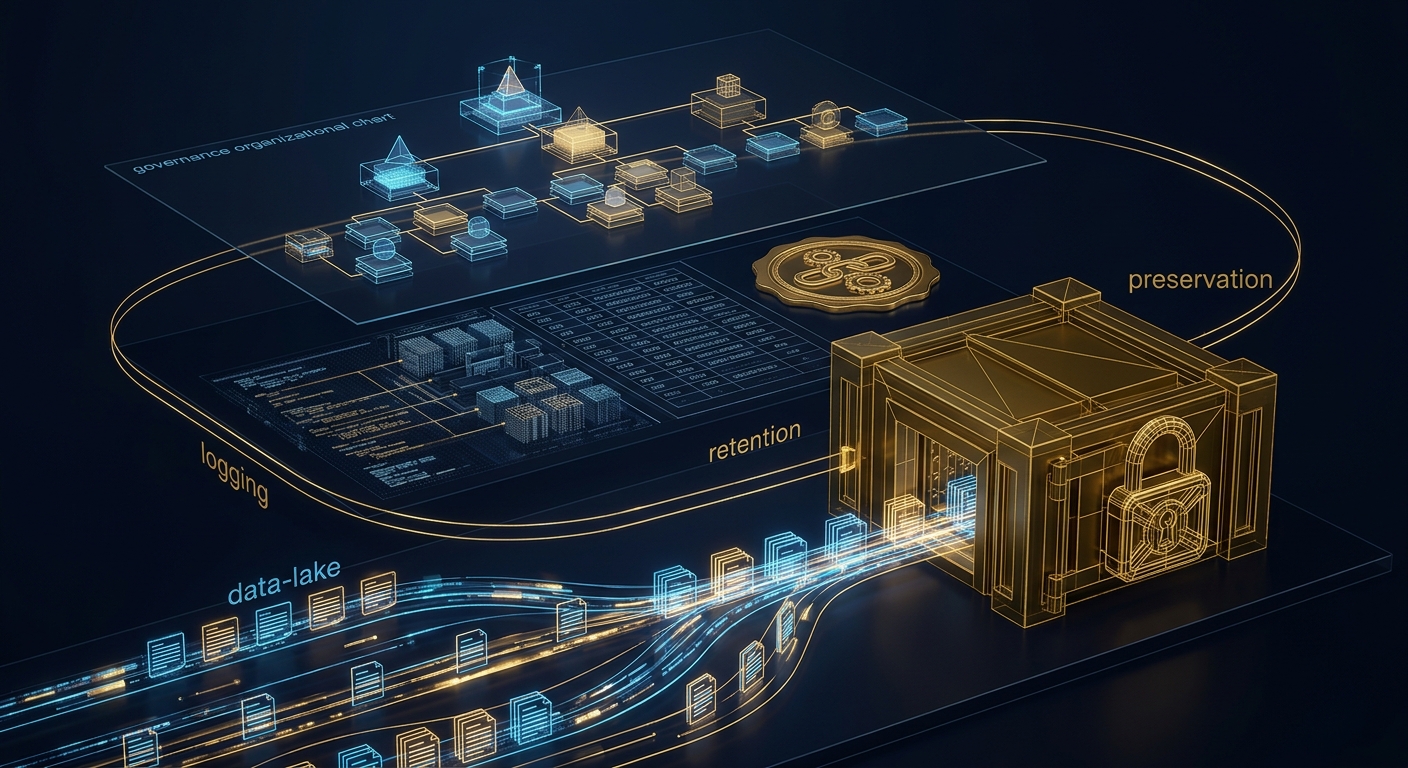
Forensic readiness is the capability an organization builds before an incident so that, when one occurs, evidence is already being generated, preserved, and made defensible. Where generic incident response focuses on stopping the bleeding, readiness ensures the answers survive scrutiny: the right telemetry is logged and retained, preservation is engineered in advance, roles and legal-hold authority are pre-assigned, and the response is rehearsed. It is the difference between reacting and being prepared to prove what happened.
Almost every organization believes it has an incident-response plan. Far fewer can answer the questions that matter after a breach, a fraud, or a departing-executive dispute: Do we have the logs that would show what the attacker touched? For how long were they retained? Who has the authority to invoke a legal hold at 2 a.m.? Can our evidence withstand a motion to exclude? Forensic readiness is the discipline of resolving those questions before the crisis, when there is time to engineer the answer correctly. For general counsel, CISOs, corporate security leaders, and boards, it is among the highest-leverage risk investments available—because the cost of discovering a gap during an incident is measured in destroyed evidence, spoliation exposure, and decisions made blind. This guide sets out what readiness actually requires and how elite programs build it.
What is the difference between forensic readiness and incident response?
The two are often conflated, and the conflation is expensive. Incident response is the operational sequence that begins after detection—contain, eradicate, recover, as codified in frameworks such as the NIST computer-security incident-handling guidance. Forensic readiness is what determines whether that sequence has anything reliable to work with. It is the pre-positioning of evidence-generating capability so that the facts of an incident can be reconstructed and, if necessary, proven to a court, a regulator, an insurer, or a board.
Put concretely: an IR plan tells you to “preserve relevant logs.” Readiness is the reason those logs exist, are complete, are time-synchronized, and were retained past the ninety-day mark when the intrusion is finally discovered. An IR plan says “engage forensics.” Readiness is the retainer, the pre-authorized authority, and the preservation runbook that let forensics start in hours rather than days. Response is a fire drill; readiness is the smoke detectors, the sprinklers, the clear exits, and the rehearsal. A world-class program treats them as complementary but distinct disciplines—and recognizes that most organizations over-invest in the reactive half while neglecting the preparatory half that governs its outcome.
What should you log and retain—and for how long?
Evidence you did not capture cannot be recovered, and the median dwell time of a serious intrusion routinely exceeds the retention window of the very logs that would document it. The core readiness question is therefore not “do we have logging” but “do we log the right sources, in a tamper-evident store, retained long enough to cover the way real incidents are actually discovered.” A defensible logging architecture spans several evidentiary layers.
- Identity and authentication. Sign-ins, MFA challenges, privilege escalations, and directory changes—the substrate of nearly every intrusion and insider matter. Cloud identity providers and directory services are the first logs an examiner asks for.
- Endpoint telemetry. Process execution, command-line arguments, and EDR detections. Without process-level visibility, “what did they run” is unanswerable.
- Network and egress. Firewall, proxy, DNS, and flow records that reveal command-and-control, lateral movement, and data leaving the environment.
- Cloud control-plane. API activity logs (for example, the audit trails of major cloud platforms) documenting who created, changed, or deleted resources and keys.
- Application and database. Access and object-level logs for the systems holding regulated or crown-jewel data.
- Email and collaboration. Mailbox audit, forwarding-rule changes, and file-sharing activity—central to business-email-compromise and exfiltration cases.
Retention is where readiness most often fails. A ninety-day default is common and, for serious matters, dangerously short—intrusions are frequently discovered months later, by which point the decisive logs have rolled off. Mature programs tier retention: high-value security telemetry (identity, endpoint, cloud control-plane) held twelve to twenty-four months in a write-once or immutable store; broader operational logs held to a shorter operational window; and regulatory data retained to the specific statutory schedule that governs it. Two disciplines make the whole architecture credible: synchronized time across every source, so a timeline can be built at all, and tamper-evidence—immutability, restricted access, and integrity monitoring—so the logs are not merely present but trustworthy.
How do you architect evidence preservation before you need it?
Logging generates evidence; preservation keeps it defensible. The most common way strong evidence is lost is not attacker anti-forensics—it is well-meaning internal activity: an administrator who reimages the compromised host, a help-desk technician who logs in “to check,” an automated reboot that flushes memory, or a retention job that purges the mailbox of a departed employee. Preservation architecture is the set of controls that prevent this before an incident forces the question.
- Isolation over remediation. A pre-agreed rule that suspected systems are isolated and preserved—not wiped, patched, or “cleaned”—until a preservation decision is made. Remediation destroys evidence; isolation keeps both options open.
- Volatile-data capture capability. The tooling and authority to capture memory and live state before power-down, since RAM holds encryption keys, injected code, and network state that vanish on reboot.
- Immutable log and backup stores. Write-once retention so that neither an attacker nor a routine job can alter or delete the record, addressing the spoliation risk directly.
- Legal-hold reach into every custodial system. The ability to suspend auto-deletion in email, chat, HR systems, and endpoints on demand—tested, not assumed.
- Pre-defined acquisition standards. Hash-verified imaging, documented tooling, and chain-of-custody templates staged in advance, so the first responder does not improvise the evidentiary foundation.
Because our digital-forensics capability is in-house and remote-by-design, preservation can begin nationwide within hours of a call—guiding on-site staff to isolate and image correctly, or performing remote acquisition directly—rather than waiting on a courier or a local vendor. Speed is not a convenience here; it is evidentiary. Every hour a compromised system keeps running is an hour of overwrite.
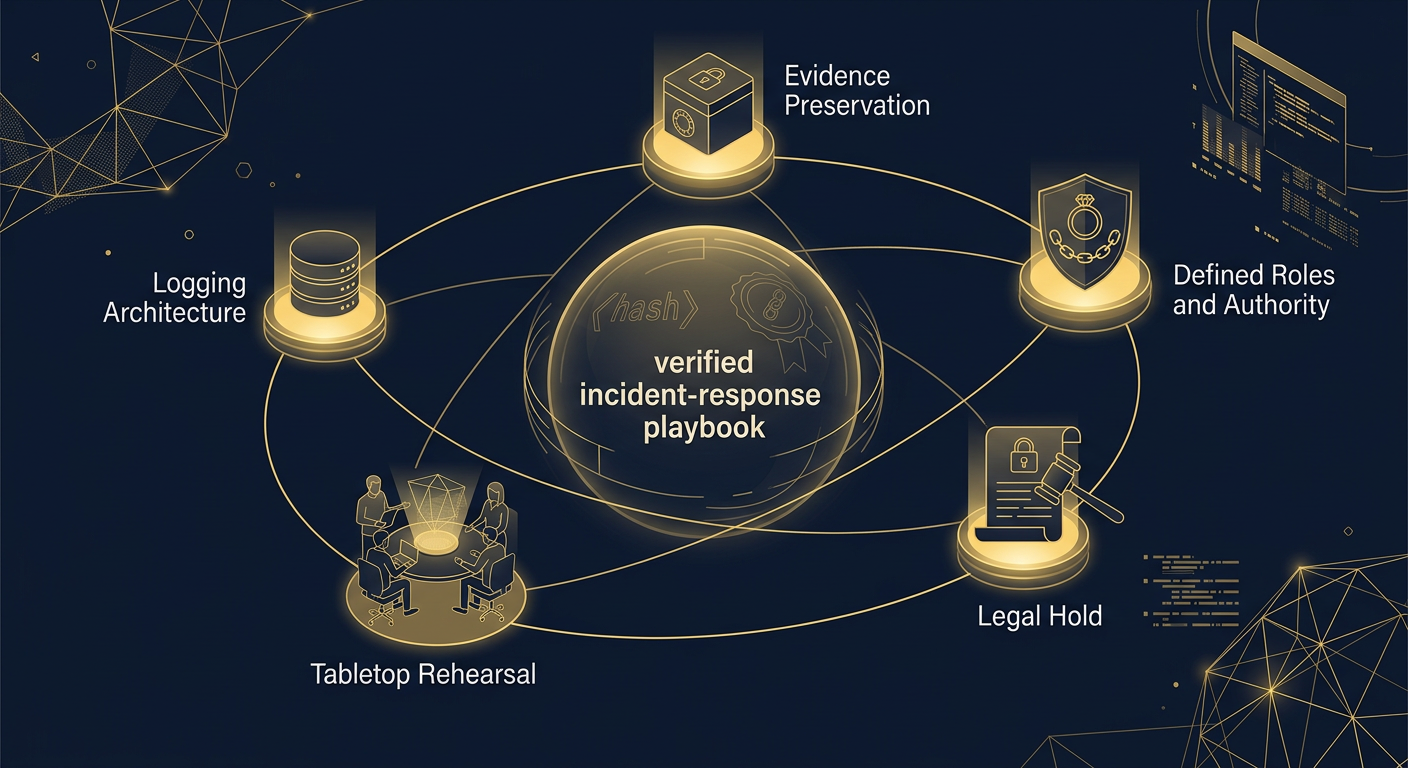
Who has authority to act—and when does legal hold trigger?
Technical readiness collapses without decision-rights readiness. In the first hours of an incident, the questions are not technical but jurisdictional: Who can order a system isolated? Who can authorize forensic acquisition of an executive’s device? Who invokes legal hold, and against which custodians? If those answers are improvised during the crisis, evidence is lost while people escalate. A readiness program assigns them in advance.
- Incident commander. A named role with the standing authority to declare an incident and direct containment and preservation, plus a defined chain of deputies for after-hours coverage.
- Legal ownership. Counsel—internal or outside—who directs the investigation under privilege, decides on legal hold, and owns communications with regulators and law enforcement.
- Preservation authority. Explicit, pre-granted authority for security to isolate and image systems, including executive endpoints, without waiting for case-by-case sign-off.
- Escalation and notification map. Who is told, in what order, and on what clock—including the board, insurers, and any statutory or contractual notification deadlines.
Legal hold deserves particular attention because getting it wrong is independently costly. The duty to preserve is triggered when litigation or investigation is reasonably anticipated—often well before a lawsuit is filed. Under the federal spoliation standard governing electronically stored information, a party that fails to take reasonable steps to preserve, and thereby loses evidence that cannot be restored, can face sanctions up to and including adverse-inference instructions or dismissal. Readiness means the hold can be issued the moment the trigger is recognized, can reach every custodial system technically, and is documented—so the organization can prove it acted reasonably even if some data was nonetheless lost.
Forensic readiness vs. generic incident response at a glance
| Dimension | Generic incident response | Forensic readiness |
|---|---|---|
| Primary goal | Contain and restore operations | Preserve and prove what happened |
| Timing | Activated after detection | Engineered before any incident |
| Logging | “Collect available logs” | Right sources, synchronized, immutably retained |
| Evidence handling | Ad hoc, improvised under pressure | Pre-staged acquisition, hashing, chain of custody |
| Authority | Escalated during the crisis | Roles and legal-hold power assigned in advance |
| Defensibility | Often untested against challenge | Court- and regulator-ready by design |
| Validation | Rarely rehearsed end to end | Tabletop-tested and measured |
How do you build a forensic readiness program step by step?
Readiness is built deliberately, in a sequence that moves from knowing what you must protect to proving you can protect it. The following framework is the arc elite programs follow; each stage is a prerequisite for the next.
- Map the scenarios and the crown jewels. Identify the incidents that would most damage the organization—insider exfiltration, ransomware, business-email compromise, executive dispute—and the systems and data whose loss or theft matters most. Readiness is scoped to real risk, not to everything equally.
- Inventory evidence sources. For each scenario, determine what would have to be proven and which logs, systems, and artifacts would prove it. This exposes the gaps between the evidence you would need and the telemetry you actually keep.
- Engineer logging and retention. Close those gaps: enable the missing sources, synchronize time, move critical telemetry into immutable storage, and set tiered retention that matches how incidents are truly discovered.
- Design the preservation architecture. Establish isolation-over-remediation rules, volatile-capture capability, immutable stores, and staged acquisition standards with chain-of-custody templates.
- Assign roles and authority. Name the incident commander and deputies, define counsel’s role and privilege posture, pre-grant preservation authority, and build the escalation and notification map.
- Codify the legal-hold process. Define the preservation trigger, the custodian-identification method, and the technical mechanism to suspend deletion across every system—then confirm it actually works.
- Secure external capability in advance. Put a forensics/IR retainer and, where relevant, breach counsel and a PR advisor under contract before an incident, so expert help starts in hours.
- Rehearse and measure. Run tabletop and, where feasible, technical exercises against your priority scenarios; measure time-to-preserve and time-to-answer; feed every gap back into the program.
Why do tabletop exercises matter, and how are they run well?
A readiness program that has never been exercised is a set of assumptions. Tabletop exercises convert assumptions into knowledge by walking the actual people who would respond through a realistic scenario and surfacing where the plan breaks. They are the cheapest place to discover that the legal-hold tool cannot reach the chat platform, that after-hours authority is undefined, or that the logs everyone assumed existed were purged sixty days ago.
A well-run exercise is scenario-specific and role-honest: it uses one of the organization’s priority scenarios, includes the real incident commander, counsel, security, IT, and communications, and injects complications—an executive’s device is involved, a regulator asks for a timeline, a backup is found encrypted. The value is not in confirming the plan works; it is in the friction. The most useful output is a gap list with owners and dates. Elite programs measure two things above all: how fast the team can move from suspicion to preservation, and how fast it can move from preservation to a defensible answer. Both improve only with repetition, and both are far cheaper to improve in a conference room than in a live breach.
Should you retain a forensics and IR provider in advance?
In serious matters, the first hours decide the outcome, and that is precisely when an organization sourcing help for the first time loses time to procurement, scoping, and onboarding. A pre-negotiated retainer collapses that delay: terms, authority, and preservation runbooks are agreed in advance, so a call becomes acquisition in hours. It also means the provider already understands your environment—your logging, your crown jewels, your custodial systems—rather than learning them under fire.
The decision between a retainer and on-demand engagement turns on risk profile, regulatory exposure, and the cost of delay, and it is a subject in its own right. For readiness purposes the essential point is narrower: the capability must be secured, tested, and integrated into the response plan before an incident, whatever the commercial structure. What distinguishes a world-class provider is the ability to preserve and examine evidence to a defensible standard nationwide—remote-by-design where possible, on-site where necessary—under recognized methodologies with hash-verified acquisition and continuous chain of custody, and to report in language a board and a court can both act on.
What is the ROI of forensic readiness?
Readiness is easy to defer because its return is realized in a crisis that has not happened yet. But the economics are stark. An organization without readiness pays in three currencies during an incident: time, as evidence is overwritten while people improvise; certainty, as decisions about notification, litigation, and recovery are made without reliable facts; and legal exposure, as missing logs and mishandled evidence become spoliation arguments that shift liability regardless of the underlying merits.
Against those costs, readiness is comparatively cheap: logging and retention are largely configuration and storage; role assignment and legal-hold design are policy; a retainer is a modest recurring fee; a tabletop is a day. The payoff is a shorter, cheaper incident, a defensible legal position, faster and more accurate regulatory notification, and a board that is briefed with facts rather than fears. The clearest way to see the value is the counterfactual: the readiness gap is discovered either in a rehearsal, where it costs a line item, or in a breach, where it costs the case. Prudent organizations choose the venue in advance.
Frequently asked questions
How is forensic readiness different from having an incident-response plan?
An incident-response plan defines what you do after an incident is detected—contain, eradicate, recover. Forensic readiness is what makes that plan effective: the pre-positioned logging, retention, preservation controls, assigned authority, and rehearsed process that ensure reliable evidence actually exists and stays defensible when the plan activates. Most organizations have some form of IR plan but lack true readiness, so their response begins with discovering that the decisive logs were purged or the evidence was overwritten. Readiness resolves those gaps before the crisis, when there is still time to fix them.
How long should we retain security logs for forensic purposes?
Longer than the common ninety-day default, because serious intrusions are frequently discovered months after they begin—by which point short-retention logs have rolled off. Mature programs tier retention: high-value security telemetry such as identity, endpoint, and cloud control-plane logs held twelve to twenty-four months in an immutable or write-once store; broader operational logs kept to a shorter window; and regulated data retained to its specific statutory schedule. Equally important as duration are synchronized time across sources and tamper-evidence, so the retained logs can be assembled into a timeline and trusted.
When does the duty to preserve evidence and issue a legal hold begin?
The duty to preserve is triggered when litigation or investigation is reasonably anticipated, which is often earlier than a filed lawsuit—for example, once a serious breach or an internal fraud is identified. Under the federal standard governing electronically stored information, failing to take reasonable preservation steps and thereby losing evidence that cannot be restored can lead to sanctions, including adverse-inference instructions. Readiness means the hold can be invoked immediately, reaches every custodial system technically, and is documented, so the organization can demonstrate it acted reasonably even if some data is nonetheless lost.
Can forensic readiness be built for an organization operating in multiple states?
Yes. Logging architecture, retention policy, preservation runbooks, role and legal-hold design, and tabletop exercises are all portable across locations, and much of the work is remote by nature. Honeybadger Solutions builds and supports readiness programs nationwide and internationally from our Arizona home command, with in-house, remote-by-design digital forensics that can begin preservation within hours of a call—guiding local staff to isolate and image correctly, or acquiring remotely—regardless of where the affected systems sit. The same defensible standards apply whether the matter is in Phoenix, another state, or abroad.
About Honeybadger Solutions
Honeybadger Solutions is an Arizona-licensed security and investigations firm providing digital forensics, cybersecurity, and full-spectrum investigations to organizations, in-house and outside counsel, insurers, and principals nationwide and internationally. Our forensics, cybersecurity, financial-investigations, and background-intelligence capabilities are in-house and remote-by-design, conducted under recognized methodologies with hash-verified acquisitions, continuous chain of custody, and board- and court-ready reporting. We operate three Arizona offices—Casa Grande (headquarters), Phoenix, and Oro Valley—serving Phoenix and every Arizona venue, all U.S. jurisdictions, and engagements abroad.
Want to know whether your organization could actually prove what happened after an incident? Book a consultation online to arrange a forensic-readiness assessment—logging, retention, preservation, legal hold, and tabletop—before you need it. Confidential. Defensible. Nationwide.
Authoritative references: NIST SP 800-61r2, Computer Security Incident Handling Guide and Federal Rules of Civil Procedure, Rule 37(e) (Failure to Preserve Electronically Stored Information).
Browse by topic
Security guard services · Private investigations · Cybersecurity · Digital forensics · Financial fraud investigation · Executive protection · All articles