
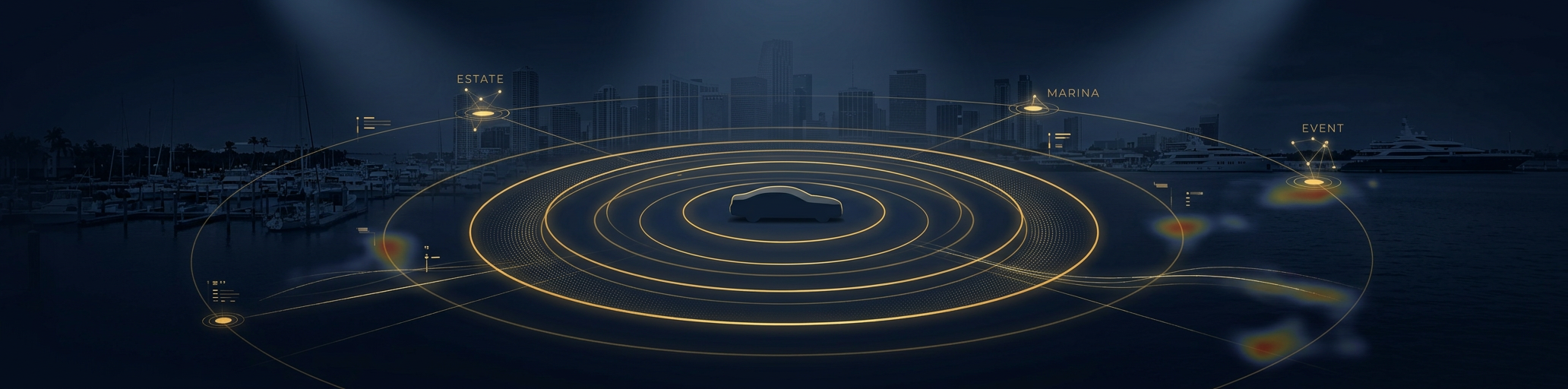
Executive protection in Miami for high-net-worth and international principals is the discipline of securing wealthy families, foreign executives, and their assets across estates, yachts, private events, and cross-border travel — without disrupting the lifestyle that brings them here. In a city defined by visible wealth, international money, and waterfront living, credible protection fuses protective intelligence, residential and maritime security, discreet close protection, and travel-risk management into one accountable program.
Miami has become the western hemisphere’s magnet for private capital. Family offices relocating from the Northeast, Latin American principals maintaining a second base in Florida, founders cashing out into waterfront estates, and a global set that arrives for Art Basel, the boat show, and the racing calendar — all of it concentrates extraordinary wealth into a compact, highly exposed environment. That concentration produces a threat picture unlike anywhere else in the United States: less about the fixated fan and far more about targeted financial crime, kidnap-and-ransom exposure carried in from abroad, and the simple, mathematical reality that visible affluence attracts predators. This guide is written for the sophisticated buyer — the principal, the family-office director, the general counsel, or the private banker — who needs to understand what genuine protection looks like in this market, how it differs from the valet-parked SUV and the off-duty officer that pass for it, and how an elite program is actually built and run.
Why is executive protection different for UHNW and international principals in Miami?
Corporate executive protection manages a knowable set of risks around a person whose exposure comes from a title. Protecting an ultra-high-net-worth or international principal in Miami inverts several of those assumptions. First, the threat frequently originates offshore: a Latin American industrialist or their family may carry a kidnap-and-ransom profile, a business dispute, or a political exposure from their home country that has nothing to do with their conduct in Florida and everything to do with who is watching them from abroad. Second, the asset base is sprawling and physical — a bayfront estate, a yacht at a private marina, a fleet of vehicles, art and jewelry, and a household staff of a dozen or more — each of which is its own attack surface. Third, the principal is often not one person but a family: a spouse, children in private schools, and elderly parents, any of whom can be the softest target and the one the principal cares about most.
The second defining feature is discretion under scrutiny. Miami’s UHNW community is socially visible — the same charity galas, restaurants, clubs, and marinas recur, and word travels. A heavy, obvious detail signals wealth, invites the exact attention it is meant to deter, and marks the principal as a target worth studying. The best protection in this market is felt by the family and invisible to everyone else. It is measured not by how imposing it looks but by how few incidents ever reach the principal — and by how many were resolved quietly, upstream, through intelligence and planning rather than confrontation.
What threats do high-net-worth principals in Miami actually face?
The headline fear is a targeted kidnapping, but the real landscape is broader and more mundane, which is exactly why it is dangerous. A credible program plans for the full range rather than the movie version.
- Targeted robbery and “follow-home” crime. Organized crews surveil high-value targets at luxury retailers, restaurants, marinas, and the airport, then follow them to a residence to rob them of watches, jewelry, and cash at the gate. It is deliberate, patient, and increasingly common against visibly wealthy targets.
- Residential burglary and home invasion. Bayfront and gated-community estates are targeted for high-value contents, and the presence of a family at home turns a burglary into a violent home invasion. Waterfront access adds a maritime approach vector most alarm systems ignore.
- Kidnap and ransom (K&R) and express kidnapping. For international principals — particularly those with exposure in parts of Latin America — K&R is a live, quantifiable threat that travels with the family and their staff, and that peaks during return travel to the home country.
- Extortion, virtual kidnapping, and coercion. Threats and fraudulent “we have your family member” schemes that exploit a principal’s wealth and their difficulty verifying a loved one’s location in real time.
- Digital exposure and doxxing. Property records, corporate filings, social posts, and data-broker profiles expose home addresses, routines, travel, and family members — the raw intelligence every physical threat depends on.
- Insider and staff-related risk. Estate staff, crew, drivers, and vendors have intimate access; poor vetting is a recurring root cause of theft, information leakage, and facilitated crime.
- Event and crowd exposure. Galas, art fairs, nightlife, and marquee sporting events place principals in dense, semi-public environments where access control and advance planning are the only real controls.
The through-line is that most of these threats announce themselves before they turn physical — in an exposed address, a surveillance run, a pattern of movement, or a message. That is why intelligence, not muscle, is the center of gravity in this work.
How does estate and residential security work for a Miami principal?
The residence is the anchor of a UHNW protection program and, for most families, the point of greatest daily vulnerability. Serious residential security is layered defense, not a single alarm panel. It begins at the perimeter — fencing, landscaping sightlines, lighting, and, on the water, dock and seawall coverage that treats the bay as a genuine approach route rather than a view. It moves inward through access control at the gate and entry points, camera coverage with real monitoring rather than after-the-fact review, intrusion detection, and a hardened safe area the family can reach and hold during a home invasion. It extends to the people: vetted household staff, controlled vendor and delivery access, and protocols that keep the family’s routines from being predictable to anyone watching.
What separates an elite residential posture from an expensive one is integration and response. Cameras that no one watches, a gate anyone can tailgate through, and a panic button with no rehearsed response are theater. A credible program conducts a formal residential risk assessment, closes the gaps in priority order, rehearses the response to a break-in or medical event, and integrates the home with the principal’s personal detail and travel plan so there are no seams between the front door and the car. Where a residence is part of a multi-property life, the same standard is applied consistently across each location the family uses.
How is yacht and maritime security handled?
Few environments are as under-protected relative to their value as a private yacht. A vessel concentrates a principal, their family, guests, crew, and often significant cash and valuables into an isolated platform — at a marina surrounded by strangers, or at anchor far from any rapid response. Maritime security addresses vectors that land-based protection ignores entirely: unauthorized boarding from the water, theft and piracy in transit or at anchor, crew vetting and integrity, and the reality that when something goes wrong offshore, help may be an hour or more away.
A competent yacht program treats the vessel as a mobile estate with its own security plan: access control at the passerelle and from the water, camera and monitoring coverage, a vetted and briefed crew, a defined safe area and muster plan, communications and emergency protocols, and coordination with the marina’s own security and, where relevant, the U.S. Coast Guard. For voyages, the plan incorporates route risk, port security in each destination, and the transition points — embarking, disembarking, tendering to shore — where a principal is most exposed. The tender run to a beach club or a waterfront restaurant is a movement like any other, and it deserves an advance.

How is event and social security managed in Miami?
Miami’s social and cultural calendar — art fairs, galas, the boat show, marquee sporting events, and a dense nightlife scene — puts UHNW principals into crowded, semi-public environments on a regular basis. The failure mode is improvisation: arriving at a gala with no advance, no known egress, and no plan for an aggressive approach or a medical emergency. Event security for a principal is built on advance work — studying the venue, walking the routes, identifying entrances, exits, and a safe room, coordinating with venue and event staff, and positioning vehicles for a clean arrival and a controlled departure.
The posture is almost always discreet. A plainclothes agent who reads as part of the party, manages proximity, and de-escalates quietly protects the principal without turning a charity dinner into a spectacle. The visible agent standing near the principal is only the last few feet of a plan that started hours earlier. The table below contrasts the discreet posture that suits most social and business settings with the overt footprint reserved for a narrow set of credible-threat situations.
| Dimension | Low-Profile (Discreet) Protection | Overt (High-Visibility) Protection |
|---|---|---|
| Primary goal | Manage risk invisibly, protect privacy | Deter through visible presence |
| Agent appearance | Plainclothes, blends with guests/staff | Unmistakably security |
| Best suited to | Daily life, galas, business, family | Credible active threat, hostile setting |
| Effect on setting | Neutral; preserves discretion | Signals wealth; can attract attention |
| Core skill emphasis | Intelligence, anticipation, de-escalation | Physical deterrence, control |
| Success looks like | Nothing appears to happen | Visible, hardened perimeter |
Most principals are served by the discreet posture the overwhelming majority of the time, with the ability to surge to a heavier footprint when a specific, credible threat justifies it. The mark of a mature provider is knowing when to shift — and, just as importantly, when not to.
How is international travel risk and kidnap-and-ransom exposure managed?
For international principals, the most acute exposure is often not in Miami at all but in transit and at the home country. A family that is well protected on a Florida estate can be dangerously soft on a return trip to a region with a real kidnapping economy. Travel-risk management extends the protective envelope across borders: pre-travel intelligence on the destination, route and airport planning, secure ground transportation and vetted local partners, communications and check-in protocols, and a defined response to a security incident abroad. For principals with genuine K&R exposure, this includes coordination with the family’s K&R insurance and response resources, and a clear crisis-management plan agreed before anyone boards a flight.
Sound travel planning is evidence-led. Reputable threat information — including U.S. Department of State travel advisories and the Overseas Security Advisory Council — anchors the assessment, and the plan is built around the specific principal, itinerary, and profile rather than a generic template. The transition points — the airport, the arrival, the first and last mile — are where kidnappings and robberies concentrate, so those are where the planning is densest. A principal who moves predictably, arrives at a fixed time, and is met by an unvetted driver in a high-risk city is exposed no matter how good the Miami estate is.
How do you build a UHNW protection program in Miami? A practical framework
Whether the family needs a single trusted agent or a standing program across estate, yacht, events, and travel, a defensible engagement follows a recognizable sequence. This is the arc a discerning family-office director or general counsel should expect from a serious provider.
- Confidential intake and risk assessment. Understand the principal, the family, the asset base, the international exposure, and any existing threats or history — the foundation for everything that follows.
- Protective-intelligence baseline. Establish a picture of active concerns: digital and address exposure, surveillance indicators, business and political risk, and K&R profile, so the program is driven by evidence rather than assumption.
- Residential and asset hardening. Assess and upgrade the estate, yacht, and vehicles — perimeter, access control, monitoring, safe areas, and staff protocols — and reduce the predictability of the family’s routines.
- Detail design matched to risk. Determine the right posture — discreet default, surge capability, family and school coverage, event and travel coverage — sized to the assessed threat rather than to ego or budget theater.
- Advance and movement planning. Build the venue advances, routes, vehicles, and contingency plans that make each appearance, marina visit, and movement routine rather than improvised.
- Travel and crisis planning. Prepare for international travel and incident response, coordinate K&R resources, and agree the crisis-management and escalation plan before it is needed.
- Staff and vendor vetting. Screen household staff, crew, drivers, and recurring vendors, because intimate access is a top root cause of loss.
- Review and adapt. Debrief incidents, update assessments, and adjust the program as the family’s profile, assets, and threat picture evolve.
The through-line is proportionality and discretion. A program that is heavier than the threat is a nuisance the family will eventually shed; one that is lighter than the threat is negligence waiting to be discovered. Getting that balance right, and adjusting it as circumstances change, is the craft.
How does Honeybadger deliver executive protection in Miami?
Honeybadger Solutions delivers executive protection in Miami through a commanded vetted-partner network operating under unified command. Threat assessment, protective-intelligence direction, planning, tradecraft standards, and single-point accountability are centralized, while protective operations are executed on the ground by rigorously vetted, Florida-licensed teams — a requirement in a state that regulates the industry through the Florida Department of Agriculture and Consumer Services, Division of Licensing. Florida is an established theater for our physical and executive-protection work, alongside California and Texas, with Arizona as home command. The principal gets one accountable partner, one consistent standard of tradecraft, and local, licensed capability — without the costly fiction that any single firm owns a fully staffed armed office in every city.
What distinguishes the program is the fusion of that protective capability with in-house intelligence. Because our background intelligence, cybersecurity, and digital-forensic disciplines are handled internally and delivered globally, an exposed residence, a doxxing incident, an extortion attempt, or a due-diligence question about a new staff member is not handed to a separate vendor — it is worked by the same command that runs the physical security and investigations. That is how a leaked address gets traced and closed, how a virtual-kidnapping scheme gets verified and defused, and how a family’s international exposure is understood before it becomes a crisis. Command and coordination are anchored from our Arizona base across the Casa Grande headquarters and the Phoenix and Oro Valley offices, directing established-theater operations in the Miami market.
Frequently asked questions
What is the biggest security threat to wealthy families in Miami?
For most UHNW families it is targeted financial crime — follow-home robbery, residential burglary, and home invasion driven by visible wealth — combined, for international principals, with kidnap-and-ransom exposure carried in from abroad. These threats are deliberate and preceded by surveillance and digital exposure, which is why protective intelligence and hardening, not just guards, sit at the center of credible protection.
Do I need visible bodyguards, or is discreet protection safer?
For most principals in Miami, discreet protection is both safer and more appropriate. A low-profile posture protects privacy, avoids signaling wealth, and lets agents manage proximity and de-escalate quietly, while the program retains the ability to surge to a visible, hardened footprint when a specific, credible threat justifies it. The skill is matching the posture to the assessed risk rather than defaulting to intimidation.
Can you secure a yacht and international travel, not just a residence?
Yes. A complete UHNW program treats the yacht as a mobile estate with its own security and crew-vetting plan, and extends the protective envelope across borders with pre-travel intelligence, secure transport, vetted local partners, communications protocols, and coordination with any kidnap-and-ransom resources. The estate, the vessel, events, and travel are run under one plan so there are no seams between them.
Does Honeybadger operate in Miami and Florida?
Yes. Florida is an established theater for our executive protection, delivered through a commanded vetted-partner network of Florida-licensed teams under unified command, with Arizona as home command. Threat assessment, protective intelligence, and accountability are centralized, and in-house intelligence, cyber, and investigative capability supports every engagement. Book a consultation online for a confidential consultation.
About Honeybadger Solutions
Honeybadger Solutions is an Arizona-licensed security and investigations firm delivering intelligence-led executive protection, investigations, and cyber services to high-net-worth families, international principals, and organizations nationwide and internationally. Physical and executive protection is delivered through a commanded vetted-partner network with established theaters in California, Texas, and Florida, directed from Arizona home command. Digital forensics, cybersecurity, financial investigations, and background intelligence are handled in-house and delivered globally.
Offices: Casa Grande (HQ), Phoenix, and Oro Valley, Arizona.
Phone: Book a consultation online
Confidential consultation: discuss a protective assessment for your family, estate, yacht, or travel with our command team.
Browse by topic
Security guard services · Private investigations · Cybersecurity · Digital forensics · Financial fraud investigation · Executive protection · All articles