

Elder financial abuse investigation services are professional, forensic engagements that detect, document, trace, and help recover money stolen from older adults — whether by trusted insiders or outside scam rings. Delivered for banks, trustees, wealth managers, elder-law firms, family offices, and adult children, they combine forensic accounting, asset tracing, and digital forensics to build institution-grade evidence and coordinate recovery, nationwide and internationally.
When an older adult is being financially drained, the people responsible for protecting them — an adult child holding a power of attorney, a trustee with a fiduciary duty, a private banker watching an account behave strangely, an elder-law attorney preparing a petition — face the same problem: suspicion is not evidence, and by the time the pattern is obvious, the money is usually gone. This resource explains what a professional elder financial abuse investigation service actually delivers, who retains it, how stolen funds are traced across modern payment rails and borders, and how a disciplined engagement turns a worried hunch into a decision-grade case. It is written for the professionals and families who carry that responsibility and need to act correctly the first time.
What do elder financial abuse investigation services actually include?
The phrase covers a spectrum of engagements, not a single product. At one end is proactive protection — monitoring an at-risk principal’s accounts and surroundings before losses mount. At the other is full reactive investigation and litigation support after money has already moved. A serious provider scopes the engagement to the client’s objective and the elder’s exposure, then assembles the right mix of forensic accounting, investigative fieldwork, and digital forensics. The common thread is evidentiary discipline: every step is documented so the work survives challenge in a guardianship court, a civil suit, a regulatory filing, or a criminal referral.
The service lines below are frequently combined within a single matter. A caregiver-theft suspicion, for example, routinely expands into a full household financial audit, a background review of the caregiver, and digital-evidence preservation from the elder’s devices.
| Service line | What it delivers | Typical trigger | Primary output |
|---|---|---|---|
| Proactive account monitoring | Ongoing review of transactions, logins, and correspondence against the elder’s baseline | Diagnosed vulnerability, prior scam, high-value estate | Early-warning alerts, deviation reports |
| Reactive financial investigation | Reconstruction of the money trail, transaction timeline, and loss quantification | Discovered losses, suspicious transfers, missing assets | Findings report with exhibits |
| Asset tracing and recovery support | Following diverted funds through accounts, institutions, and jurisdictions | Confirmed theft, unaccounted-for funds | Fund-flow map, recovery targets |
| Scam attribution and OSINT | Identifying and tracing external fraudsters and payment rails | Romance, impersonation, tech-support, contractor fraud | Attribution package, payment-tracing report |
| Background and vetting | Verifying caregivers, advisors, new associates, and fiduciaries | New person gaining financial access | Vetting report, red-flag assessment |
| Litigation and expert support | Court-ready documentation and testimony | Guardianship, civil recovery, prosecution | Declaration, exhibits, expert testimony |
What separates an elite provider from a commodity one is not the list of services but the sequencing and the standard. Preservation comes before probing; attribution is corroborated, not assumed; and the report is built from day one to the evidentiary weight the client’s chosen remedy demands. Undue-influence and power-of-attorney abuse mechanics — how coercion is proven and how fiduciary accountings are tested — are a discipline of their own; our companion guide on elder financial exploitation covers that terrain, while this article focuses on the service itself and how to engage it.
Who retains an elder financial abuse investigation service?
The client is rarely the victim. Older adults who are being exploited often cannot see it, are ashamed to report it, or have been isolated from the very people who would help. The engagement is therefore usually commissioned by a professional or family member acting on the elder’s behalf, and the investigative approach is tuned to who that client is.
- Financial institutions and BSA/AML officers. Banks and credit unions detect anomalies but face limits investigating outside their own walls; they engage outside investigators to trace funds beyond the institution and support Suspicious Activity Report follow-through.
- Wealth managers, RIAs, and family offices. Advisors and family-office directors watching a principal’s accounts drift retain investigators to protect the estate and their own fiduciary standing.
- Trustees, guardians, and conservators. Fiduciaries with a legal duty to account need independent forensic work to identify losses that occurred before or during their tenure.
- Elder-law and estate attorneys. Counsel preparing guardianship petitions, will contests, or recovery suits engage investigators under privilege to build the evidentiary record.
- Adult children and concerned relatives. Family members who notice a parent’s finances behaving strangely — a new “friend,” unexplained withdrawals, a changed beneficiary — retain a firm to establish what is actually happening before confronting anyone.
Each client type carries different constraints. An institution needs work that dovetails with regulatory reporting; an attorney needs product that fits the rules of evidence; a family needs discretion and emotional intelligence alongside forensic rigor. A capable service reads those constraints at intake and scopes accordingly.
How are external scams against elders investigated?
Not all elder financial abuse comes from within the family. A large and growing share is committed by organized external fraud rings that exploit isolation and trust from a distance. These cases are investigated differently from insider theft because the perpetrator is anonymous, often overseas, and the money moves fast through digital rails.
- Romance and “pig-butchering” schemes, where a fabricated relationship is used to extract escalating transfers, increasingly routed into cryptocurrency.
- Government and institution impersonation — fraudsters posing as the IRS, Social Security, Medicare, or the elder’s own bank to trigger “protective” transfers.
- Tech-support and refund scams that seize remote access to devices and accounts.
- Grandparent and emergency scams exploiting fear about a relative in trouble.
- Predatory contractors and door-to-door schemes extracting payment for unnecessary or unperformed work.
Investigating these requires digital forensics to preserve the communications and device artifacts, open-source intelligence to attribute phone numbers, wallets, and personas, and financial tracing to follow the payment — whether it left by wire, gift card, peer-to-peer app, or crypto exchange. The U.S. Treasury’s Financial Crimes Enforcement Network has documented tens of billions of dollars in reported elder financial exploitation activity in a single year in its analysis of Bank Secrecy Act filings, and that figure captures only what institutions flag. Speed matters enormously: the window to intercept a wire or freeze an account is often measured in hours, which is why a service that can mobilize immediately and coordinate with institutions and law enforcement is worth far more than one that produces a report weeks later.
Can stolen funds actually be traced and recovered?
Tracing and recovery are two different questions, and honesty about the distinction is a mark of a credible firm. Tracing — establishing where the money went — is achievable in the large majority of cases with proper access and technique. Recovery — getting it back — depends on how fast the theft was caught, where the money landed, and whether the destination is inside a cooperative legal system.
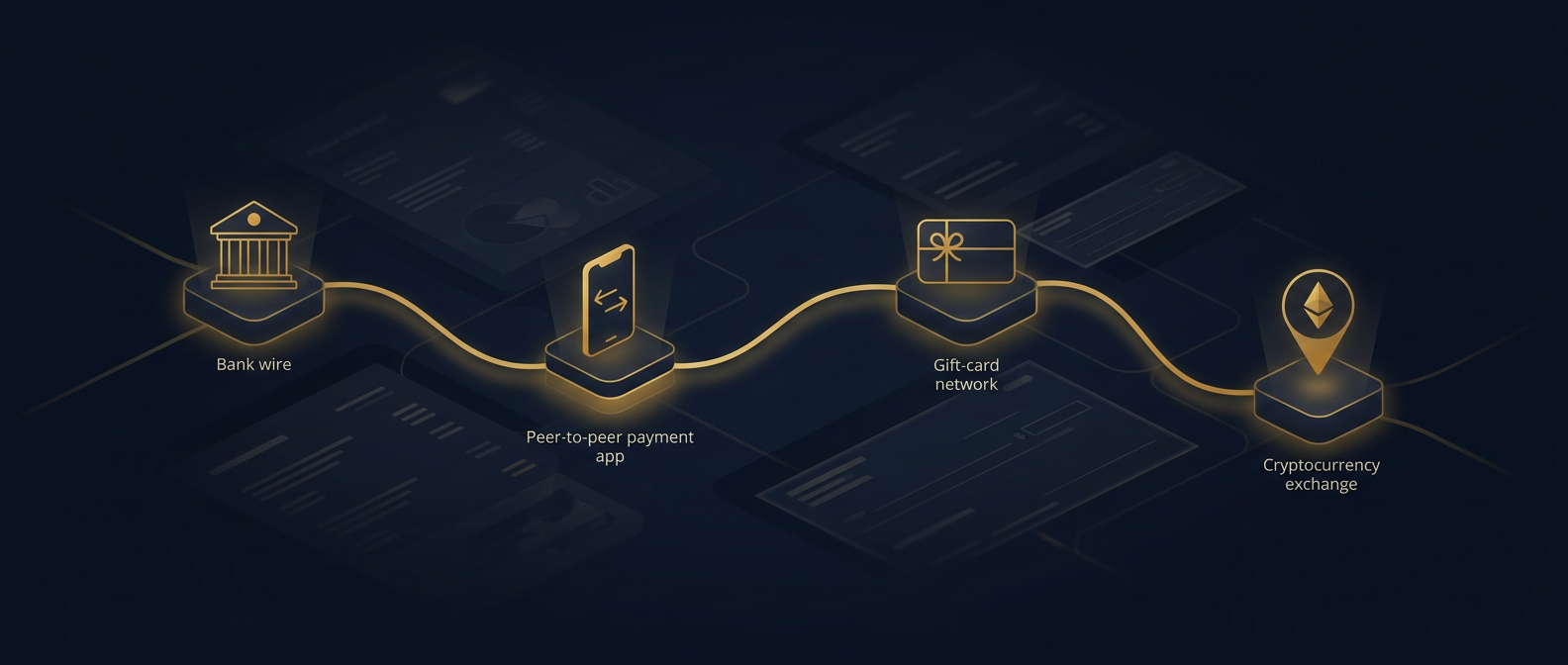
Investigators follow funds across bank transfers, cash withdrawals, cashier’s checks, peer-to-peer payment apps, gift-card networks, and cryptocurrency exchanges, mapping each hop and identifying the institutions that hold recoverable value. Domestic insider theft caught early has strong recovery prospects through civil claims, restitution, and institutional reversal. Funds sent overseas or converted to crypto and layered through mixers are far harder — recoverable in some cases through coordinated legal action and exchange cooperation, but never guaranteed. A responsible service tells the client the realistic range up front rather than promising a number it cannot control. The investigation also runs in parallel with the safety net: a report to Adult Protective Services where appropriate, an organized package handed to law enforcement, and engagement with the financial institutions that can freeze or claw back funds. The U.S. Department of Justice Elder Justice Initiative and state elder-protection statutes provide the legal architecture; the investigation supplies the evidence that lets that architecture do something.
How do you engage a service, and what should you preserve first?
The single most damaging mistake families make is acting before evidence is secured — confronting the suspected exploiter, closing accounts, or deleting messages — which destroys the record the case depends on and warns the perpetrator to cover their tracks. A disciplined engagement follows a deliberate order:
- Preserve, do not confront. Secure original statements, checkbooks, correspondence, and the elder’s phone and computer in their current state; avoid tipping off any suspected insider or scammer.
- Confidential intake and scoping. Define the objective — protection, recovery, guardianship support, or prosecution — because it dictates the evidentiary standard and the resources deployed.
- Engage under the right authority. Retain the firm directly or, better in contested matters, through counsel so the work is organized and, where applicable, privileged.
- Establish the financial baseline. Reconstruct the elder’s normal income, spending, and gifting pattern over years so deviations become provable rather than merely suspicious.
- Trace and attribute. Map the flow of funds, identify perpetrators and the institutions holding value, and preserve digital evidence forensically.
- Coordinate protection and reporting. File with Adult Protective Services and engage institutions and law enforcement in parallel, so recovery and safety advance together.
- Deliver decision-grade product. Provide a report with exhibits and, where needed, expert testimony calibrated to the guardianship, civil, or criminal track.
Families can locate their local reporting channel through the National Center on Elder Abuse, but reporting alone rarely produces recovery — the organized evidence a professional service builds is what turns a report into action.
How does remote, nationwide delivery work, and what separates elite providers?
Financial investigation is document- and data-driven, which means the core work — records analysis, fund tracing, digital forensics, and OSINT attribution — is performed remotely and delivered nationwide and internationally without the delay or cost of putting an investigator on a plane. Records are collected securely, devices are imaged forensically wherever the elder is located, and coordination with institutions and counsel happens across jurisdictions. Where physical steps are genuinely needed, they are handled through vetted local resources under the same command.
The differences between a world-class provider and a mediocre one show up precisely in these cases. Elite firms preserve before they probe, corroborate attribution rather than guessing, move within hours when a wire can still be stopped, integrate forensic accounting with digital forensics and background intelligence under one roof, handle the elder and family with genuine discretion, and write reports that anticipate a defense attorney’s every attack. Weak providers deliver a bank-statement summary, tip off the subject, or promise recoveries they cannot deliver. The stakes — an older person’s security and an estate’s integrity — do not tolerate the difference.
How does Honeybadger deliver elder financial abuse investigation services?
Honeybadger Solutions delivers elder financial abuse investigations as an integrated forensic and intelligence engagement rather than a bookkeeping review. Our investigations team reconstructs the money trail, traces diverted funds across accounts, institutions, and borders, and identifies both insider and external perpetrators. Because our digital forensics, financial investigation, and background intelligence capabilities are handled in-house and delivered nationwide and internationally, we can preserve device and account evidence forensically, attribute scam infrastructure, and vet the caregivers, advisors, and new associates surrounding a vulnerable principal — all under one accountable roof.
Every engagement is scoped to the client’s objective — protection, recovery, guardianship support, or criminal referral — and coordinated discreetly with financial institutions, Adult Protective Services, law enforcement, and counsel so the tracks reinforce one another. This work sits within our broader security and family-office protection practice, giving banks, trustees, wealth managers, elder-law firms, and families a single partner that pairs forensic rigor with the discretion these deeply personal matters demand. As an Arizona-licensed firm serving clients across the United States and internationally, we bring Fortune-500 investigative standards to protecting the people and estates that matter most.
Frequently asked questions
What is the difference between an elder financial abuse investigation and reporting to Adult Protective Services?
Adult Protective Services receives and screens reports and can open protective interventions, but its mandate is protection, not forensic investigation or asset recovery, and its caseloads are heavy. A private investigation service builds the actual evidence: a reconstructed money trail, traced funds, forensically preserved records, and a report to the standard courts and prosecutors require. The two work in parallel, with the investigation supplying what agencies and courts need to act.
Can money stolen from an elderly person be recovered?
Tracing where funds went is achievable in most cases; recovery depends on how quickly the theft was caught, where the money landed, and whether the destination is inside a cooperative legal system. Domestic insider theft caught early has strong recovery prospects through civil claims, restitution, and institutional reversal. Funds sent overseas or converted to cryptocurrency are far harder and never guaranteed. A credible firm gives a realistic range up front.
Should I confront the person I suspect before hiring an investigator?
No. Confronting a suspected exploiter, closing accounts, or deleting messages before evidence is preserved is the most common way cases collapse — it destroys records and warns the perpetrator to hide assets and cover their tracks. Preserve original documents, statements, and the elder’s devices in their current state, then engage investigators and counsel to guide preservation, tracing, and reporting.
Can these investigations be handled remotely and nationwide?
Yes. Financial investigation is document- and data-driven, so records analysis, fund tracing, digital forensics, and open-source attribution are performed remotely and delivered nationwide and internationally. Devices are imaged forensically wherever the elder is located, and coordination with institutions, agencies, and counsel happens across jurisdictions, with vetted local resources used only where a physical step is genuinely required.
About Honeybadger Solutions
Honeybadger Solutions is an Arizona-licensed security and investigations firm delivering intelligence-led financial investigations, elder financial abuse inquiries, digital forensics, and background intelligence to banks, trustees, wealth managers, family offices, elder-law firms, and families nationwide and internationally. Digital forensics, cybersecurity, financial investigations, and background intelligence are handled in-house; physical and executive protection is delivered through a commanded vetted-partner network directed from Arizona home command.
Offices: Casa Grande (HQ), Phoenix, and Oro Valley, Arizona — serving all Arizona, nationwide, and international clients.
Phone: Book a consultation online
Confidential consultation: discuss a suspected elder financial abuse matter with our investigations team.
Browse by topic
Security guard services · Private investigations · Cybersecurity · Digital forensics · Financial fraud investigation · Executive protection · All articles