
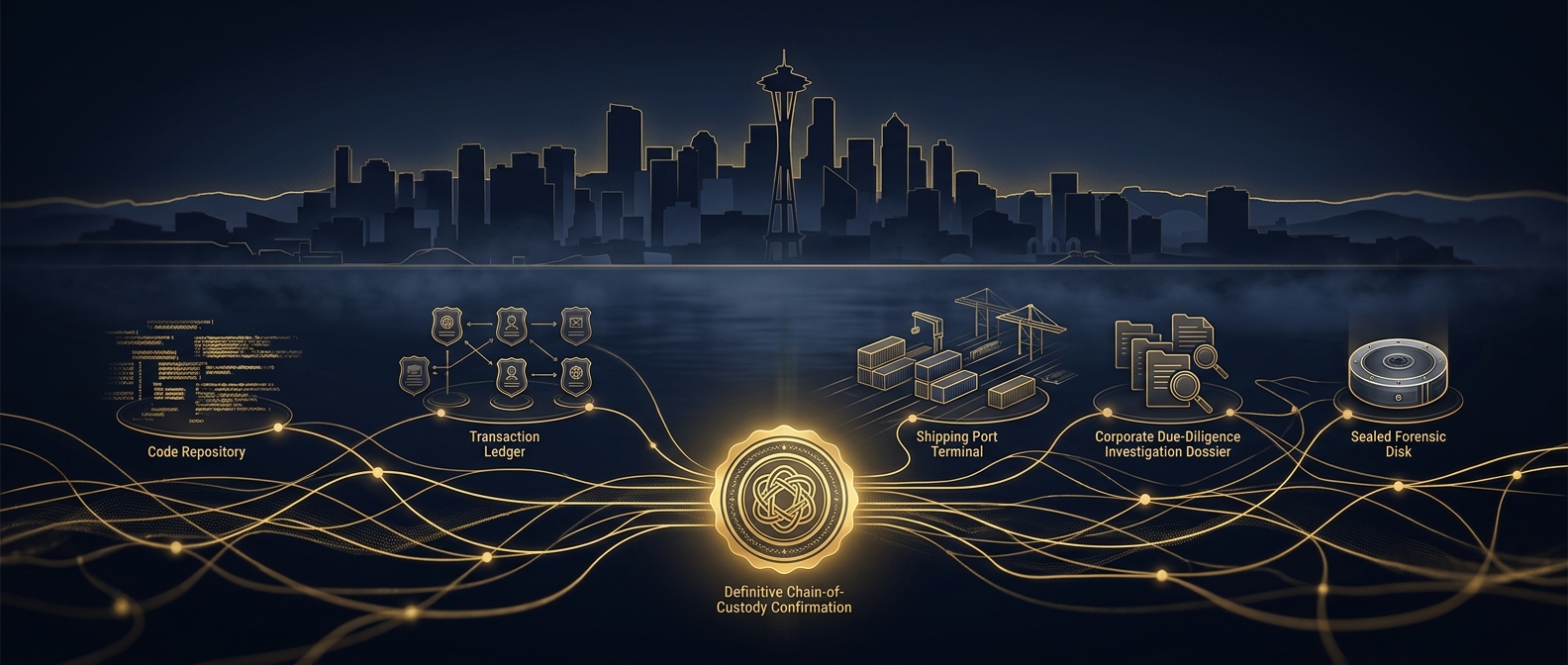
A Seattle private investigator working technology and maritime cases operates where digital forensics meets Washington law: the highest-volume matters are trade-secret and source-code theft, corporate and insider investigations, executive and vendor background intelligence, cargo and supply-chain fraud moving through the Northwest Seaport Alliance, and family-law inquiries. Field investigation inside Washington must be performed under a Department of Licensing credential, while forensic, financial, and intelligence work is delivered remotely. What separates a credible provider is licensing discipline, evidence handled to a courtroom standard, and genuine fluency in Puget Sound’s tech and maritime terrain.
Seattle is not a generic investigations market. It is the commercial heart of the Puget Sound region: home to some of the world’s most valuable technology and cloud-computing companies, a deep-water container gateway operated as the Northwest Seaport Alliance, a working waterfront of fishing fleets, cruise terminals, and the nation’s largest ferry system, and an aerospace base that concentrates rare intellectual property. That combination produces a distinctive caseload. A Seattle matter is far more likely than one in Denver or Kansas City to involve stolen source code, a departing engineer bound for a rival, a diverted shipping container, an injured maritime worker whose claim falls under federal rather than state law, or a cross-border asset trail. This guide, written for general counsel, litigators, technology and logistics executives, risk managers, and private principals, explains what a Seattle private investigator actually does, how Washington licensing works, and why the region’s tech and maritime economy demands specialized handling.
What tech and maritime cases do private investigators handle in Seattle?
Serious investigative demand in the Puget Sound region concentrates in a handful of case families. They overlap — a single departing-employee matter can implicate several — but each carries its own evidence profile, legal framework, and urgency. Understanding them is the first step for any GC, founder, executive, or private client deciding what kind of help they need and how fast they need it. The unifying discipline never changes: lawful gathering, verification, and documentation of facts a client can act on in court, in a claim, in a transaction, or in a personal decision. What changes in Seattle is the mix.
Trade-secret and source-code theft is the signature technology matter. Because Washington sharply limits employee non-competes, litigation over misappropriated trade secrets — not contractual restraint — is the primary mechanism companies use to stop stolen intellectual property from crossing to a rival. The proof lives in endpoint artifacts, cloud and repository logs, and version-control histories. Corporate and insider investigations cover the broader problem of trusted access abused: bulk downloads, personal-cloud syncs, procurement fraud, and sabotage, often surfacing at resignation. Executive and vendor background intelligence vets senior hires, board candidates, funding and acquisition targets, and counterparties. Cargo and supply-chain fraud follows the freight economy of the ports and the Interstate 5 corridor. Maritime injury and workers’ compensation matters turn on which coverage regime applies, and family-law and location work rounds out the private-client caseload.
| Case type | Typical trigger | Where the proof lives | Primary legal framework |
|---|---|---|---|
| Trade-secret / source-code theft | Engineer or executive departs for a competitor or launches a rival | Endpoint artifacts, USB history, Git/repo logs, cloud audit logs, personal-cloud sync | Federal DTSA and Washington Uniform Trade Secrets Act (RCW 19.108) |
| Corporate / insider investigation | Anomalous access, resignation, fraud, or a whistleblower tip | Access and identity logs, DLP alerts, mailbox and SaaS audit records, device images | Washington UTSA, Computer Fraud and Abuse Act, employment agreements |
| Executive / vendor background intelligence | Senior hire, board seat, funding round, or acquisition | Public records, litigation and bankruptcy filings, corporate registries, OSINT, references | FCRA where a consumer report is used |
| Cargo theft / supply-chain fraud | Freight moving through the Northwest Seaport Alliance and the I-5 corridor | Bills of lading, carrier and broker records, gate and yard logs, GPS and telematics | FMCSA authority checks; chain of custody |
| Maritime injury / workers’ comp | Longshore, vessel-crew, or warehouse injury claim | Lawful surveillance in public view, activity checks, concurrent-employment records | LHWCA, Jones Act, or Washington L&I depending on worker status |
| Family law / location | Divorce, custody, support, or service of process | Public records, lawful surveillance, financial and asset tracing | Washington family law; all-party consent (RCW 9.73) |
The through-line is that every one of these matters ultimately turns on evidence — machine records, documents, and testimony — that must survive an adversarial challenge in court, in arbitration, or before a regulator. That is why our investigations and digital forensics teams treat preservation and chain of custody as the first move in any Seattle engagement, not an afterthought.
How does Washington private-investigator licensing actually work?
Washington is a licensed state, and the rules matter to the client, not just the vendor. Private investigation for compensation is governed by Chapter 18.165 of the Revised Code of Washington and administered by the Washington State Department of Licensing (DOL). The framework is two-tiered: the investigative agency must be licensed through a qualified principal, and each investigator working for that agency holds an individual private investigator license. Applicants submit fingerprints for a Washington State Patrol and FBI criminal background check, pass a licensing examination, and the principal must maintain a surety bond and liability insurance. An investigator who carries a firearm in the course of duty must additionally hold the firearm authorization the DOL requires.
The practical consequence is that a client cannot lawfully rely on an unlicensed operator for Washington field work, and evidence gathered by an unlicensed investigator can become a liability rather than an asset — opposing counsel will attack it, and it may be excluded. The distinction that trips people up is between field investigation in Washington — surveillance, interviews, sub-rosa work, and pretext contact conducted for a fee — which requires a Washington license, and services such as digital forensics, financial analysis, and open-source background intelligence, which are performed on data and records rather than through on-the-ground activity in the state. Before engaging anyone for a Seattle matter, verify the licensing posture deliberately.
- Confirm the license exists and is current. Verify both the agency and the individual investigator credential through the Washington DOL, along with any disciplinary history, before work begins.
- Match the license to the work. Field surveillance and interviews in Washington require a Washington PI license; ask specifically who — the firm or a named partner — holds it and will perform the in-state activity.
- Separate the disciplines cleanly. Understand which parts of your matter are Washington field work (licensed, in-state) and which are forensic, financial, or background work delivered remotely, so nothing falls into a gap.
- Establish permissible purpose. Insist the firm document the lawful basis for the work — litigation, insurance claim, fraud, or due diligence — which governs what records may be accessed and how findings may be used under the DPPA, GLBA, and FCRA.
- Insist on privilege and counsel direction. For litigation-bound matters, have outside counsel open and direct the investigation so the work product is protected from the outset.
- Demand a chain-of-custody standard. Require written evidence-handling protocols, hash-verified imaging, and an examiner prepared to testify — casual collection collapses under cross-examination.
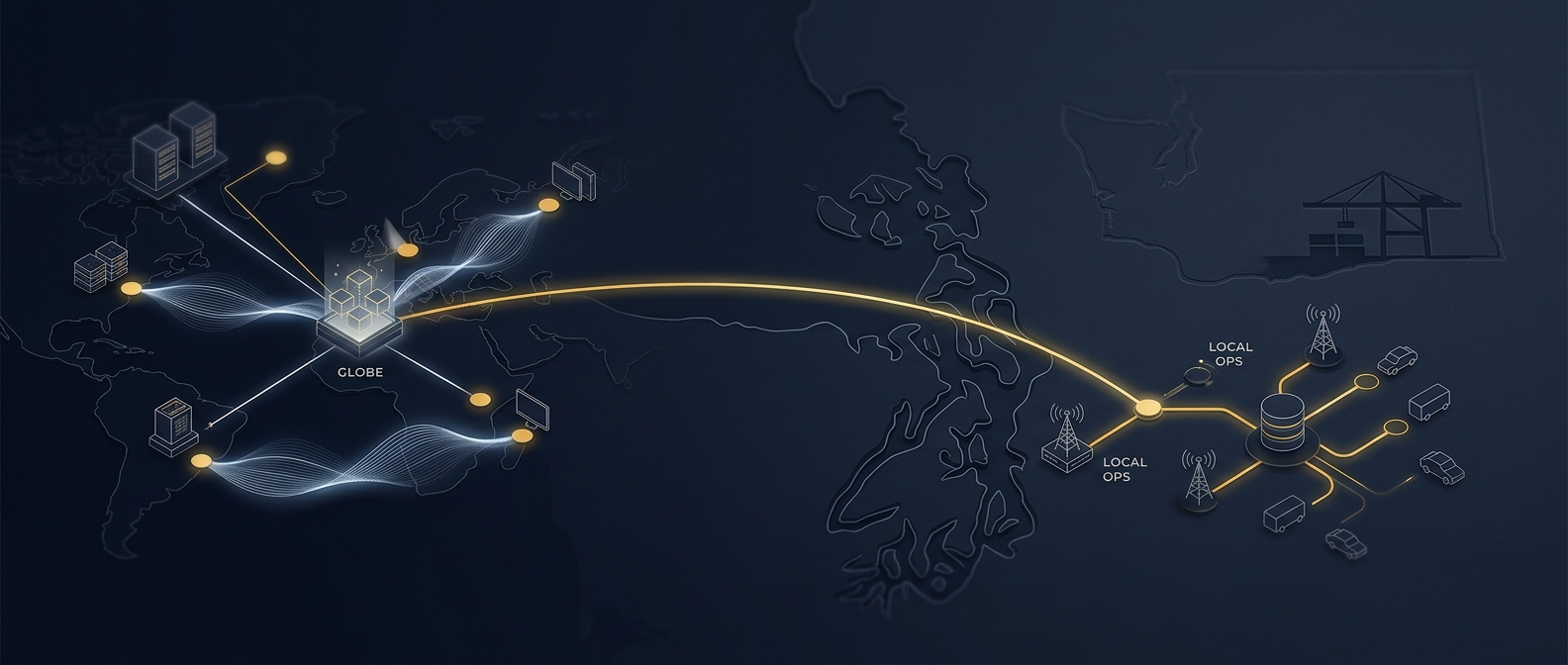
Honeybadger commands a vetted network of Washington-licensed field partners for on-the-ground work across the Puget Sound region, while our in-house global capabilities — digital forensics, cybersecurity, financial investigations, and background intelligence — support the same matter remotely. That structure keeps every activity on the correct side of the licensing line under a single accountable chain of command.
Why does Washington’s non-compete limit change the tech playbook?
One of the most important legal facts shaping Seattle technology investigations is that Washington, like California, sharply restricts employee non-compete agreements. Under RCW 49.62, effective in 2020, a noncompetition covenant is void and unenforceable against a worker unless that worker’s annual earnings exceed a statutory threshold that the Department of Labor and Industries adjusts each year for inflation — a figure well into six figures. Most rank-and-file engineers, and many senior ones, are therefore free to leave for a direct competitor, and the agreement they signed will not stop them.
This reshapes the investigator’s mandate. In a state that broadly enforced non-competes, an employer could often stop a departure with a contractual injunction and never need to prove what left the building. In Washington, that lever is limited — so the durable protection for intellectual property is trade-secret law, and trade-secret law is evidence-hungry. To win relief under the federal Defend Trade Secrets Act or Washington’s Uniform Trade Secrets Act (RCW 19.108), a company must show it owns a protectable secret, that it took reasonable measures to keep it secret, and that the secret was actually misappropriated. Each element rests on forensic and documentary proof that decays quickly if it is not preserved.
The strategic takeaway is blunt: in Seattle, the departure itself is frequently lawful, so the entire contest moves to what the employee took and whether the company can prove it. That is why the first hours after a suspicious resignation are decisive — quarantining devices, preserving short-retention cloud, repository, and mailbox logs before they age out, and imaging endpoints under counsel’s direction before routine offboarding wipes the very artifacts an injunction depends on. Companies that investigate first and preserve second routinely forfeit cases they should have won.
How are maritime, port, and cargo cases investigated on Puget Sound?
Seattle’s working waterfront gives the market a maritime dimension that generalist investigators mishandle. The Northwest Seaport Alliance — the marine-cargo partnership of the ports of Seattle and Tacoma — is one of the largest container gateways in North America, and the region layers fishing fleets, cruise operations, shipyards, and the country’s busiest ferry system on top of it. Wherever high-value freight sits, stops, or changes hands, it attracts organized theft and fraud.
Modern cargo loss is far more than a trailer stolen from a lot. It includes fictitious pickups, where thieves pose as a legitimate carrier using stolen or spoofed motor-carrier identities; strategic theft through identity fraud and double-brokering; and insider-enabled diversion, where a load is routed to the wrong destination and disappears. The FBI treats cargo theft as a significant organized-crime problem with cascading supply-chain cost. Investigating it means reconstructing a shipment’s movement lawfully — bills of lading, rate confirmations, carrier and broker onboarding files, gate and yard logs, GPS and telematics data, and facility surveillance — then determining whether the loss was external, insider-enabled, or a paper fraud. Speed is everything: the first 24 to 72 hours usually decide whether recovery is realistic, and the work is run in coordination with the carrier, insurer, and law enforcement rather than around them. The same density of intermediaries that makes the corridor efficient also breeds shell brokers, phantom carriers, and inflated or duplicate freight invoicing, which our financial investigation team exposes by tracing beneficial ownership and payment flows.
The maritime economy also changes the injury and workers’ compensation picture in a way that is unique to port cities. Which law governs a claim depends entirely on the worker’s status. A longshore or harbor worker injured on or adjacent to navigable waters is generally covered by the federal Longshore and Harbor Workers’ Compensation Act, administered by the U.S. Department of Labor — not by state comp. A member of a vessel’s crew — a seaman — falls instead under the Jones Act, which allows a negligence claim against the employer. A land-based warehouse or trucking worker is covered by Washington’s state fund through Labor and Industries. For self-insured employers, carriers, and defense counsel, an investigator’s role is to verify a claim objectively within the correct regime: lawful activity checks, documentation of a claimant’s actual physical capability through surveillance in public spaces, and verification of concurrent employment — never trespass, private-space intrusion, or unlawful recording. Getting the coverage question and the surveillance boundaries right is what makes the resulting record usable.
What does background intelligence and family-law work look like in Seattle?
The region’s velocity — rapid hiring, fast funding, acquisitions closed in weeks — creates persistent exposure to people and companies that have not been properly vetted. Investigative due diligence answers a deceptively simple question: is this person or entity who they claim to be, and is there anything in their history a reasonable board, fund, or acquirer would want to know before committing capital or authority? For a founder, executive, or board candidate, that means verifying degrees and employment history that are surprisingly often embellished, surfacing undisclosed litigation, judgments, liens, or regulatory actions, checking for prior business failures marked by fraud rather than misfortune, and mapping conflicts of interest. For investment and acquisition targets, the aperture widens to beneficial-ownership analysis, sanctions and adverse-media screening, and verification that claimed technology and traction are real. Where the work produces a consumer report used for an employment or credit decision, the federal Fair Credit Reporting Act imposes specific consent and disclosure rules, which our background checks and intelligence teams build into the engagement from the start.
Family-law matters carry a distinctly Seattle wrinkle. In a market where a large share of compensation arrives as equity — restricted stock units, options, and deferred grants — the true financial picture in a divorce or support dispute is rarely captured by a salary figure alone. A capable investigator helps counsel establish actual income and assets, including concealed equity, undisclosed side businesses, and out-of-state or offshore holdings, using public records, lawful surveillance, and financial tracing. Location work — finding a party for lawful service of process, or documenting a custody-relevant pattern of conduct — must stay strictly within Washington’s privacy and consent rules. In every family matter the boundary is firm: the investigator gathers facts and supports the attorney, and does not give legal advice.
What legal limits must a Seattle investigator respect?
The value of any investigation is only as durable as its legality, and Washington is not a permissive jurisdiction. Washington is an all-party (two-party) consent state under the Washington Privacy Act, RCW 9.73, so intercepting or recording a private conversation without the consent of every participant is a crime — a trap that ensnares operators accustomed to one-party states, and one that matters greatly in workplace inquiries and workers’ compensation interviews. Financial privacy is federally protected: obtaining a person’s bank information from an institution by deception, known as pretexting, is a federal offense under the Gramm-Leach-Bliley Act, so any operator promising “guaranteed account balances” is describing an illegal act. Motor-vehicle records are restricted by the Driver’s Privacy Protection Act to permissible purposes, and GPS placement, trespass, and pretext contact each carry bright lines that separate admissible evidence from suppression and liability.
Maritime and port matters add a further dimension: much of the record lives with private carriers, terminals, and brokers, and reaching protected data often requires litigation, subpoenas, and coordination with law enforcement rather than a freelance workaround. Serious firms build the case on lawful public records, open-source intelligence, in-house forensic analysis, cooperative access with the client’s own supply-chain partners, and properly channeled legal process — and they say plainly what cannot be obtained lawfully. That candor is what protects the client’s case, and it is the line between an intelligence partner and a liability.
How does Honeybadger run a Seattle investigation?
Honeybadger Solutions approaches Puget Sound matters the way they must be handled to hold up under Washington law and adversarial scrutiny: preservation first, coordinated disciplines, and evidence developed to a courtroom standard from the first hour. When a suspected trade-secret theft, insider incident, or cargo loss surfaces, the priority is to freeze the evidence — quarantine devices before they are reimaged, preserve short-retention cloud, repository, mailbox, and telematics logs before they age out, and image endpoints under counsel’s direction — before any analysis or confrontation begins. From there the matter is built by correlation: device and file artifacts, access and identity records, shipment and financial records, and background intelligence read together against a timeline anchored to the departure, the transfer, or the loss point.
The structure is what makes it work across state lines. Digital forensics, cybersecurity, financial investigations, and background intelligence are handled in-house and delivered remotely to Seattle clients nationwide and internationally, while on-the-ground field investigation, surveillance, and interviews in Washington are performed through our commanded network of vetted, Washington-licensed field partners. For any physical or protective requirement, we coordinate through that same commanded vetted-partner network; our established theaters for armed protective work are California, Texas, and Florida, and Pacific Northwest requirements are handled on a mandate basis — we do not claim owned armed offices in Washington. Arizona is our home command, with offices in Casa Grande, Phoenix, and Oro Valley, and every engagement runs under one accountable chain of command, in step with the client’s counsel and, where directed, under privilege. Learn more about our reach into the region on our Seattle page, or call to discuss a matter in confidence — one team closing the gap between what happened and what can be proven, on the correct side of every licensing and evidentiary line.
Frequently asked questions
Does a private investigator need a license in Washington?
Yes. Private investigation for compensation in Washington is regulated under RCW 18.165 and administered by the Washington State Department of Licensing (DOL). The agency must be licensed through a qualified principal, and each investigator holds an individual private investigator license. Applicants submit fingerprints for a Washington State Patrol and FBI background check, pass a licensing exam, and the principal must carry a surety bond and liability insurance. Field surveillance and interviews inside Washington require that license; forensic, financial, and background work performed on data and records is delivered remotely. Verify the credential before you engage anyone.
Can a Seattle employer stop an engineer who leaves for a competitor?
Usually not by non-compete alone. Under RCW 49.62, Washington voids noncompetition covenants unless the worker earns above a statutory threshold that is adjusted annually for inflation, so most engineers are free to join a direct competitor. The durable protection for intellectual property is trade-secret law under the federal Defend Trade Secrets Act and Washington’s Uniform Trade Secrets Act, which requires the company to prove, with forensic and documentary evidence, that a protectable secret was actually taken. That is why preserving devices, repository logs, and cloud records in the first hours after a resignation is decisive.
Which law covers an injured maritime worker’s claim in Seattle?
It depends on the worker’s status. A longshore or harbor worker injured on or adjacent to navigable waters is generally covered by the federal Longshore and Harbor Workers’ Compensation Act, administered by the U.S. Department of Labor. A member of a vessel’s crew — a seaman — falls under the Jones Act, which allows a negligence claim against the employer. A land-based warehouse or trucking worker is covered by Washington’s state fund through Labor and Industries. An investigator verifies the facts of a claim within the correct regime; the coverage determination itself is a legal question for counsel.
Is surveillance or recording legal in Washington?
Observing and recording a subject in public view is lawful and routine, including for verifying a claimant’s activity against a claimed injury. What is not lawful is trespass, intrusion into private space, harassment, or recording a private conversation without the consent of all parties, because Washington is an all-party consent state under RCW 9.73. Pretexting for financial records and improper access to motor-vehicle data are also prohibited by federal law. Evidence gathered outside those lines can be excluded and expose the client to counterclaims, so a credible firm documents observations objectively and within the law.
About Honeybadger Solutions
Honeybadger Solutions is an Arizona-licensed security and investigations firm delivering intelligence-led investigations, digital forensics, cybersecurity, financial investigation, and background intelligence to general counsel, litigators, technology and logistics executives, families, and organizations in Seattle, across the United States, and internationally. Digital forensics, cybersecurity, financial investigations, and background intelligence are handled in-house and delivered remotely; on-the-ground field investigation in Washington is performed through our commanded network of vetted, Washington-licensed field partners. Physical and armed protective work runs through the same commanded vetted-partner network, with California, Texas, and Florida as established theaters and Arizona as home command.
Offices: Casa Grande (HQ), Phoenix, and Oro Valley, Arizona — serving Seattle, all Arizona, nationwide, and international clients.
Phone: 602-725-2818
Confidential consultation: engage our command team before you reissue the laptop, close the account, or respond to the claim.