

Executive protection for San Diego’s biotech, pharma, and technology leaders is a discreet, intelligence-led discipline that shields high-value principals from targeted threats — economic espionage, activist targeting, cross-border risk, and event exposure. It combines protective intelligence, advance work, low-profile close protection, and secure transport, executed by California-licensed teams under a single command. Done well, the principal moves freely and productively while risk is identified early and managed almost invisibly.
San Diego occupies a rare position in the American economy: a dense corridor of life-science and technology value stretching from La Jolla and Torrey Pines through Sorrento Valley, University City, and up into Carlsbad. The region the industry nicknames “Biotech Beach” concentrates genomics, diagnostics, immuno-oncology, medical devices, and wireless technology into a few square miles anchored by world-class research institutions. That concentration of intellectual property, capital, and visible leadership is precisely what elevates the security profile of the people who run these companies. A founder who just closed a Series C, a chief scientific officer whose platform is the subject of a contested patent, a CEO presenting at an investor conference — each carries an exposure that a generic guard service is not built to manage. This guide is written for the general counsel, chief security officer, family-office principal, and board member who owns that exposure. It explains what real executive protection (EP) involves, the specific threat picture in San Diego, how protection is run at conferences and across the border, and how to distinguish a world-class program from an expensive liability.
Why do San Diego biotech and tech executives need executive protection?
The instinct to assume “we’re not a target” is the most common and most expensive misjudgment a leadership team makes. San Diego’s executives sit at the intersection of several converging threat vectors that are unusual in both intensity and specificity.
First is economic espionage and intellectual-property targeting. Life-science and semiconductor firms hold research programs worth hundreds of millions or billions of dollars, and both state-sponsored and commercial actors actively pursue that value. The FBI has repeatedly warned that pharmaceutical, biotech, and advanced-technology research is a priority collection target, and the threat is not confined to the network — it reaches the executive whose devices, travel patterns, and unguarded conversations become the softest path to the data. Physical proximity to a distracted principal in a hotel bar or a jet-bridge line is a recognized collection technique, which is why protective intelligence and personal security are inseparable in this sector.
Second is activist and ideological targeting. Companies engaged in animal research, gene editing, controversial therapeutics, or high-profile technology platforms attract organized campaigns that historically have escalated from protest to residential picketing, doxxing, and intimidation directed at named executives and their families. San Diego’s research institutions have a long institutional memory of this. Modern campaigns begin online — a home address scraped from a property record, a school run inferred from social media — and the digital exposure precedes the physical risk.
Third is wealth-event and liquidity exposure. IPOs, acquisitions, and large financings are public, dated, and dollar-quantified. They convert a private individual into a visibly wealthy one on a known timeline, raising the risk of extortion, fraud targeting, opportunistic crime, and unwanted attention. Fourth is the region’s proximity to the U.S.–Mexico border, which introduces cross-border travel and kidnap risk that most domestic executives never have to weigh. Each of these vectors is manageable — but only through a program designed for it, not a posted guard reacting after the fact.
What does executive protection actually involve at an elite level?
Executive protection is frequently confused with “a bodyguard.” At an elite level it is a system of interlocking capabilities in which the visible protector is the smallest and last component. The discipline is built to prevent incidents from ever developing, not merely to respond to them.
Protective intelligence is the foundation: continuous assessment of named and anonymous threats, monitoring of hostile online activity, digital-footprint reduction for the principal and family, and pre-travel and pre-event risk pictures. Advance work is the discipline that separates professionals from amateurs — surveying venues, routes, hotels, and meeting locations before the principal arrives, identifying safe rooms and medical resources, coordinating with venue security, and building primary and alternate movement plans. Close protection — the agent or detail physically with the principal — is delivered on a spectrum from a single low-profile protector in business attire to a full detail with a security driver, matched to the assessed threat rather than to ego. Secure transportation covers vetted drivers, route planning, counter-surveillance awareness, and hardened logistics where warranted. Residential and workplace security extends the umbrella to the home and campus, where principals are most predictable and therefore most exposed.
The hallmark of a mature program is that it is calibrated. A biotech CEO does not need a motorcade to a Sorrento Valley board meeting; the same CEO presenting at a high-profile investor conference, or traveling into an elevated-risk region, may need a materially different posture. The table below maps common San Diego scenarios to a proportionate protective response — the calibration a sophisticated buyer should expect a provider to reason through, out loud, before proposing a package.
| Scenario | Primary risk | Proportionate protective posture |
|---|---|---|
| Routine local movement (office, board meeting) | Low; opportunistic | Protective intelligence baseline; secure driver on request |
| Post-IPO / announced liquidity event | Extortion, fraud, unwanted attention | Digital-footprint reduction, low-profile protector, residential review |
| Investor / industry conference appearance | Crowd exposure, aggressor access, IP collection | Advance work, credentialed access control, close protection at venue |
| Activist campaign / doxxing underway | Residential picketing, intimidation, family exposure | Protective intelligence, residential security, family protocols |
| Cross-border or international travel | Kidnap, detention, medical, road trauma | Journey management, vetted transport, pre-arranged response and extraction |
| Named or credible personal threat | Targeted violence | Full detail, threat management, law-enforcement liaison |
How is executive protection handled at conferences and events?
San Diego is a convention town, and for the life-science and technology sector the calendar is dense: investor days, industry conventions at the San Diego Convention Center, biotech partnering summits, and the ripple effect of the January healthcare-investment season that pulls leadership into public, scheduled, heavily photographed settings. Events are among the highest-risk environments an executive routinely enters, precisely because they are open, publicized in advance, and designed to make the principal accessible.
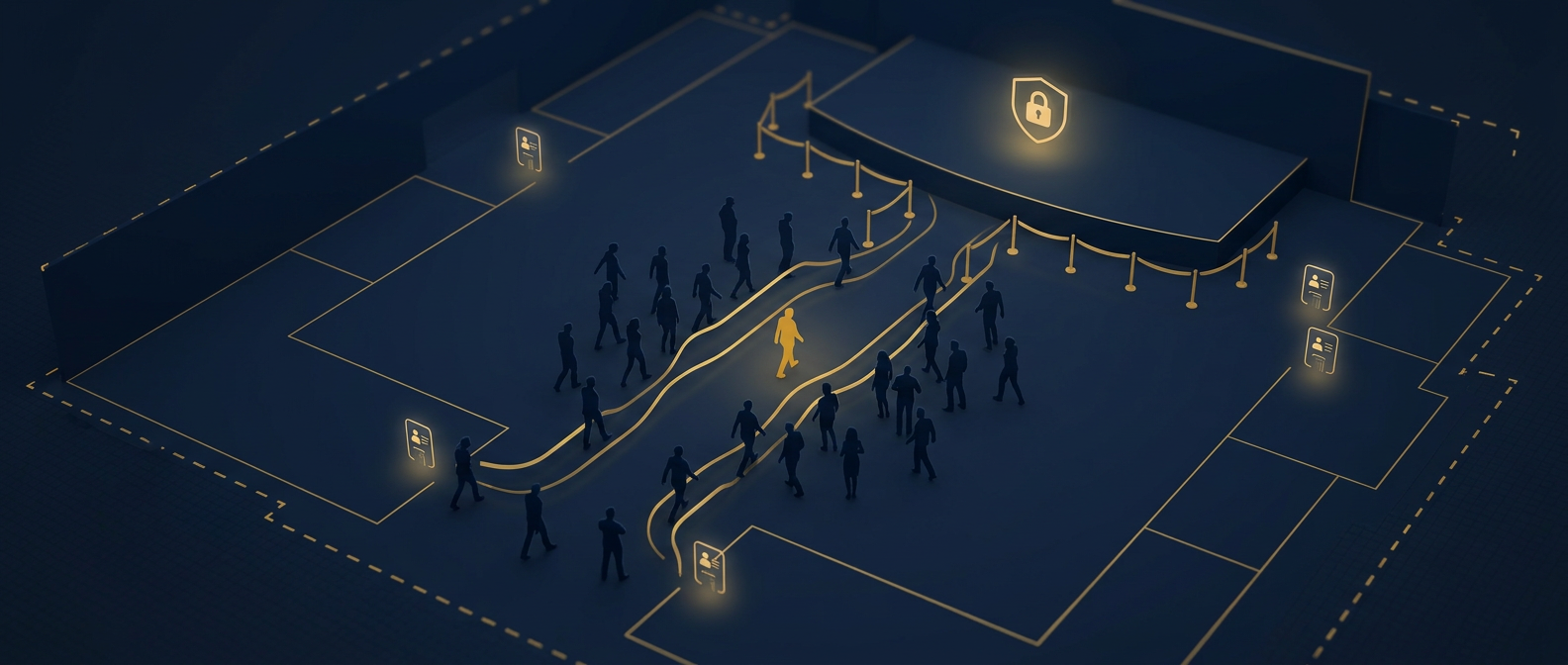
Event protection is won or lost in the advance. Before the principal arrives, a professional team walks the venue: entrances and egress, stage and green-room access, elevator and loading-dock routes, the exact location of medical resources and the nearest trauma center, and the credentialing scheme that controls who reaches the principal. The team coordinates with venue and conference security, establishes a discreet extraction route, and pre-positions so that a protector is never improvising in a crowd. During the event, the posture is deliberately low-profile — a well-run detail is nearly invisible to other attendees, managing access at receptions and meet-and-greets, screening the rope line, and keeping the principal on schedule without the theater of an entourage that itself draws attention. The objective is a leader who networks, presents, and closes business while a controlled bubble moves with them.
For sponsors and organizers, event EP also extends to keynote speakers, visiting board members, and VIP guests whose safety the host organization has quietly assumed responsibility for. That duty of care is real, and it is discharged through planning and credentialed control, not through a couple of guards hired the morning of.
How do you manage cross-border and travel risk from San Diego?
Few American cities put an international border this close to the executive suite. The San Ysidro and Otay Mesa crossings are among the busiest land borders in the hemisphere, and San Diego leaders routinely travel into Baja California for manufacturing, clinical, philanthropic, or personal reasons. That proximity introduces a risk category most domestic principals never confront: express kidnapping, targeted abduction, cartel-adjacent violence in specific corridors, vehicle crime, and detention risk. The U.S. State Department maintains active, area-specific advisories for Mexican states, and a serious program treats those advisories as the floor of its assessment rather than the ceiling.
Cross-border protection is journey management, not just a driver. It means a pre-planned and pre-vetted route, current intelligence on the specific corridor and time of day, vetted local operators where the profile warrants, secure and confirmed accommodation, communication and check-in protocols, and a pre-arranged medical and security response — including extraction — contracted before the wheels turn, not sourced during an emergency. The same discipline governs domestic and international air travel: private aviation out of Montgomery-Gibbs or Carlsbad’s McClellan-Palomar, commercial movement through San Diego International, and arrival protection at the destination. Travel is where executives are most exposed and least controlled, and it is where an intelligence-led program earns its keep. A world-class provider will, when the intelligence supports it, recommend deferring, rerouting, or hardening a trip rather than rubber-stamping it — and will document that advice.
How do you build or procure an executive protection program? A practical framework
Whether protection is engaged for a single event, a defined travel window, or a standing program, a defensible engagement follows a recognizable arc. The following framework reflects how elite providers reason and what a discerning buyer should insist on.
- Threat and risk assessment. Establish the principal’s actual exposure — role, public profile, liquidity events, activist attention, family footprint, and travel pattern — before any posture is proposed. Protection without assessment is guesswork.
- Protective intelligence baseline. Reduce the principal’s and family’s digital footprint, remove exposed home and routine data where possible, and stand up monitoring for hostile online activity and named threats.
- Posture design and calibration. Match the protective response to the assessed threat — from intelligence-only, to a single low-profile protector, to a full detail — and define clear escalation triggers.
- Advance work. Survey venues, routes, residences, and destinations; identify safe rooms, medical resources, and alternate plans; coordinate with venue and local security.
- Secure logistics. Establish vetted transportation, route and journey management, and communication and check-in protocols proportionate to risk.
- Detail execution. Deliver close protection with licensed, vetted agents operating to a documented standard of tradecraft and a low-profile posture that fits the principal’s life.
- Incident and crisis planning. Pre-arrange medical, security, and extraction response, define decision authority, and rehearse the plan — an untested plan fails under pressure.
- Review and continuity. Debrief every engagement, update the assessment, and maintain single-point accountability so the program improves and the duty of care is evidenced over time.
The through-line is documentation and command. In a dispute or an incident, the difference between a defensible organization and a negligent one is rarely intention — it is whether the assessment, the plan, and the response were recorded, and whether one accountable party owned the outcome.
What separates world-class executive protection from mediocre providers?
The market is crowded with providers who put a large person in a dark suit and call it protection. The differences that matter are specific and verifiable. Licensing and legal standing come first: in California, protective services are regulated by the Bureau of Security and Investigative Services (BSIS), and agents providing armed or unarmed protective work must hold the correct credentials — a licensed Private Patrol Operator, guard registration, and, for armed work, the exposed-firearm permit. A provider who is vague about California licensing is a liability, not a partner. Vetting and tradecraft come next: rigorous background screening of every agent, documented training standards, medical and defensive-tactics competency, and the discipline to operate low-profile rather than perform security theater.
Intelligence integration is the modern differentiator. Physical protection divorced from digital and background intelligence is half a program; the threats to a biotech executive begin online, and a provider that cannot see the digital exposure cannot protect against its physical consequence. Finally, single-point command and accountability separates a coordinated program from a patchwork of subcontractors. One team should own the threat assessment, set the standard of tradecraft, and answer for the outcome — even when protective operations are executed by vetted specialists in a given jurisdiction. Standards published by bodies such as ASIS International and the FBI’s guidance on counterintelligence and economic-espionage threats reinforce the same point: protection is a managed, evidenced discipline, not a commodity.
How does Honeybadger deliver executive protection in San Diego?
Honeybadger Solutions delivers executive protection in San Diego through a commanded vetted-partner network. Threat assessment, protective-intelligence, planning, tradecraft standards, and single-point accountability are directed centrally from our Arizona home command, while protective operations in California are executed by rigorously vetted, California-licensed teams. California is one of our established protective theaters — alongside Texas and Florida — so a San Diego engagement is served by practitioners who operate to a documented standard under our command, not by a broker passing your risk to whoever is available. This gives an organization one accountable partner and a consistent standard of tradecraft, without the costly fiction that any single firm staffs a fully owned armed office in every city its principals visit.
What makes the model distinct for the life-science and technology sector is the intelligence spine behind the detail. Because our digital forensics, cybersecurity, financial-investigation, and background-intelligence work is handled in-house and delivered globally, we close the online reconnaissance gaps that protection-only vendors ignore — a leaked itinerary, an exposed home address, a hostile pattern of life, a compromised device, or an IP-collection attempt — and fold them into one coordinated security program. That same investigative depth supports pre-event and pre-travel assessments, activist-campaign monitoring, and the investigative follow-through when a threat needs to be identified and managed rather than merely deflected. Our command capability is anchored across our Casa Grande headquarters and our Phoenix and Oro Valley offices, with protective operations delivered wherever the principal needs to be.
Frequently asked questions
Do San Diego biotech and tech executives really need executive protection?
Many do, at least situationally. The sector concentrates valuable intellectual property, visible liquidity events, and leaders who attract economic-espionage, activist, and extortion attention, all in a region bordering Mexico. The right answer is rarely “a full-time bodyguard” and rarely “nothing” — it is a calibrated program driven by an honest threat assessment, scaled up for conferences, travel, and active threats.
What licensing should an executive protection provider hold in California?
In California, protective services are regulated by the Bureau of Security and Investigative Services (BSIS). A legitimate provider operates under a licensed Private Patrol Operator, agents hold current guard registration, and any armed work requires the exposed-firearm permit. A provider who cannot clearly speak to California licensing should be treated as a liability rather than a partner.
Can you provide protection for a single conference or event?
Yes. Event and conference protection is one of the most common engagements, and it is won in the advance — venue survey, credentialed access control, coordination with venue security, discreet extraction planning, and a low-profile detail at receptions and the rope line. Engagements can be scoped for a single day, a multi-day convention, or a recurring investor and industry calendar.
How is cross-border travel into Mexico handled?
Through journey management, not a lone driver. That means current corridor-specific intelligence measured against State Department advisories, a pre-planned and vetted route, secure confirmed accommodation, communication and check-in protocols, and a pre-arranged medical, security, and extraction response contracted before departure. When intelligence warrants, the responsible recommendation is to defer, reroute, or harden the trip — documented, not rubber-stamped.
About Honeybadger Solutions
Honeybadger Solutions is an Arizona-licensed security and investigations firm delivering intelligence-led executive protection, investigations, and cyber services to executives, families, and organizations nationwide and internationally. Physical and executive protection is delivered through a commanded vetted-partner network with established theaters in California, Texas, and Florida, directed from Arizona home command. Digital forensics, cybersecurity, financial investigations, and background intelligence are handled in-house and delivered globally.
Offices: Casa Grande (HQ), Phoenix, and Oro Valley, Arizona.
Phone: 602-725-2818
Confidential consultation: discuss an executive-protection assessment, event coverage, or travel-risk plan with our command team.