
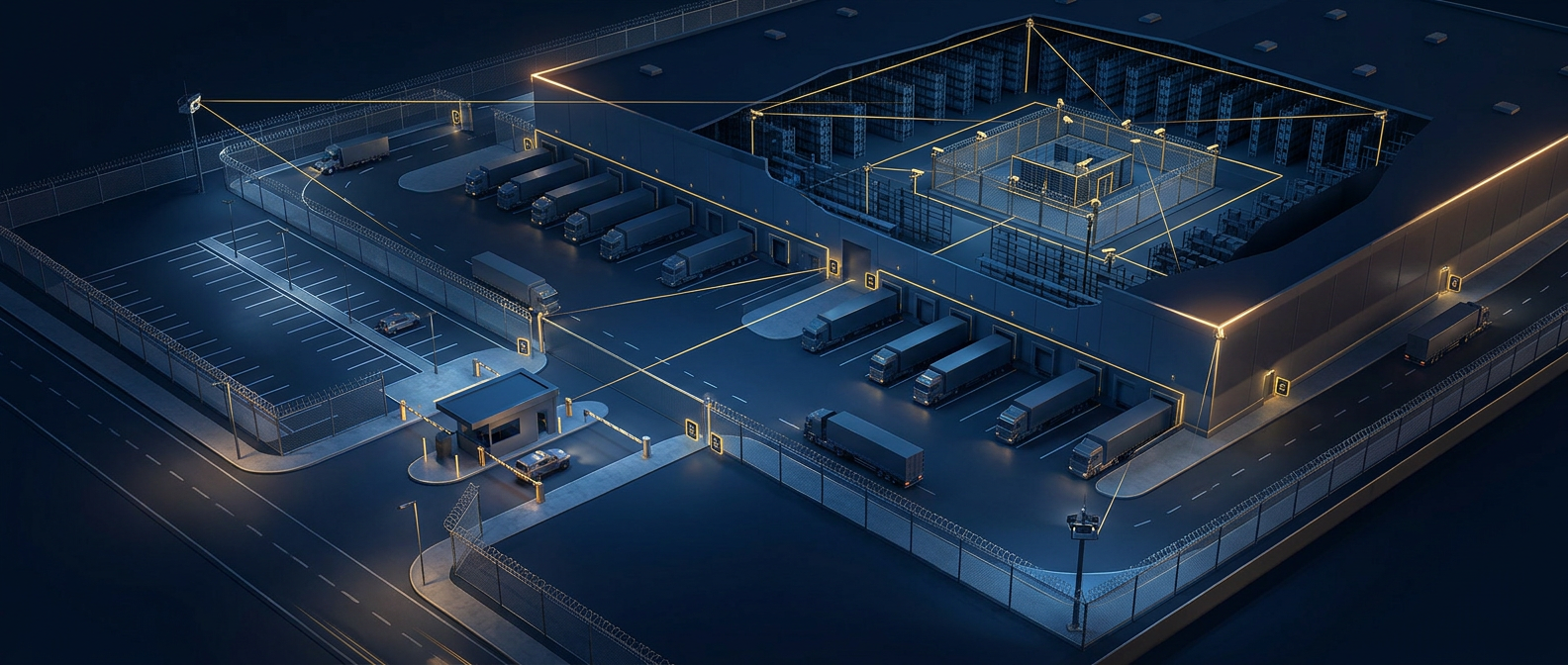
A warehouse and distribution center security program is a layered physical-protection system that combines perimeter hardening, controlled access, dock and yard security, camera coverage, guard operations, and inventory-control integration into a single defense-in-depth architecture. Its purpose is to deter, detect, delay, and respond to theft, intrusion, and internal loss before goods leave the building — a standing program of controls, distinct from the after-the-fact work of investigating a cargo theft once it has already occurred.
A modern distribution center is a fortress that must also function as a revolving door. Hundreds of employees, temporary workers, drivers, and vendors move through it every shift; trailers arrive and depart around the clock; and inside sit millions of dollars of readily resellable goods. That combination — high value, high velocity, high foot traffic — makes the warehouse one of the most demanding physical-security environments in the commercial world. This guide is written for the chief security officer, VP of supply chain, general counsel, or facility director responsible for protecting these sites. It explains how elite security programs are actually built layer by layer, where the real vulnerabilities hide, how physical security connects to inventory control, and what separates a credible program from a guard shack and a few cameras.
What is a warehouse security program — and how is it different from cargo-theft investigation?
A warehouse security program is preventive infrastructure. It is the set of physical controls, procedures, technology, and personnel that operate every day to keep unauthorized people out, keep goods where they belong, and create a defensible record of who did what and when. A cargo-theft or internal-loss investigation, by contrast, is a reactive discipline that reconstructs an incident after the fact — tracing a stolen load, identifying a colluding employee, or building evidence for prosecution and insurance recovery. The two are complements, not substitutes: a mature operation runs a strong program so that investigations are rare, and when an investigation is unavoidable, the program’s own records — access logs, video, seal manifests — become the evidentiary backbone.
The distinction matters because organizations frequently confuse the two. A company that has suffered a loss will call for an investigation, catch the culprit, and consider the matter closed — having changed nothing about the conditions that allowed the loss. World-class operators do the opposite: they treat every incident as a diagnostic on the program and reinvest the findings into hardening the layers that failed. This article is about the program.
Why is layered security — defense in depth — the right model?
No single control secures a warehouse. A fence is climbed, a camera fails, a badge is loaned, a guard is distracted. The professional answer is defense in depth: multiple independent layers, each of which a thief must defeat, so that the failure of any one control does not equal a breach. The doctrine, formalized in the physical-security standards of bodies such as ASIS International, is often summarized as four functions the layers must collectively perform — deter, detect, delay, and respond. Deterrence discourages the attempt; detection identifies it in progress; delay buys the minutes response needs; and response — human or law-enforcement — resolves it. A program with cameras but no response, or guards but no detection technology, has holes a competent adversary will find.
The layers, working from the property line inward, are: the outer perimeter; the vehicle gate and truck yard; the building envelope and dock doors; interior access control and high-value storage; surveillance and monitoring that overlays all of them; and the human and procedural layer — guards, protocols, and inventory discipline — that ties them together. Each is examined below.
How do you secure the perimeter and truck yard?
The perimeter is the first opportunity to deter and the first place to detect. Effective perimeters combine physical barriers — fencing of appropriate height and specification, anti-ram measures where vehicle attack is credible, and controlled, minimized gate count — with lighting engineered to eliminate shadow and glare, and with detection technology such as perimeter intrusion sensors, thermal cameras, or video analytics that flag a human crossing a line after hours — the layered approach the U.S. Cybersecurity and Infrastructure Security Agency (CISA) promotes for commercial facilities. Landscaping and “clear zones” matter more than they appear: overgrown vegetation, stacked pallets against a fence, or a parked trailer become the ladder and the blind spot an intruder relies on.
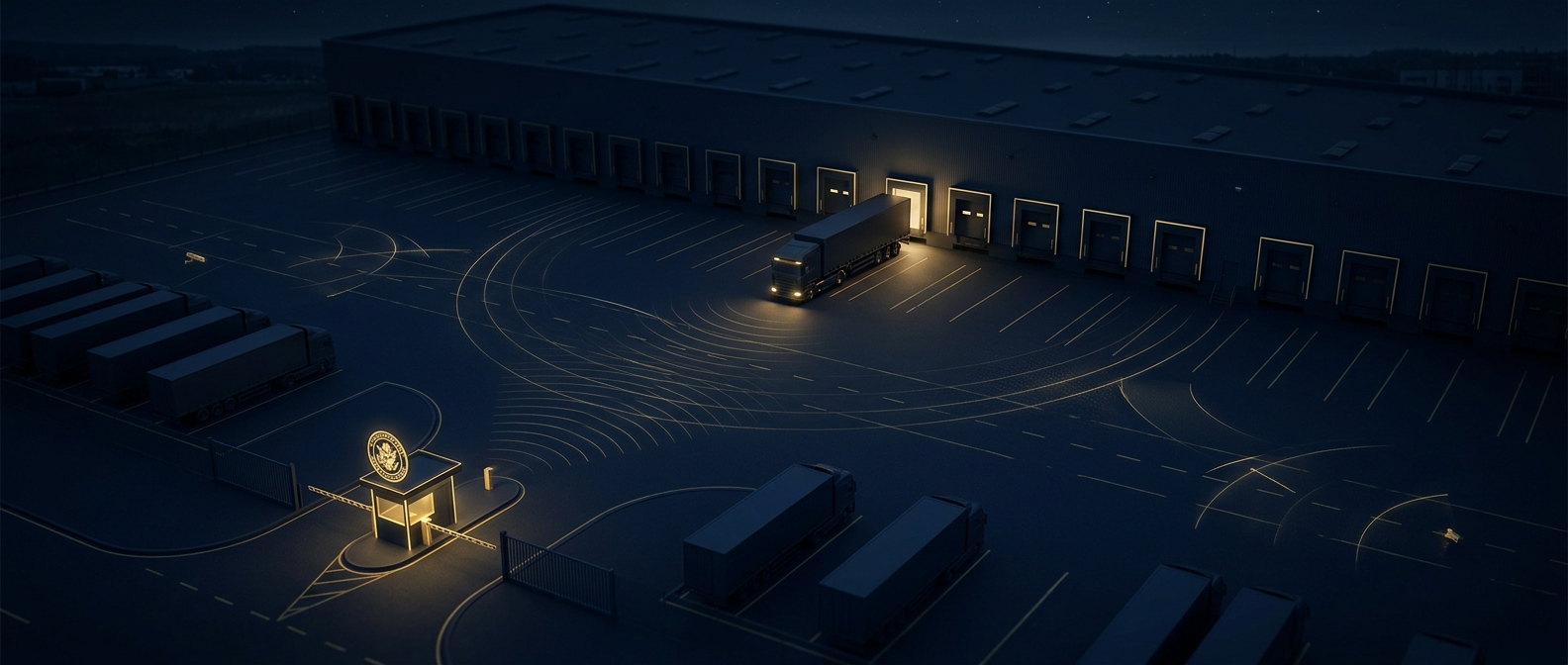
The truck yard is where the highest-value target — a fully loaded trailer — sits most exposed. Yard security depends on rigorous gate control: verifying driver identity and appointment against the manifest, recording tractor and trailer numbers, and never allowing an unscheduled or unverified vehicle to stage near the docks. Unattended loaded trailers are a signature vulnerability; leading operators use kingpin or landing-gear locks, park high-value trailers dock-side against the building, and control the yard as a secured zone rather than an open parking lot. A drop lot separated from the secured yard, with its own surveillance, keeps staged trailers from becoming a soft target.
How do you control access and stop tailgating?
Access control determines who crosses the building envelope and where they may go once inside. A credible system issues individual, revocable credentials — never shared badges — and enforces the principle of least privilege: a picker does not need access to the returns cage, IT does not need the high-value room, and a temporary worker’s credential expires automatically at the end of the assignment. Every access event is logged, giving both a live picture and an evidentiary trail.
The most persistent access failure in warehouses is tailgating — one authorized badge-in followed by several unbadged people slipping through the same door. It defeats the entire access-control investment because the logs show one entry where five people passed. Countermeasures range from procedural (a strictly enforced “one badge, one person” culture and staff empowered to challenge) to physical (turnstiles, mantraps, or speed gates at main entrances) to technological (anti-passback rules that prevent a badge from entering twice without exiting, and video analytics that detect piggybacking). High-value areas — electronics cages, pharmaceutical vaults, returns processing — warrant a second factor, such as a PIN or biometric in addition to the badge, so that a lost or cloned card alone cannot open the most sensitive space.
Why is the loading dock the highest-risk zone?
The dock is where the controlled interior meets the outside world, where goods physically change custody, and where the great majority of warehouse loss originates — through error, theft, and collusion between insiders and drivers. It deserves disproportionate attention. Dock security rests on a few disciplines executed without exception: dock doors kept closed and locked when not in active use, never propped open for convenience; a formal seal program in which every outbound trailer is sealed with a numbered, tamper-evident bolt seal, the number recorded on the bill of lading, and verified again at the gate on departure; and a documented driver-check-in process that confirms identity and appointment before a trailer is ever backed to a door.
The subtle risks live here. “Short” loads and “pilfered” cases exploit gaps between the pick, the load, and the seal. A driver who lingers unsupervised on the dock, an employee who stages extra product near an open door, or a seal verified on paper but never physically checked — each is a well-worn method. The countermeasure is procedural rigor backed by dedicated, overlapping camera coverage of every dock door and the staging lanes behind it, so that the moment a load is built, sealed, and dispatched is captured end to end and reconcilable against the paperwork.
What does effective camera coverage actually require?
Cameras are the connective tissue of the program, but coverage is where budgets are wasted. Effective video is designed to a purpose, not scattered for reassurance. Elite programs map coverage against risk: complete, overlapping views of every dock door, gate, and building entrance; coverage of high-value storage and returns; and interior views that follow the flow of goods so a case can be traced from receiving to dispatch. Resolution and placement are matched to the task — a gate camera must read a license plate and a trailer number, a dock camera must resolve a face and a carton label, and a wide-area camera provides situational context. A camera that produces unusable footage at the decisive moment is worse than none, because it created false confidence.
Equally important is what happens behind the lens. Retention must be long enough that a loss discovered at the next inventory count — often weeks later — is still on the system. Recorders must be physically secured and access-controlled so footage cannot be deleted by the very insider it might implicate. Video analytics — line-crossing, loitering, piggybacking, and after-hours motion — shift the system from passive recording toward active detection, alerting a monitor to an event as it happens rather than documenting it for a post-mortem. When footage is later needed for an investigation or prosecution, its evidentiary value depends entirely on chain of custody and export integrity, which is why the program and the investigative function must be designed together.
What role do guards and monitoring play?
Technology detects; people decide and respond. A guard force provides the judgment, deterrent presence, and physical response that no sensor can. But guarding is only as good as its direction. Warehouse guard operations are effective when they are governed by clear, written post orders — exactly what each post is responsible for, what to check, whom to admit, and how to escalate — rather than a vague instruction to “watch the place.” Gate officers verify drivers and seals; roving patrols vary their timing so they cannot be predicted and evaded; and a monitoring function — on-site or in a remote center — watches the analytics and alarms that the roving officers cannot.
The most common guarding failures are structural, not personal: officers with no real authority to challenge, no reliable communications, no defined escalation to law enforcement, and no accountability for the access and seal procedures they are supposed to enforce. A guard who waves through an unverified trailer because “the dispatcher said it was fine” has nullified the yard’s entire control layer. World-class programs integrate guards into the access, dock, and inventory disciplines rather than treating them as a separate, decorative line item — and they measure guard performance against the procedures, not merely their presence.
How does physical security integrate with inventory control?
Physical security and inventory control are two halves of the same loss-prevention system, and treating them separately is the most common program-level mistake. The warehouse management system (WMS) knows what should be on the shelf and in the trailer; the physical-security layer controls who can touch it. When the two are reconciled, discrepancies surface fast and point directly at where and when loss occurred. A cycle-count shortage in a specific location, cross-referenced against access logs and dock video for that window, converts a vague “shrink” number into an actionable lead.
Integration also enables prevention. Segregating high-value SKUs into an access-controlled cage, requiring dual verification for their picking and loading, and flagging anomalous transaction patterns — voids, adjustments, after-hours activity — turns the inventory system into a detection sensor in its own right. Because internal theft and collusion account for a large share of warehouse loss, the marriage of transaction data with physical-access and video data is often the only way to distinguish a genuine external breach from an inside job. This is precisely the seam where a firm that runs both physical security and financial and forensic investigation delivers what a guard company alone cannot.
What is C-TPAT and why does it shape warehouse security?
For any operation touching international supply chains, the U.S. Customs and Border Protection Customs Trade Partnership Against Terrorism (C-TPAT) program is the governing benchmark. C-TPAT is a voluntary public-private partnership in which importers and logistics operators adopt a defined set of Minimum Security Criteria in exchange for benefits such as reduced inspections and faster processing. Its criteria read like a blueprint for the very program described above — physical access controls, personnel security and background screening, procedural security for handling cargo, container and trailer seal integrity to the ISO 17712 standard, physical security of facilities, and security training and threat awareness.
Even for purely domestic operations that will never file for certification, the C-TPAT Minimum Security Criteria are the most useful free framework available for structuring a warehouse security program, because they translate the abstract goal of “secure the supply chain” into concrete, auditable controls. Organizations that align to them gain not only trade benefits but a defensible, standards-based posture that satisfies insurers, customers, and — should the worst happen — litigation.
Guard-only site versus a layered program: what is the difference?
Many facilities believe they are secured because they have a guard at the gate and a bank of cameras. The table below contrasts that posture with a genuine layered program so a buyer can tell which one they actually have.
| Dimension | Guard-only / cameras posture | Layered security program |
|---|---|---|
| Model | Single point of presence | Deter, detect, delay, respond across layers |
| Perimeter | Fence and a gate | Barrier, lighting, sensors, controlled yard |
| Access | Shared badges, unmonitored doors | Individual credentials, least privilege, anti-tailgating |
| Dock | Doors open for convenience | Seal program, driver check-in, dedicated video |
| Video | Cameras for reassurance | Risk-mapped coverage, retention, analytics |
| Guards | Presence without post orders | Written orders, integrated with procedures |
| Inventory | Shrink tracked separately | WMS reconciled with access and video |
| Standard | Ad hoc | Aligned to C-TPAT criteria |
How do you build the program? A seven-layer framework
A credible program is built deliberately, from a risk baseline outward. The sequence below reflects the discipline elite operators follow.
- Assess and baseline. Conduct a physical-security risk assessment of the site — threat profile, current controls, loss history, and the value and velocity of goods — and benchmark it against the C-TPAT Minimum Security Criteria to expose gaps.
- Harden the perimeter and yard. Establish barriers, clear zones, lighting, and detection at the property line; control the truck yard as a secured zone with rigorous gate verification and trailer locks.
- Lock down the envelope and docks. Secure all doors, enforce a closed-and-locked dock policy, and implement a numbered seal program with driver check-in and gate verification on departure.
- Deploy access control. Issue individual revocable credentials on least privilege, add anti-tailgating measures at main entrances, and require a second factor for high-value areas.
- Design video to purpose. Map camera coverage to risk with overlapping views of docks, gates, and high-value storage; set retention to your inventory-count cycle; secure recorders; and layer in analytics for active detection.
- Direct the guard force. Staff to written post orders, integrate officers into access and seal procedures, ensure communications and law-enforcement escalation, and measure performance against the procedures.
- Integrate inventory and monitor. Reconcile the WMS with access and video data, segregate and dual-control high-value SKUs, flag anomalous transactions, and review the program on a fixed cadence — treating every incident as a diagnostic that hardens the layer that failed.
How does Honeybadger secure warehouses and distribution centers?
Honeybadger Solutions designs and directs warehouse and distribution-center security as an integrated program, not a single service line. Our industrial and manufacturing security and commercial and corporate security practices deliver the physical program — risk assessment, perimeter and dock hardening, access-control and camera design, guard direction, and C-TPAT alignment — while our transportation and cargo security capability extends protection to the yard and the load in transit. Because our investigations and financial-forensic capabilities are handled in-house, we build programs whose own records — access logs, seal manifests, and secured video — stand up as evidence when internal theft or collusion must be proven.
Headquartered in Arizona with offices in Casa Grande, Phoenix, and Oro Valley, we serve logistics operators, retailers, and manufacturers across all of Arizona, nationwide, and internationally. Physical guarding and protective operations are delivered through our commanded, vetted-partner network — with established theaters in California, Texas, and Florida and other regions served on a mandate basis — all directed to a single, consistent program standard so that a distribution network is secured the same way in every location. We also help operators pursue and maintain security consulting engagements that keep the program aligned to evolving supply-chain requirements.
Frequently asked questions
What is the single biggest security vulnerability in a warehouse?
The loading dock, and the human procedures around it. It is where goods change custody, where insiders and drivers can collude, and where the majority of warehouse loss originates. A closed-and-locked dock policy, a numbered tamper-evident seal program verified at the gate, a disciplined driver check-in, and dedicated overlapping camera coverage of every door and staging lane address the highest-probability loss before it can occur.
How is warehouse security different from investigating a cargo theft?
A security program is preventive — the daily controls, technology, and personnel that stop loss from happening. A cargo-theft investigation is reactive — reconstructing an incident after the fact to trace goods, identify culprits, and support prosecution or insurance recovery. The best operators run a strong program so investigations are rare, and design the program so its own records become the evidence when an investigation is unavoidable.
Do we need C-TPAT certification to benefit from its criteria?
No. Certification is only relevant to operators in international supply chains seeking trade benefits. But the C-TPAT Minimum Security Criteria are the best free framework available for structuring any warehouse security program, domestic or international, because they translate “secure the facility” into concrete, auditable controls covering access, personnel, procedures, seals, physical security, and training.
How does physical security help control inventory shrink?
By reconciling the warehouse management system with physical-access and video data. A shortage in a specific location, cross-referenced against who had access and what the dock cameras recorded in that window, turns a vague shrink figure into an actionable lead. Segregating high-value SKUs into access-controlled cages with dual verification, and flagging anomalous transactions, turns the inventory system itself into a detection sensor — essential because much warehouse loss is internal.
About Honeybadger Solutions
Honeybadger Solutions is an Arizona-licensed security and investigations firm delivering intelligence-led physical security, security consulting, investigations, protection, and cyber services to logistics operators, retailers, manufacturers, and organizations nationwide and internationally. Digital forensics, cybersecurity, financial investigations, and background intelligence are handled in-house and delivered globally. Physical security and guard operations are delivered through a commanded, vetted-partner network with established theaters in California, Texas, and Florida, directed from Arizona home command.
Offices: Casa Grande (HQ), Phoenix, and Oro Valley, Arizona.
Phone: 602-725-2818
Confidential consultation: discuss a warehouse or distribution-center security program with our team.