
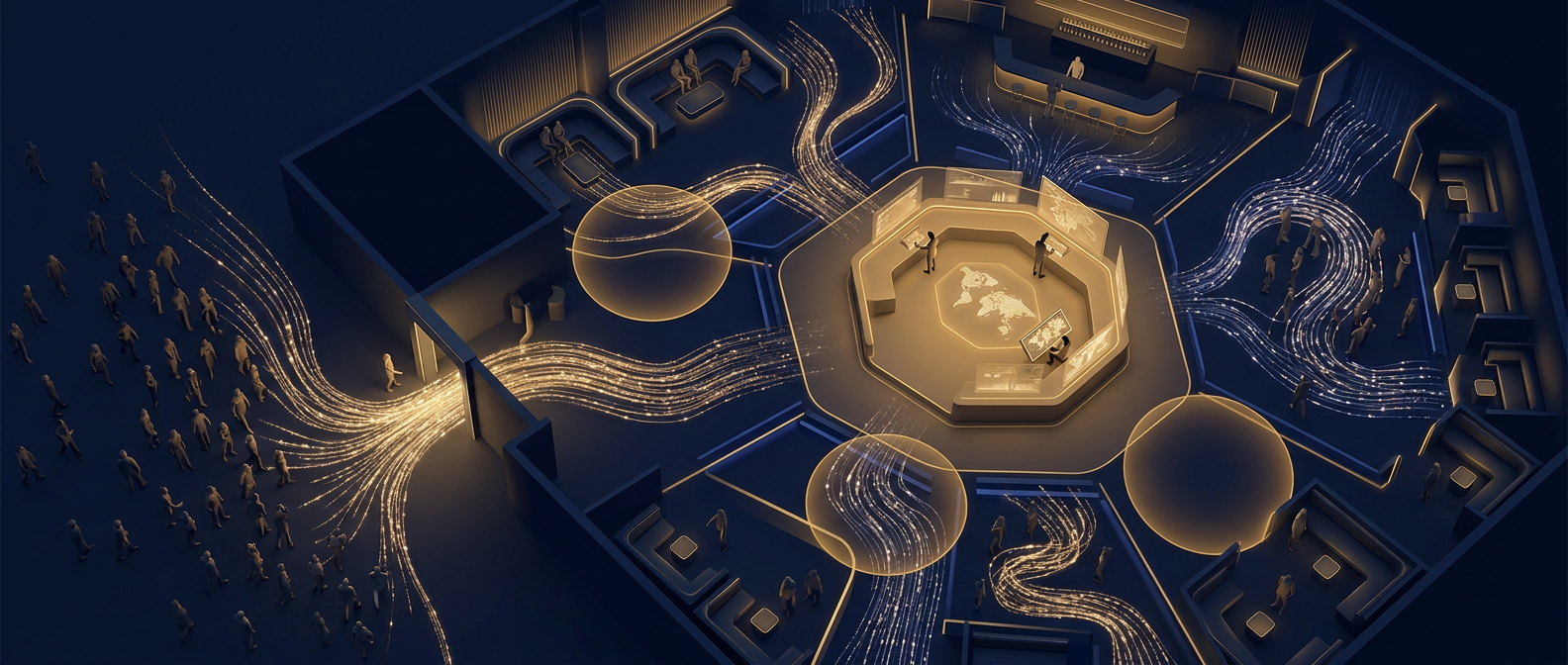
Nightclub and bar security is the disciplined management of a licensed venue’s crowd, entry, and conduct risk — combining capacity and occupancy control, professional door and ID screening, lawful and documented use of force, safe ejection procedures, rigorous incident reporting, and trained staff. Done properly it protects patrons and employees, keeps the venue defensible when an incident becomes a lawsuit, and preserves the license. Done poorly, a single mishandled ejection or overcrowded floor can end in death, litigation, and closure.
For an owner, operator, or general counsel behind a hospitality group, the security function at a nightclub or bar is not a doorman and a velvet rope — it is one of the highest-liability operational systems the business runs. Alcohol, dense crowds, late hours, cash, and the friction of hundreds of strangers in a confined space combine into an environment where the difference between a quiet night and a catastrophic one is measured in seconds and in the quality of the people at the door. The financial and reputational exposure is severe: dram-shop and negligent-security claims, wrongful-death suits from crowd crushes or ejections gone wrong, assault and battery allegations against staff, and regulatory action against the liquor license. This guide explains what elite venue security actually looks like — how capacity is managed, how the door is run, where the legal limits on force sit, how ejections and incidents must be documented, and how to build a program that performs under pressure and holds up in court.
Why is nightclub and bar security a distinct discipline?
Venue security is not corporate guarding with a different uniform. The risk profile is unique: a fluid, intoxicated, high-density crowd; a legally regulated product; a compressed window in which most incidents cluster around closing time; and a public that arrives expecting to relax, not to be policed. The security team must simultaneously deliver hospitality and enforce hard limits — welcoming paying patrons while refusing entry to the intoxicated, defusing conflict without escalating it, and removing a threat without becoming the defendant. That dual mandate, executed at 1 a.m. with hundreds of people watching and filming, is what separates trained venue professionals from hired muscle.
The stakes are also unusually legal. Assaults concentrate in and around licensed premises, and research compiled by the U.S. Department of Justice-supported Center for Problem-Oriented Policing shows that a small number of poorly managed venues generate a disproportionate share of violence — and that management practices, not just clientele, drive the difference. That is the crucial insight for an operator: violence at a venue is largely a function of how the place is run. Crowd density, wait times, intoxication management, staff conduct, and physical layout are controllable variables. A serious security program treats them as such.
How do you manage crowd capacity and occupancy safely?
Occupancy control is the single most important life-safety function in a venue, and the one most often quietly violated for revenue. Every licensed space has a maximum occupant load fixed by the fire marshal under the NFPA 101 Life Safety Code and local fire codes, calculated from floor area and the number and width of exits. That number is not advisory. Overcrowding is the mechanism behind the deadliest nightclub disasters on record — crowd crushes and blocked egress during fire or panic — and it is precisely the scenario that ends a business permanently.
Professional capacity management means a live, auditable headcount — clicker counters or electronic access counts at every entrance, netted against exits, so the number inside is known at all times, not estimated. It means holding a queue outside once capacity is reached rather than letting the floor exceed its load, keeping every marked exit and egress path clear and unlocked whenever the venue is occupied, and maintaining safe density on stairs, balconies, and near stages where crush risk concentrates. It also means planning for the surge: special events, holidays, and headline acts draw crowds that overwhelm a door built for an ordinary Friday. The discipline is unglamorous and it costs admissions on a busy night — which is exactly why the pressure to breach it is constant, and why occupancy control must sit with security, not with whoever is counting the cover charge.
What does professional door and ID screening involve?
The door is the venue’s primary filter, and most of the night’s risk is decided there. Effective screening does four things at once: it verifies age and identity, it detects and refuses intoxicated or impaired patrons, it screens for weapons and prohibited items, and it sets the behavioral tone for everyone inside. Each function carries its own exposure.
Age and identity verification protects the license directly. Serving a minor is a strict-liability trap in most jurisdictions, and a fake ID accepted at the door becomes the venue’s problem, not the patron’s. Trained door staff know the security features of legitimate identification, use ID-scanning technology where appropriate and lawful, and understand the privacy limits on retaining scanned data. Intoxication screening is the frontline of dram-shop liability — refusing entry to an already-impaired guest is far safer, legally and morally, than serving them and managing the consequences later. Weapons screening, whether by wanding, bag checks, or posted policy, must be applied consistently to withstand claims of discriminatory enforcement. And every one of these decisions must be made courteously and uniformly; selective or profiled enforcement is both an ethical failure and a lucrative target for civil-rights and discrimination claims. The best door teams turn away problems while making the admitted guest feel welcomed — a skill that is trained, not innate.
What are the legal limits on use of force, and why is documentation everything?
This is where venues are most often destroyed. Security staff at a bar or nightclub are private citizens, not police. They hold no special authority to use force; their powers derive from the ordinary law of self-defense, defense of others, and the limited privilege to remove a trespasser from private property. The universal standard is that any force used must be reasonable and proportionate to the threat, and must stop the instant the threat does. A patron who is merely refusing to leave is a trespassing problem, not a combat problem — force applied to a non-violent, non-compliant guest is the fact pattern behind a large share of six- and seven-figure judgments against venues.
Certain techniques are effectively indefensible and should be prohibited by written policy: strikes and blows to a compliant or contained person, chokeholds and neck restraints, and any prone restraint that risks positional asphyxia — holding a person face-down with weight on their back has caused deaths and is a fast route to a wrongful-death claim. The professional posture is de-escalation first, disengagement over engagement, and the minimum contact necessary to protect people. When force is genuinely unavoidable, it must be witnessed, controlled, and immediately documented.
Documentation is not paperwork — it is the venue’s defense. In the near-certain event that an altercation produces a claim, the contemporaneous incident report, the CCTV footage, the witness statements, and the record of who did what and why are what determine liability. A venue that can produce a clear, timestamped account showing trained staff acting reasonably usually prevails. A venue that produces nothing — no report, missing or overwritten footage, no witnesses — usually pays. Guidance from OSHA on workplace violence reinforces the same principle from the employee-safety side: incidents must be recorded, reviewed, and used to drive prevention. The operator’s rule should be absolute — if force was used or an injury occurred, it is documented before anyone goes home.

How should ejections be handled to reduce liability?
Ejecting a patron is one of the most dangerous routine tasks in the venue, because it combines a person who may be intoxicated and angry, a public audience, and staff under pressure to act quickly. The goal of a professional ejection is a person removed from the premises safely, lawfully, and with dignity — and a record that proves it. The removal itself is only half the problem: what happens to an ejected guest outside the door is a recognized liability, because a visibly intoxicated patron pushed onto the street and into a car creates foreseeable harm the venue can be answerable for.
A defensible ejection follows a repeatable sequence rather than an improvised scramble:
- Verbal first. A trained staff member calmly informs the guest they need to leave and offers a face-saving path to the exit. Most ejections end here when handled well.
- Escort, don’t drag. If cooperation is given, walk the guest out; contact is limited to light guidance and used only if the guest becomes a threat.
- Use numbers, not violence. The presence of multiple calm staff resolves resistance far more reliably than force by one. A second officer also serves as a witness.
- Manage the exit and the aftermath. Return belongings, do not steer an impaired guest into driving, and offer to call a ride or a cab where practical. Note refusals.
- Escalate lawfully. If the guest commits a crime or will not leave, contact law enforcement rather than escalating force. Trespass enforcement is theirs to complete.
- Document immediately. Complete an incident report with time, staff involved, reason, actions taken, witnesses, injuries, and whether police were called — and preserve the relevant CCTV before it is overwritten.
The through-line is patience over force and evidence over memory. The venues that get sued into closure are almost never the ones that ejected a patron — they are the ones that did it violently, without witnesses, and without a record.
What separates a professional venue security program from hired muscle?
The gap between a reactive door crew and a managed security program is visible in every controllable variable, and it is exactly the gap that plaintiffs’ attorneys probe after an incident. The table below contrasts the two.
| Dimension | Reactive “Bouncer” Model | Professional Security Program |
|---|---|---|
| Capacity control | Estimated; breached on busy nights | Live audited count against fire-code load |
| Use of force | Improvised; force-forward | Written policy; de-escalation first; prohibited techniques defined |
| Door screening | Inconsistent, personality-driven | Trained, uniform, privacy-aware |
| Ejections | Fast and physical | Verbal, escorted, witnessed, documented |
| Documentation | Rare or none | Incident report + preserved CCTV every time |
| Staff training | On-the-job only | Licensed, trained, certified, refreshed |
| Litigation posture | Indefensible; usually pays | Defensible record; usually prevails |
| Regulatory risk | License in jeopardy | Compliance demonstrable to authorities |
The distinction is not cosmetic. Insurers, licensing authorities, and courts all read these variables directly. A venue that can show trained, licensed staff operating under written policy with contemporaneous documentation is a fundamentally different risk than one relying on the judgment of whoever is largest at the door.
Why is incident reporting the backbone of venue risk management?
Incident reporting does two jobs. First, it protects the venue in any single dispute, as described above. Second — and this is what elite operators understand — it is a data system that reveals where risk actually lives. When every ejection, altercation, refusal, medical episode, and use of force is logged consistently, patterns emerge: a particular night, a particular door, a specific choke point on the floor, a recurring type of conflict, a staff member whose incidents cluster suspiciously. Those patterns are the roadmap for prevention. A venue that reviews its incident data monthly can redesign a queue, re-post staff, adjust drink service, or retrain a team before the next serious event, rather than after.
A useful report captures the objective essentials and nothing speculative: date and time, location within the venue, persons involved (by description and, where lawful, identity), a factual narrative of what occurred, actions taken by staff, force used and by whom, witnesses, injuries and medical response, whether law enforcement attended, and the CCTV references preserved. Reports should be completed the same night, stored securely, and treated as potential evidence — because that is exactly what they become.
How do you build a venue security program? A staff-training and operations framework
Whether a venue staffs security in-house or contracts a licensed provider, a defensible program is built on the same foundations. The following framework maps the elements a court, an insurer, or a licensing board would expect a reasonable operator to have in place.
- License and vet every officer. Confirm state security licensing where required, run background checks, and verify each staff member is legally authorized to work the door — unlicensed security is a liability multiplier.
- Publish written policy. Document capacity limits, screening standards, use-of-force rules and prohibited techniques, ejection procedure, and reporting requirements, and require sign-off from every officer.
- Train de-escalation and conflict management. Make verbal de-escalation the default response, drilled and refreshed, so force is genuinely the last option rather than the first.
- Train lawful use of force. Teach the reasonable-and-proportionate standard, self-defense limits, and safe control tactics — and expressly prohibit strikes on the compliant, chokeholds, and prone restraint.
- Drill capacity and emergency egress. Rehearse headcount discipline, evacuation, fire response, and medical and overdose response, including AED and naloxone readiness where appropriate.
- Standardize incident reporting. Deploy a single report format, require same-night completion, and integrate CCTV preservation into the closing routine.
- Coordinate with law enforcement and medical. Establish clear thresholds for calling police and EMS, and a working relationship with local authorities before an emergency, not during one.
- Review, audit, and retrain. Analyze incident data on a fixed cadence, correct patterns, and refresh training — a program that never reviews itself silently decays.
The connective tissue, again, is documentation. In hospitality security the defensible operator and the negligent one rarely differ in intention — they differ in whether the policy, the training records, the incident reports, and the footage exist to prove that reasonable care was taken.
How does Honeybadger support hospitality and event security?
Honeybadger Solutions approaches hospitality and event security as a risk-management discipline, not a headcount at the door. We help owners and operators assess a venue’s real exposure — capacity and egress, door and screening design, crowd flow, use-of-force policy, ejection procedure, incident-reporting systems, and staff training — and build a program that protects patrons and staff while standing up to the litigation and licensing scrutiny that follows any serious incident. Where an investigation is needed after the fact, our in-house investigations and CCTV and digital-evidence capabilities reconstruct what happened and preserve it properly for counsel.
Physical and event protection is delivered through a commanded vetted-partner network: threat assessment, planning, tradecraft standards, and single-point accountability are directed centrally, while licensed, jurisdiction-appropriate teams execute on the ground. Our established armed and protective theaters are California, Texas, and Florida, with Arizona as home command and other regions served on a mandate and expansion basis, scoped case by case. This gives a hospitality group one accountable partner and a consistent standard of tradecraft — reinforced by in-house security and intelligence depth — rather than a patchwork of unvetted local crews. For Arizona operators, that command capability is anchored across our Casa Grande headquarters and our Phoenix and Oro Valley offices, and extends nationwide for multi-venue and event work.
Frequently asked questions
Can bar and nightclub security legally use force on a patron?
Only within the ordinary limits of self-defense, defense of others, and the privilege to remove a trespasser — and only force that is reasonable and proportionate to the threat, stopping the moment the threat ends. Security staff are private citizens with no police powers. Force against a non-violent, non-compliant guest, strikes on a contained person, chokeholds, and prone restraint are effectively indefensible and are the leading cause of large judgments against venues.
What is the most common cause of nightclub security lawsuits?
Excessive force during ejections and negligent-security claims, closely followed by overcrowding and over-service. The pattern that repeats is a violent or improvised ejection with no witnesses and no record. Venues that de-escalate, use numbers over force, and produce a contemporaneous incident report and preserved CCTV usually prevail; those with no documentation usually pay.
How is safe capacity determined for a venue?
Maximum occupant load is fixed by the fire marshal under the Life Safety Code and local fire codes, based on floor area and the number and width of exits. It is a hard legal limit, not a target. Professional venues maintain a live, audited headcount against that number, hold a queue outside once it is reached, and keep every marked exit clear and unlocked whenever occupied.
Why does every venue incident need to be documented?
Because incidents become claims, and the contemporaneous record decides them. A timestamped incident report, preserved footage, and witness statements showing trained staff acting reasonably are the venue’s defense. Documentation also functions as data: reviewed regularly, it reveals the recurring times, doors, and choke points driving risk, letting operators prevent the next serious event rather than react to it.
About Honeybadger Solutions
Honeybadger Solutions is an Arizona-licensed security and investigations firm delivering intelligence-led hospitality and event security, protection, investigations, and cyber services to venues, operators, and organizations nationwide and internationally. Physical and event protection is delivered through a commanded vetted-partner network with established theaters in California, Texas, and Florida, directed from Arizona home command. Digital forensics, cybersecurity, financial investigations, and background intelligence are handled in-house and delivered globally.
Offices: Casa Grande (HQ), Phoenix, and Oro Valley, Arizona.
Phone: 602-725-2818
Confidential consultation: discuss a venue security assessment or program review with our command team.