
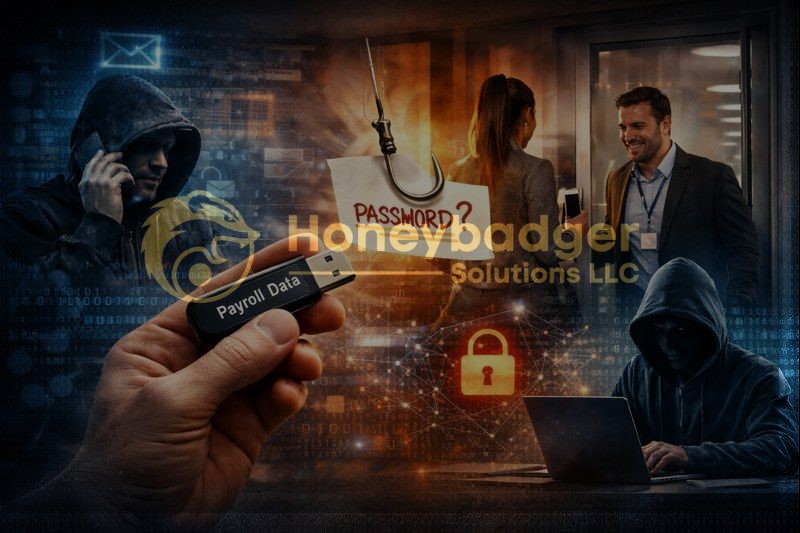
Social engineering bypasses your firewall by attacking the one control no patch can harden: human judgment under pressure. Phishing, vishing, smishing, pretexting, business email compromise, and physical tailgating all exploit trust, urgency, and authority rather than software flaws. The defense is not a single tool — it is layered verification protocols, phishing-resistant MFA, a no-blame reporting culture, and recurring red-team testing that proves the controls actually hold.
Every dollar an organization spends hardening its network perimeter is undermined the moment an employee reads a caller ID, sees a familiar logo, or hears a voice that sounds like the CEO, and simply complies. Attackers know this. They have shifted the center of gravity of intrusion away from exploiting code and toward exploiting people, because people are cheaper to compromise, harder to patch, and available around the clock. A firewall does not know the difference between a legitimate password reset and one an attacker just talked an employee into performing.
At Honeybadger Solutions, our in-house cybersecurity and digital forensics practice investigates the aftermath of these intrusions nationwide and, just as often, is engaged before the intrusion happens — to test, train, and harden the human attack surface. This guide reflects how social engineering is actually executed against real organizations, and what separates a workforce that catches the attempt from one that becomes the headline.
What Is Social Engineering, and Why Does It Bypass Every Firewall You Own?
Social engineering is the deliberate manipulation of a person into taking an action — clicking a link, reading back a code, wiring funds, holding open a door — that a rational security policy would forbid. It works because it targets cognitive shortcuts that make people functional at work: the instinct to help a colleague, the reluctance to challenge someone who sounds senior, the reflex to resolve urgency quickly. None of those instincts are flaws. They are exactly what makes a workforce productive, and attackers weaponize that productivity against the organization that depends on it.
Technical controls — firewalls, endpoint detection, email filtering — are built to recognize malicious code, anomalous traffic, and known-bad indicators. A social-engineering attack often contains none of these. A phone call has no malware signature. A convincing email from a spoofed domain can pass every authentication check if the attacker has done their homework. The intrusion succeeds not because the perimeter failed, but because the perimeter was never the target. The target was a person authorized to do exactly what the attacker asked.
This is why the U.S. Cybersecurity and Infrastructure Security Agency treats social engineering as a distinct, primary initial-access category rather than a subset of malware delivery — and why CISA’s guidance on recognizing and reporting phishing focuses on behavioral tells rather than technical signatures. The fix cannot be purely technical either. It has to be procedural, cultural, and continuously tested.
How Do Phishing, Vishing, and Smishing Actually Work?
These three terms describe the same manipulation delivered over three different channels — email, voice, and SMS — and elite attackers move fluidly between them within a single campaign.
Phishing remains the volume workhorse: mass emails impersonating a bank, a vendor, or an internal system, engineered to harvest credentials or deliver a payload. Spear phishing is the targeted variant — the attacker researches a specific employee’s role, manager, vendors, and recent public activity (LinkedIn changes, press releases, conference attendance) to craft a message that references real, verifiable details. A spear-phishing email referencing an actual upcoming audit, a real vendor invoice number, or a manager’s real travel schedule bypasses the skepticism that generic phishing triggers immediately.
Vishing (voice phishing) moves the attack to the phone, where tone, urgency, and perceived authority do work that text cannot. A caller posing as IT support, a bank fraud department, or a company executive can walk a target through disabling a security control in real time, adapting the script the instant the target hesitates — something a static email can never do. Increasingly, vishing campaigns are paired with synthetic voice tools that mimic a known executive’s cadence; while voice-cloning fraud is its own emerging threat category, the underlying defense is identical to any vishing scenario: never take a verbal instruction to move money, reset credentials, or grant access at face value, regardless of how convincing the voice sounds.
Smishing (SMS phishing) exploits the fact that mobile messaging carries an implicit trust text-based fraud filters rarely catch. A text claiming to be a delivery notification, a multi-factor authentication code request, or an HR portal alert routes the target to a spoofed login page optimized for a small screen, where subtle URL discrepancies are far harder to notice than on a desktop browser.
What Is Pretexting, and Why Is It the Most Dangerous Technique?
Pretexting is the construction of a false scenario — a pretext — convincing enough that the target voluntarily supplies information or access without ever being asked to do anything that feels like a security violation. Where phishing relies on a single moment of deception, pretexting is a performance: the attacker researches the organization, builds a plausible identity (a new vendor contact, an auditor, an internal IT technician, a job candidate), and sustains that identity across multiple interactions to earn trust incrementally.
Elite pretexting operations, of the kind used in professional penetration testing and by sophisticated criminal actors alike, follow a reconnaissance-first discipline: mapping the org chart from public sources, identifying who reports to whom, learning internal jargon and vendor names from job postings and press releases, and timing outreach to moments of legitimate organizational stress — a merger, a system migration, a holiday weekend when senior staff are unreachable. The pretext is dangerous precisely because it rarely asks for anything alarming on its own; it asks for one small, reasonable-sounding thing, then another, until the cumulative disclosure is severe.
This is why credential requests, password resets, and access changes are consistently the highest-value pretext targets, and why the strongest defense is a hard rule with no discretionary exceptions: sensitive actions require verification through a channel the requester does not control, every time, regardless of how senior the requester claims to be.
How Does Business Email Compromise Turn a Single Message Into a Six-Figure Loss?
Business email compromise (BEC) is the financial endgame of social engineering: an attacker impersonates an executive, vendor, or trusted partner — often from a compromised or lookalike email account — to redirect a wire transfer, alter payroll direct-deposit details, or authorize a fraudulent invoice payment. Unlike ransomware, BEC leaves no encrypted files and often no malware at all; the entire “attack” can consist of a single, well-timed email that reads exactly like a normal business request. The FBI’s Internet Crime Complaint Center (IC3) has consistently identified BEC as one of the costliest categories of reported cybercrime, precisely because the average loss per incident is so high relative to the minimal technical effort required.
The table below summarizes how the major human-attack-surface techniques differ in channel and intent, because the correct defensive control depends entirely on which vector is in play.
| Technique | Primary Channel | Typical Pretext | Frontline Defense |
|---|---|---|---|
| Phishing / Spear Phishing | Invoice, password reset, executive request | Email filtering + link inspection + reporting habit | |
| Vishing | Phone / voice | IT support, bank fraud dept., executive urgency | Callback to a known number, never the caller’s |
| Smishing | SMS / text | Delivery alert, MFA code, HR notice | Never tap links in unsolicited texts; verify in-app |
| Pretexting | Any / sustained | Vendor, auditor, new hire, IT technician | Identity verification independent of the claimed role |
| Business Email Compromise | Executive wire instruction, vendor bank-detail change | Dual authorization + out-of-band voice confirmation | |
| Physical Tailgating | In-person | Delivery, contractor, forgotten badge | Badge-only entry culture; no exceptions, no embarrassment |
Note what every “frontline defense” column has in common: verification through an independent channel. That single principle, applied consistently, defeats the overwhelming majority of social-engineering attempts regardless of how the pretext is delivered.
Why Do Attackers Still Walk Through the Front Door?
Physical tailgating — following an authorized employee through a badge-controlled door without presenting credentials — remains one of the highest-yield, lowest-tech intrusion techniques available, because it exploits ordinary courtesy rather than any digital vulnerability. An attacker carrying a delivery box, wearing a plausible contractor uniform, or simply walking briskly and confidently behind a group of employees relies on the fact that most people find it socially uncomfortable to challenge a stranger, especially one who appears to belong.
Once inside, the physical attack surface is enormous: unattended workstations, visible whiteboards with project details, unlocked server closets, and network jacks in conference rooms that may not be segmented from production systems. A tailgating intrusion can end in a planted device on the internal network, a photographed document containing credentials, or simply enough reconnaissance to make a subsequent pretexting call devastatingly convincing — “I was just in your Phoenix office yesterday with the facilities team” is a sentence that opens doors, literally and figuratively.
Arizona organizations that maintain staffed reception, escorted-visitor policies, and access-controlled facilities close this gap structurally. Honeybadger Solutions’ own licensed in-house Arizona security personnel routinely identify tailgating exposure during site assessments — unmonitored rear entrances, propped fire doors, loading docks without visitor logs — that no amount of network hardening would ever surface, because the vulnerability was never digital to begin with.

What Does a Defensible Human Firewall Actually Look Like?
No single control stops social engineering. A defensible program layers seven disciplines, each closing a gap the others cannot:
- Recurring, realistic training — simulated phishing, vishing, and pretext exercises delivered continuously, not an annual slideshow, with results tracked by team and role rather than treated as a pass/fail compliance box.
- Out-of-band verification protocols — any request to move money, reset credentials, or change payment details must be confirmed through a pre-established channel the requester does not control, such as calling a known number back rather than the number provided in the message.
- Dual authorization on financial changes — wire transfers and vendor bank-detail updates require a second, independent approver with authority to say no, eliminating the single-point-of-failure that BEC exploits.
- Phishing-resistant multi-factor authentication — FIDO2 hardware keys or passkeys for privileged accounts, since SMS and push-based MFA can themselves be socially engineered through fatigue attacks or real-time relay.
- Physical access discipline — badge-only entry with a genuinely enforced no-exceptions culture, visitor escort policies, and staffed reception at every public-facing door.
- A no-blame reporting culture — employees who click a bad link or fall for a pretext must be rewarded for reporting it within minutes, not punished, because the cost of a hidden incident always exceeds the cost of an early one.
- Independent penetration testing and red-teaming — scheduled, unannounced tests of the exact vectors above, because a policy that has never been tested against a skilled adversary is a hypothesis, not a control.
The seventh discipline is where most programs quietly fail. Training materials and written policy documents can look complete on paper while the actual workforce — under real pressure, from a real stranger on the phone — behaves very differently.
How Do Social-Engineering Penetration Tests and Red-Team Exercises Expose Real Gaps?
A social-engineering assessment does what a compliance checklist cannot: it applies genuine adversarial pressure to the human attack surface under controlled, authorized, and legally scoped conditions, then documents exactly what broke and why. A competent engagement typically combines several test vectors — simulated phishing and vishing campaigns against a representative employee sample, an authorized pretexting attempt against helpdesk or reception staff, and, where scoped, a physical tailgating and badge-access assessment of the facility itself.
The value is not in proving that some employee, somewhere, can be fooled — given enough time and creativity, that is almost always true and is not the point of the exercise. The value is in identifying systemic gaps: a helpdesk that resets passwords without independent identity verification, a reception desk with no visitor-escort enforcement, an absence of any internal reporting mechanism for suspicious contact, or a leadership team whose own behavior undermines the policy it publishes. These are process failures, not individual ones, and they recur predictably until an organization tests for them deliberately rather than discovering them after a loss.
Honeybadger Solutions’ security consulting practice designs these engagements to be diagnostic rather than punitive — the deliverable is a prioritized remediation roadmap addressed to leadership, not a list of employee names, because the failures that matter live in the process, not in any one person’s judgment on a given afternoon.
What Should You Do in the First Hours After a Suspected Social-Engineering Incident?
Speed and sequence both matter. First, isolate: if credentials, MFA, or a financial channel may be compromised, disable or reset them immediately through a verified administrative path, not through the same channel the attacker used. Second, freeze: if a wire transfer or payment change is suspected, contact the receiving and sending financial institutions within minutes — recovery windows for fraudulent wires close fast, often within hours. Third, preserve: capture the original email headers, call logs, SMS content, or physical access logs before anyone “cleans up” the evidence, since chain-of-custody integrity determines whether the incident can later be attributed, reported to law enforcement, or pursued for recovery. Fourth, engage a professional digital forensics and investigations team to determine the full scope — what was actually accessed, whether the intrusion is isolated or part of a broader compromise, and what regulatory or client-notification obligations may follow.
Organizations that have already rehearsed this sequence through tabletop exercises consistently outperform those experiencing it for the first time live, because every minute spent deciding who is authorized to act is a minute the attacker does not have to spend.
Frequently Asked Questions
What is the single most effective defense against social engineering?
Mandatory out-of-band verification for any request involving money, credentials, or access — confirmed through a channel the requester does not control — stops the largest share of successful attacks, because it removes the attacker’s ability to control the entire interaction.
Can technology alone stop phishing, vishing, and pretexting?
No. Email filtering, phishing-resistant MFA, and endpoint controls meaningfully reduce exposure, but every documented major social-engineering loss involved a person taking an action the technology could not itself prevent. Technology narrows the target; trained people and verification protocols close the remaining gap.
How often should a business run social-engineering penetration tests?
At minimum annually, with simulated phishing and vishing exercises running continuously throughout the year. How those simulations should be scored and measured, and why report rate matters more than click rate, is covered in our guide to phishing awareness training that actually reduces clicks. Organizations handling wire transfers, sensitive client data, or regulated information should scope a full-spectrum test — phishing, vishing, pretexting, and physical tailgating — at least twice a year and after any significant organizational change.
What should we do if we suspect our organization was socially engineered?
Immediately reset any potentially exposed credentials through a verified path, contact your financial institution if money movement was involved, preserve all logs and communications without alteration, and engage a professional investigations team before drawing conclusions. Honeybadger Solutions can be reached at Book online.
About Honeybadger Solutions
Honeybadger Solutions is an Arizona-licensed security and investigations firm delivering social-engineering testing, digital forensics, cybersecurity, financial investigations, and background intelligence to clients across Arizona, nationwide, and internationally. Our in-house cyber and forensics practice is remote-by-design and maintains rigorous chain-of-custody standards for every engagement. We operate from three Arizona offices — Casa Grande (headquarters), Phoenix, and Oro Valley — with licensed in-house personnel conducting physical security and facility assessments statewide, and a commanded vetted-partner network extending physical capability into established theaters beyond Arizona.
Book a consultation online to schedule a social-engineering risk assessment, red-team exercise, or a confidential consultation following a suspected phishing, vishing, pretexting, business email compromise, or physical intrusion incident.
Browse by topic
Security guard services · Private investigations · Cybersecurity · Digital forensics · Financial fraud investigation · Executive protection · All articles